Palantir CTO Says AI Is Fueling a Blue-Collar Productivity Boom — Sanders Calls for Data Center Moratorium
Palantir CTO Shyam Sankar says AI is driving a productivity boom for blue-collar workers in manufacturing and healthcare, accelerating hiring, shortening training, and boosting on‑the‑job productivity — a direct counterpoint to Senator Bernie Sanders’s warnings.
- AI-driven productivity: Palantir CTO Shyam Sankar told Fox Business that AI is improving productivity for factory workers, nurses and technicians and is leading to more hiring and faster training.
- Concrete examples: Sankar pointed to manufacturers adding shifts and to healthcare staff spending more time on patient care thanks to AI tools and scheduling systems.
- Policy clash: Senator Bernie Sanders warned in a video posted on X that AI could eliminate “millions of jobs” and called for a moratorium on new data centers; media coverage is summarized in Fox Business.
- Deployment vs. infrastructure: Sankar argued the U.S. is over-investing in data centers and under-investing in deployments that help workers, a point he elaborates in his essay “Technology is the problem”.
Sankar: AI boosting blue-collar productivity
Shyam Sankar, Palantir’s CTO, framed AI as a tool that helps frontline workers do more with the time they have. On Fox Business’s “The Bottom Line”, he said AI is streamlining tasks such as production planning and labor scheduling so workers can spend more time building parts and solving problems on the shop floor.
Sankar argued the real gains are not for software engineers alone but for blue-collar jobs — the factory floor, warehousing, and healthcare. He described this as an “AI blue-collar jobs” effect, where tools help workers be more productive and create room for more hiring, not less — a theme also noted in industry republishing like Moomoo.
Real-world examples: factories, healthcare and training
Manufacturing: Sankar pointed to a manufacturing client that used AI-driven scheduling to make a third shift profitable, leading to new hires and expanded production capacity in the United States. He said AI helped balance production lines and improve labor utilization, consistent with Palantir-style deployed systems noted by analysts at MLQ.
Healthcare: According to Sankar, AI reduced the time nurses spend on data collection, freeing ICU staff to focus on direct patient care and life‑saving interventions.
Training and workforce entry: Sankar highlighted that Panasonic Energy cut apprenticeship time for battery technicians from three years to three months by applying modern tools and targeted curricula — a shift reported elsewhere that allowed hiring from other industries.
Sankar’s critique of U.S. AI strategy
Sankar warned that U.S. policy focuses too much on “supply-side” investments such as building data centers, rather than on “demand-side” deployments that directly raise worker productivity and wages. He said money and attention are concentrated on infrastructure that benefits a few, while less is done to ensure AI delivers value for everyday workers — a theme he expands on in his essay.
His argument is twofold: properly applied AI can create Palantir-style productivity wins on the factory floor, and policy should encourage deployments that generate broad economic benefits. Sankar has supported initiatives like the so-called “Genesis mission” aimed at better balancing AI investment and impact.
Sanders: moratorium and mass-unemployment warning
Senator Bernie Sanders presented a starkly different view. In a video posted to X, Sanders warned that AI and robotics could wipe out “millions of jobs” and drive “massive unemployment,” leaving many people without income. Media coverage of his remarks appeared in Fox Business.
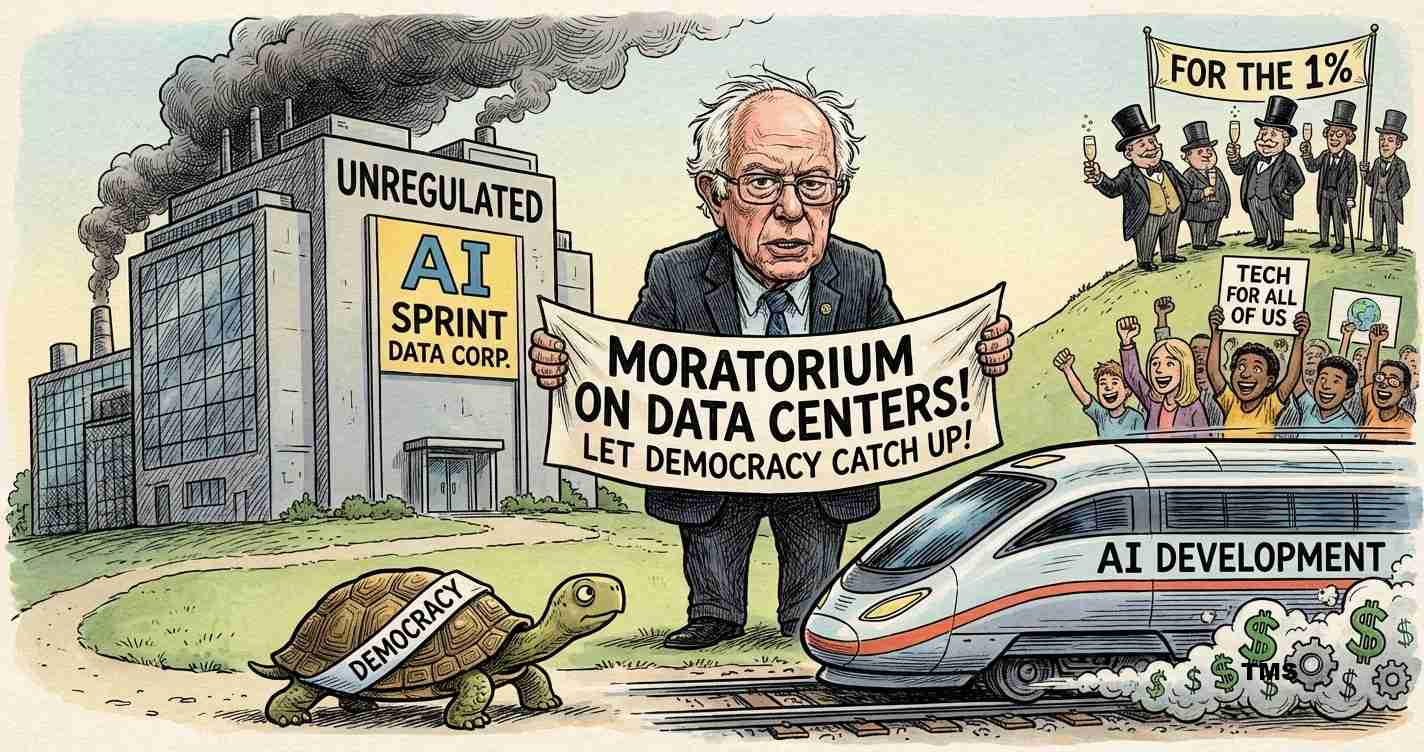
“A moratorium on new data centers” — Sanders argued that a pause in data center construction would slow an “unregulated sprint” to scale AI and give democracy time to catch up while regulators devise rules to ensure benefits reach ordinary Americans.
Evidence and limits in the public record
Sankar’s claims draw on case studies and customer accounts that show productivity gains and new hiring in certain operations. Reporting notes examples from manufacturing and healthcare and cites the Panasonic Energy apprenticeship change as a training success (coverage summarized in Fox Business and a republished piece on Moomoo; production-line balancing is discussed by MLQ).
Limits: Public data remain mixed on whether AI will net-create jobs nationwide, replace them, or change job content. The cited examples are illustrative and limited in scope; independent confirmation from the referenced companies was not included in the reporting.
Sankar dismissed fears of AI-induced unemployment as “propaganda” from tech hubs, urging policy to focus on practical deployment that benefits workers; Sanders counters that without stronger rules, scale could concentrate gains and hollow out opportunities for many.
Implications for the United States
Economic impact: If Sankar’s examples scale, AI could boost productivity in manufacturing, logistics and health care and make some U.S. factories more profitable — potentially attracting onshore investment and expanding shifts. Policymakers should weigh targeted incentives that encourage firms to deploy AI in ways that expand hiring and wages (reporting).
Political consequences: The debate presents two paths: encourage deployment and worker-focused training to translate AI gains into middle-class jobs, or follow Sanders’s restraint approach — a moratorium on data center construction to slow AI until regulation can catch up (Sanders video).
Social and regional effects: Faster training and clearer on-the-job tools could help displaced workers re-enter the workforce sooner. Sankar’s Panasonic example suggests retooling apprenticeship and community-college efforts could scale transitions in places like Reno where battery and EV supply chains are growing (coverage).
Practical applications: Companies can use AI for scheduling, production-line balancing, and accelerated training. Business leaders and policymakers should focus on demand-side deployments that increase worker productivity and wages rather than only expanding infrastructure (Sankar’s essay; MLQ).
Reporting notes and sources
- Fox Business: AI fuels blue-collar productivity boom across manufacturing — Palantir technology chief tells Fox Business
- Moomoo news repost: AI revolution, mass unemployment? Palantir CTO: AI is driving a blue-collar productivity boom
- Shyam Sankar: “Technology is the problem” (personal commentary)
- MLQ analysis: Palantir production line balancing example
- Sanders video short on X (YouTube repost)