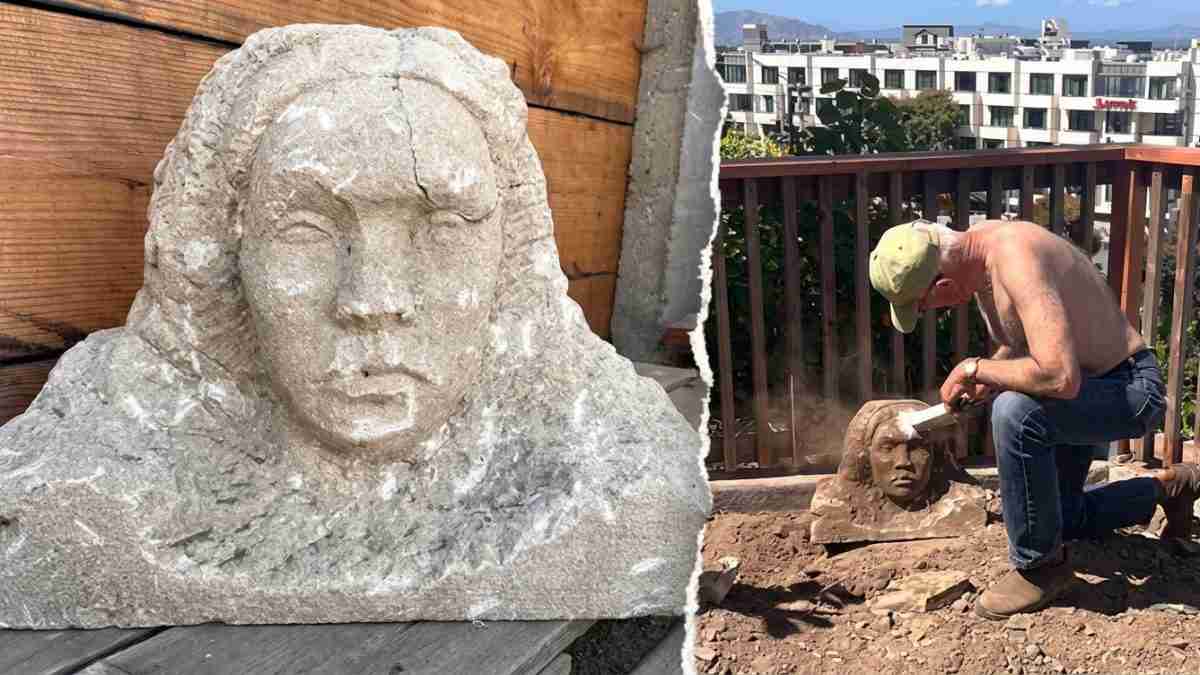
SAN FRANCISCO, Aug. 30 (San Francisco News Online) — A San Francisco couple digging in their Russian Hill backyard uncovered a 150-pound limestone bust of a woman, opening a mystery that reaches into the city’s history as an arts center.
Greg Gatwood said he first thought his shovel had struck concrete or the footing of a fence post. He used a pickaxe to free the object in May 2026, according to accounts he and his partner, artist Judy Gittelsohn, gave to news organizations.
The sculpture is about 22 inches wide, 18 inches high and 10 inches deep, the couple told the Los Angeles Times and Smithsonian magazine. It shows a woman’s head and neck rising from a rectangular base.
But no one has yet identified its sculptor, determined when it was made or explained why it was buried.
What is known about the sculpture?
The object is made of limestone and weighs about 150 pounds. Gittelsohn said its level of craftsmanship suggests it was made by a trained artist rather than an amateur.
“It was done by someone with a sophisticated skill level. It was not created by a hobbyist,” Gittelsohn told Smithsonian.
She believes the bust may date to the 1930s, based on its style. That is an estimate, not an established date. The couple has contacted roughly 50 scholars, historians, curators and other art experts in an effort to identify the work.
“I have spoken to close to 50 people, and nobody knows anything about it,” Gittelsohn told Smithsonian.
The research has produced possibilities, but no attribution. Gittelsohn has suggested that the sculpture could have been made by an artist connected to the Works Progress Administration, a federal arts and public-works program during the Great Depression. She also believes it may have been created by a student of San Francisco sculptor Ralph Stackpole.
Neither theory has been confirmed.
Why does the neighborhood matter?
The discovery took place in a neighborhood with a possible connection to San Francisco’s art-school history. The couple’s house was reportedly built in 1948 on what had previously been an undeveloped lot. Across the street stood a building that housed the sculpture department of the California School of Fine Arts, later known as the San Francisco Art Institute.
Stackpole taught sculpture at the school from 1918 to 1941, according to the Los Angeles Times. That history has led the couple to wonder whether a student, instructor or visitor could have been connected to the buried bust.
The former school’s presence across the street makes the theory plausible enough to investigate, but it does not establish a link. No supplied record identifies the bust, its maker or the person who buried it.
Could it be connected to the 1939 world’s fair?
Historian Anne Schnoebelen, vice president of the Treasure Island Museum board, offered another possible connection: the 1939 Golden Gate International Exposition, held on Treasure Island in San Francisco.
Schnoebelen said the bust could possibly relate to the fair’s Court of Pacifica. She mentioned Adaline Kent, Helen Phillips and Sargent Claude Johnson as artists who might be relevant to that line of inquiry.
Schnoebelen also emphasized that there is no evidence tying the sculpture to a particular artist or period. Her comments, like Gittelsohn’s theories, are possibilities rather than an art-historical attribution.
The Golden Gate International Exposition ran from 1939 into 1940 and featured art, architecture and displays that reflected San Francisco’s civic ambitions at the time. A confirmed connection would place the bust within a significant chapter of the region’s cultural history. So far, however, no fair catalog entry or other documentation supplied in the reports links the object to the exposition.
What happens next?
The couple plans to keep researching the sculpture. Reports have also described plans for a public display at the American Messenger Gallery in September 2026, although the exact date and arrangement have not been confirmed. Another account said Gatwood was building a pedestal for the bust in the couple’s garden.
A public showing could give San Francisco’s art community another chance to study the work and recognize its style, materials or subject. Until records, conservation work or expert analysis provide more evidence, the bust remains what the couple first found: a substantial piece of unidentified art beneath a backyard that had held its secret for decades.