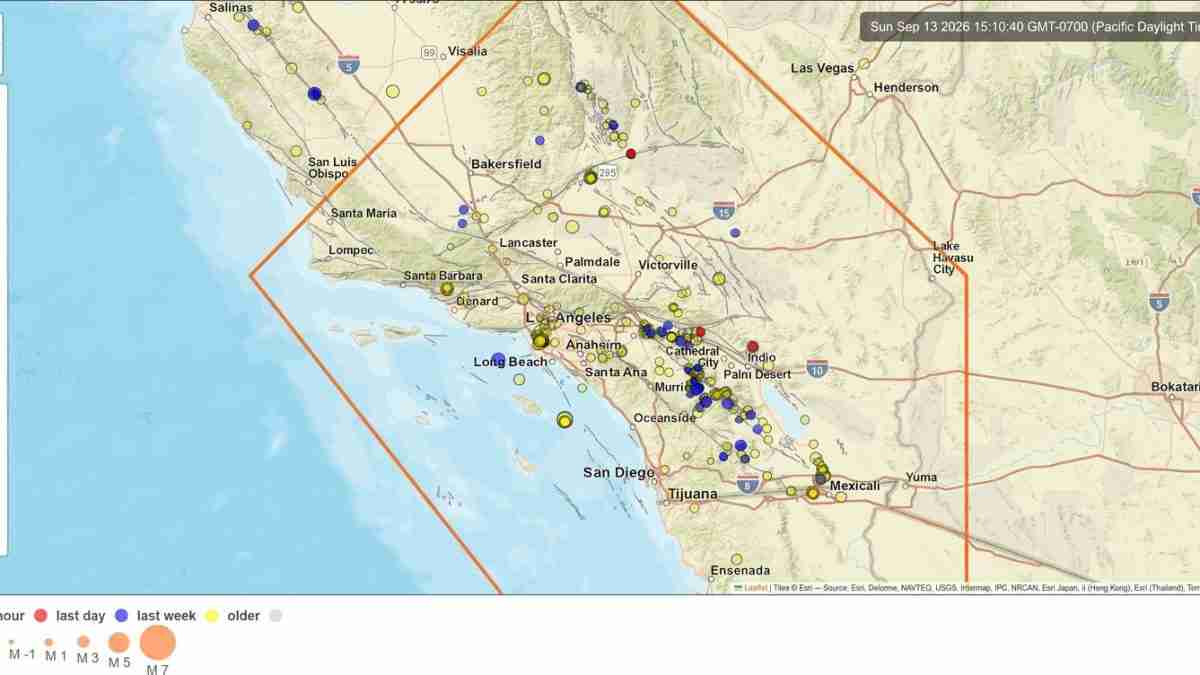
SOUTHERN CALIFORNIA, Sept. 14 (Our California Times) — A cluster of small earthquakes shook parts of Southern California over slightly more than 18 hours, with activity reported from about 8 p.m. Friday to 2:30 p.m. Saturday, according to earthquake records attributed to the U.S. Geological Survey.
The events were concentrated near Lennox and Westmont in South Los Angeles. Reported magnitudes ranged from 1.0 to 2.7. People in communities including Hawthorne, Inglewood, Crenshaw, Huntington Park, Bell, West Adams, Mid-City and Gardena reported light shaking.
The episode is commonly described as an earthquake swarm. That term generally means a series of earthquakes occurring close together in time and location, without one clearly dominant mainshock.
How many earthquakes were recorded?
The reported total varies. Some accounts describe dozens of earthquakes, while others cite 90 or 93 events. Other counts include more than 60 or more than 80 earthquakes in a wider Southern California area.
Those figures may not describe exactly the same group of events. The accounts do not establish that they used identical geographic boundaries, time periods, magnitude cutoffs or versions of the USGS earthquake catalog.
The most consistent details are the location around Lennox and Westmont, the roughly 1.0-to-2.7 magnitude range and the sequence’s duration of more than 18 hours.
Was the Newport-Inglewood Fault Zone responsible?
The swarm occurred near the Newport-Inglewood Fault Zone, a fault system that crosses the Los Angeles region and extends toward Newport Beach before continuing offshore, according to background analysis based on USGS data.
But the available information does not confirm that the earthquakes occurred directly on a mapped section of that fault. It also does not identify the specific fault or underground structure that produced the sequence.
That distinction matters. A location near a fault zone does not, by itself, establish that the fault caused an earthquake. More detailed analysis of earthquake locations and depths would be needed to connect the events to a particular fault segment.
Does the swarm signal a larger earthquake?
The reported data do not establish that the swarm changed the region’s earthquake risk or forecast a larger earthquake. No official hazard assessment, forecast, injury report or property-damage report was identified in the available information.
Small earthquake sequences are monitored because they can provide information about activity beneath an area. But this episode alone does not show that a major earthquake is imminent, nor does it prove that the Newport-Inglewood Fault Zone has become more dangerous.
A separate report linked a magnitude 3.2 earthquake near Compton to the same fault zone days earlier. The available information does not include a direct USGS record or enough detail to verify whether that event was part of the same sequence.
What is known with confidence?
The strongest finding is that Southern California experienced a concentrated burst of small earthquakes near Lennox and Westmont. The largest reported event in the cluster measured magnitude 2.7, and some residents felt light shaking.
The event count is less certain because the reported totals differ. The connection to the Newport-Inglewood Fault Zone is also not confirmed beyond the swarm’s proximity to the broader fault system.
This is an earthquake-catalog report, not the result of a peer-reviewed study. The available material identifies no named researchers, formal methodology, confidence intervals or replication analysis for the sequence.