NEWPORT, VERMONT, July 25 (Nationwide Times) — Researchers say they have identified the first known freshwater transmissible cancer in fish, after finding that brown bullhead catfish in Lake Memphremagog carry melanomas that appear to spread from fish to fish.
The finding comes from a study published in Nature by scientists at the University of Vermont, the Vermont Department of Fish and Wildlife and the U.S. Geological Survey. Because the paper appears in a peer-reviewed journal, the researchers say the work has gone through formal review, but the study still leaves key questions unanswered, including exactly how the cancer spreads.
What did the researchers find?
The team studied brown bullhead catfish in Lake Memphremagog, a border lake shared by Vermont and Quebec that is a drinking-water source for about 175,000 people.
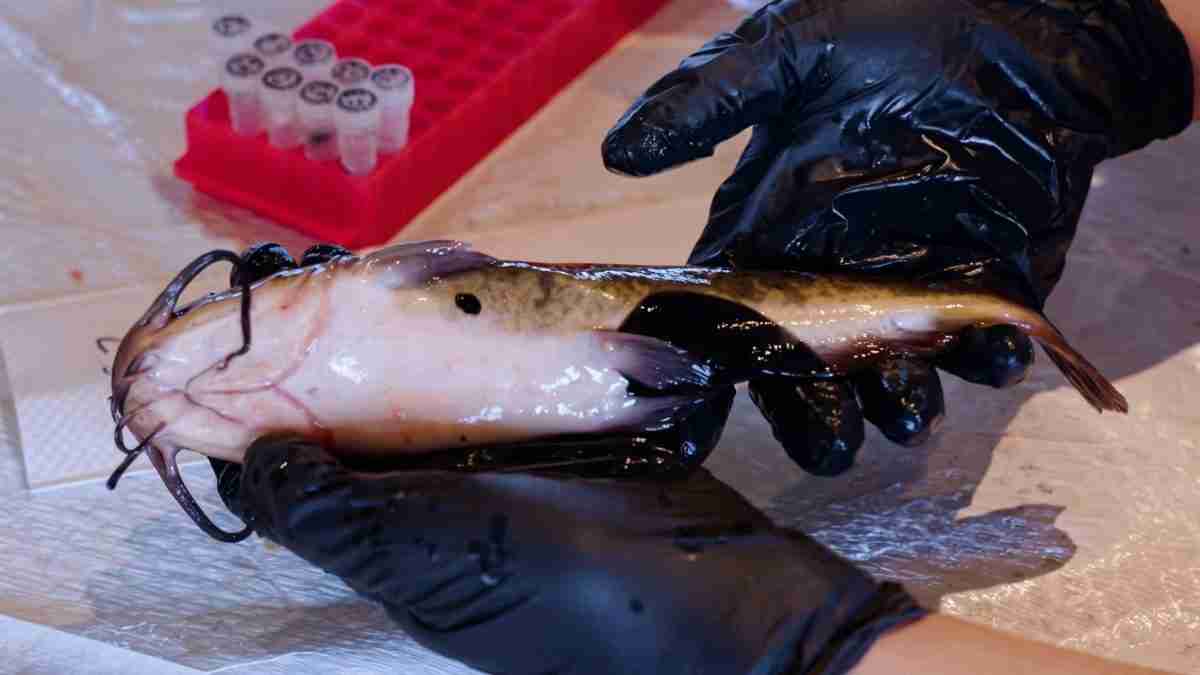
They reported that the fish had raised black skin lesions that turned out to be melanomas, or skin cancers. The researchers said the tumor cells were more closely related to one another than to the fish carrying them, which is the pattern expected if the cancer is clonal — meaning the cancer cells all came from one original line and spread to new animals.
In plain terms, the cancer seems to be the disease itself moving between fish, not just a series of separate cancers that happened to develop in the same species.
How common was it?
According to the study, anglers and biologists first began noticing more of these black lesions around 2012. In surveys carried out from 2014 through 2017, researchers found lesions or growths in roughly 23% to 37% of sampled brown bullhead catfish.
That means the problem was not rare in the lake population the scientists examined. Still, the study does not show that every fish in the lake is infected, and it does not provide evidence that the cancer has spread beyond this one body of water.
How do scientists know it is contagious?
The evidence comes from the genetics of the tumors. The researchers said the cancer cells were so similar to each other that they looked like copies of one another, rather than cancers that formed separately inside different fish.
The study also found no evidence that a virus or other microorganism caused the outbreak.
That does not mean scientists know the transmission route. They do not. The researchers suspect the cancer may spread when fish gather closely, possibly during spawning, but they have not proved that mechanism.
Why does the lake’s drinking-water status matter?
Lake Memphremagog drew attention because it supplies drinking water to a large population. That raised concern when the cancer was identified, even though the researchers say the fish do not pose a health threat to humans.
The study authors said the fish are safe to handle and study. They and Vermont wildlife officials have advised against eating infected fish, especially those with visible skin lesions.
Does the cancer affect other fish?
So far, the researchers say they have seen it only in brown bullhead catfish in Lake Memphremagog. Julie Dragon, one of the study authors at the University of Vermont, said the team has not seen the cancer in other catfish or in other bottom-dwelling fish in the lake.
That is one reason scientists think the disease may be limited to this species, at least for now. But researchers are still sampling other waterways in the region to see whether it appears elsewhere.
What about arsenic and pollution?
The study also reported elevated arsenic levels in the cancer cells and an overlap between the disease’s location and areas with naturally occurring arsenic. But the researchers have not shown that arsenic caused the cancer.
They have also floated other possible contributors, including poorer water quality after Tropical Storm Irene in 2011, which sent runoff and flood pollution into the watershed. That remains a hypothesis, not a proven cause.
What happens next?
Researchers from the University of Vermont, Vermont Fish and Wildlife and the U.S. Geological Survey have secured funding for follow-up work. One planned experiment would place infected bullhead with healthy fish in a tank next spring to help test how transmission may work.
For now, the study establishes something new: a freshwater fish cancer that appears to move between animals in the wild. It also shows how little scientists still know about why it started, how it spreads and whether it can appear in other waters.
In other words, the discovery is important because it is real and documented — but the full story of the disease is still being written.