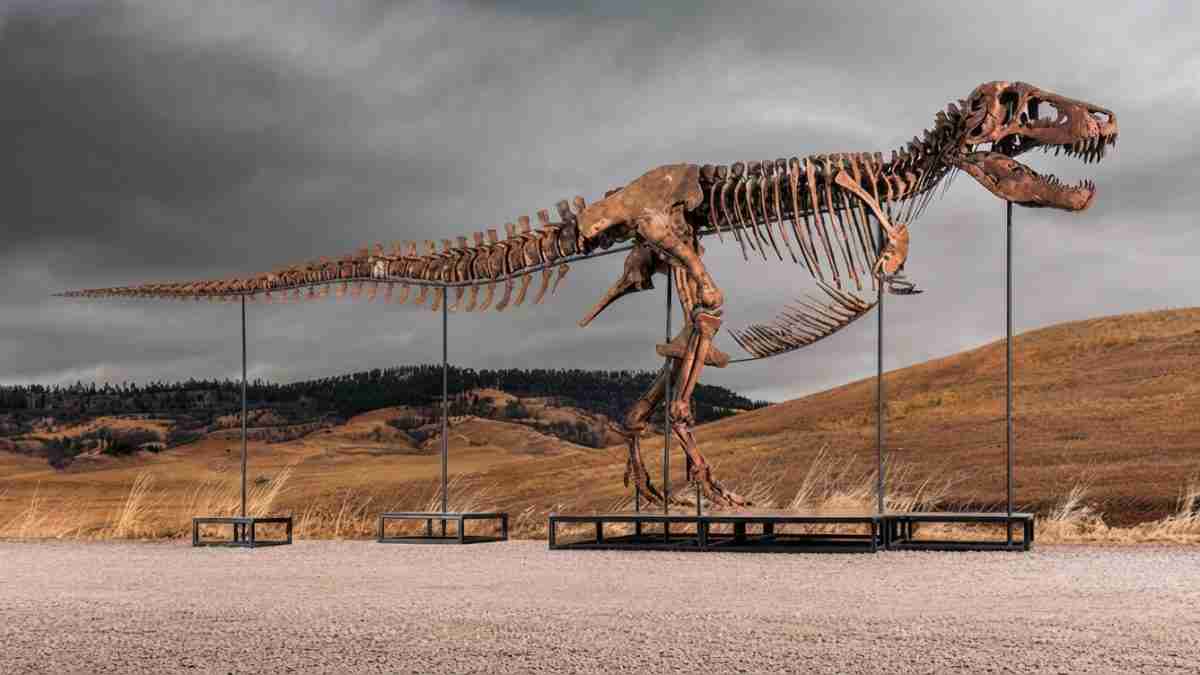
RAPID CITY, S.D., July 15 (Rapid City Online) — A Tyrannosaurus rex skeleton nicknamed Gus set a new bar for dinosaur fossils on Tuesday, when Sotheby’s said it sold for $50.1 million after a 10-minute bidding war with seven bidders. The winning bid came by phone, and the buyer stayed anonymous.
What was sold?
Gus is the fossil skeleton of a Tyrannosaurus rex found on a cattle ranch in Harding County, South Dakota, on land owned by the late Gary ‘Gus’ Licking. Sotheby’s described it as about 67 million years old, about 38 feet long and 12.5 feet tall. Reports based on Sotheby’s catalog also said the skull was 54 inches long.
How complete is it?
That part depends on how the fossil is counted. Reports attributed to Sotheby’s put Gus at about 61% to 63% complete by bone count, with 183 fossil bone elements recovered. Sotheby’s also said those bones represented about 75% to 80% of the dinosaur’s original bone mass. In auction terms, that makes Gus one of the largest and most complete T. rex specimens ever discovered.
Why did it sell for so much?
Rarity is the main reason. A full-sized predator like T. rex is already rare, and large, well-preserved skeletons draw serious attention from collectors. The final price also shows how competitive that market can be: seven bidders took part before the hammer fell. Gus broke the previous auction record for a dinosaur fossil, set by Stan, another T. rex skeleton that sold at Christie’s for nearly $32 million after its discovery in South Dakota in 1987.
What does the sale mean for science?
The price itself does not tell scientists anything new about how T. rex lived. It does show how valuable a scientifically important fossil can become once it enters the auction market. Because the winning bidder remained anonymous, the public does not yet know where Gus will go next or whether it will be displayed in a museum, kept in a private collection or studied further.
How was Gus found?
According to Sotheby’s reporting, Licking had spent years finding teeth and small bone fragments on his property before working with Thomas Heitkamp and the Theropoda Expeditions team to search for something larger. The BBC said the discovery team spent three years carefully excavating the skeleton before naming it after Licking.