
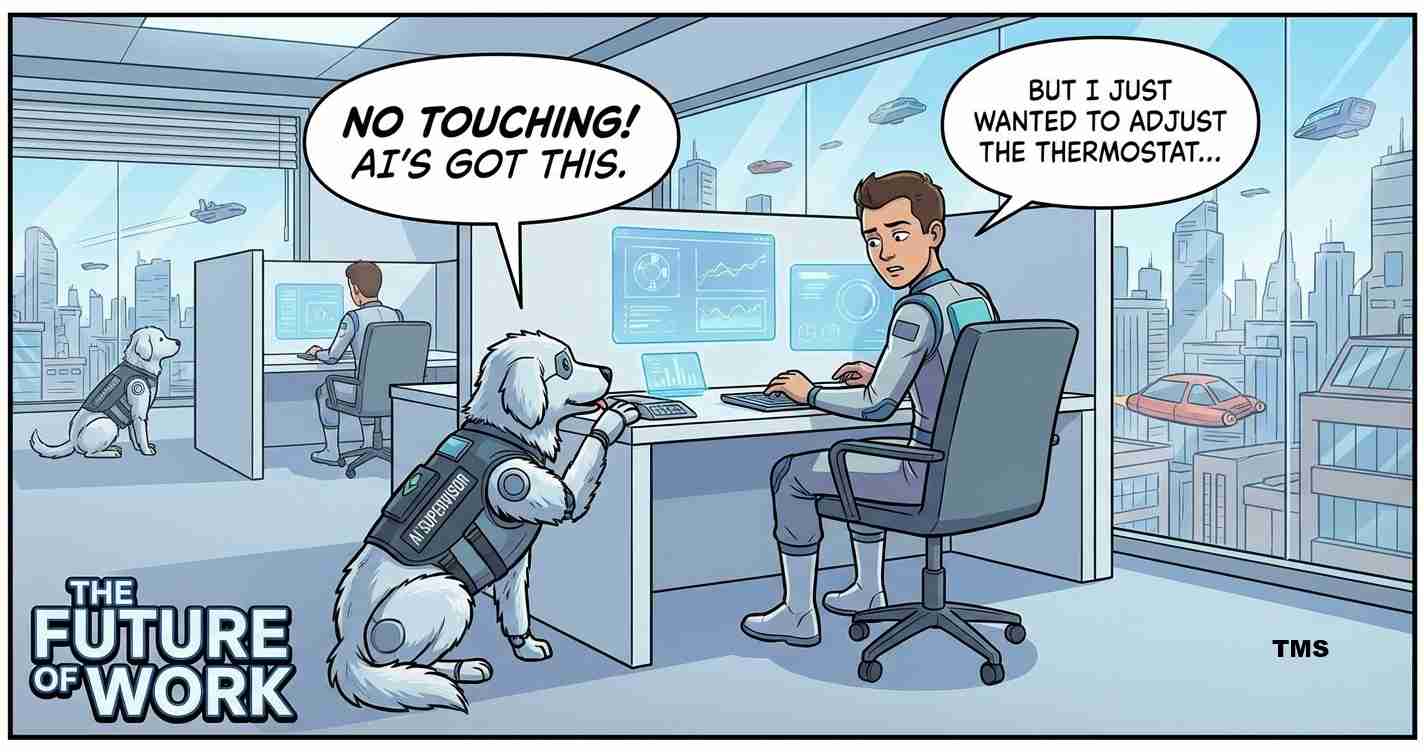
No, AI Won’t Ruin Your Life — It Might Even Push America Toward a 4‑Day Workweek
Andrew Yang warns that AI and automation could eliminate up to 44% of U.S. jobs — as many as 30 to 40 million roles over a decade — and urges Universal Basic Income paid by an AI compute tax nationwide.
- Major job risk: Yang estimates up to 44% of U.S. jobs are vulnerable to automation — possibly 30–40 million positions over ten years (Business Insider; Yang’s blog).
- Policy push: He advocates a $1,000/month Universal Basic Income (his “Freedom Dividend”), funded by a token/compute tax on AI companies (Yang’s blog).
- Automation today: Companies already use AI to draft press releases, automate customer service and warehouse work, and cite tech adoption in headcount decisions (Business Insider).
- Debate remains: Experts disagree on timing and scale; solutions range from retraining to direct payments and shorter workweeks.
What Andrew Yang is saying now
Renewed warning: Yang has reiterated forecasts first raised during his 2020 campaign, arguing modern AI can perform both manual and cognitive repetitive tasks and that roughly 44% of U.S. jobs fit that description. He calculates that if half of those roles vanish within a decade, the United States could lose 30–40 million positions (Business Insider; Yang’s blog).
Earlier examples: Yang points to self-driving vehicles as an early case: in 2018 he warned autonomous trucks could displace about 1 million trucking jobs and risk social unrest if communities were unprepared (Business Insider).
He highlights vulnerable sectors such as retail, call centers, fast food, insurance, accounting and others, while rejecting claims of instant apocalypse. His core argument: without national policies to cushion transitions, many towns and families may suffer severe economic pain (Business Insider).
How AI is changing work today
AI is moving from experiments into routine business use. Yang and observers note several signs of displacement and efficiency:
- Recruiting, customer service and basic accounting tasks are increasingly automated; some press releases and client reports can be drafted in minutes with AI tools (Yang’s blog).
- Large firms have tied some cuts to technology adoption; managers cite automation and efficiency as drivers of layoffs across media and tech (Business Insider).
- Examples include Amazon reducing new hiring through warehouse automation and companies shifting roles as AI handles routine work (Business Insider).
These trends affect white‑collar jobs too: consultancies and knowledge firms are rethinking staffing because AI can complete many research and writing tasks much faster than human teams (Yang’s blog).
What studies say (and what they don’t agree on)
Analyses vary by method and timeframe. Yang’s 44% figure aligns with studies that identify large shares of jobs containing automatable tasks. Other institutions foresee slower change or job creation that offsets losses, though transitions may be uneven.
Why this matters: if losses are rapid and large, governments need stronger safety nets and active labor programs; if change is gradual, focus shifts to retraining and incentives for job creation. Yang uses his reading of the evidence to press for immediate national measures (Business Insider; Yang’s blog).
Yang’s policy: Universal Basic Income and AI taxes
Freedom Dividend: Yang’s headline proposal is a Universal Basic Income of $1,000 per month for every adult — his original “Freedom Dividend.” He argues UBI would provide a secure floor while workers retrain, start businesses, or accept reduced hours without immediate poverty (Yang’s blog).
Paying for it: To fund UBI, Yang proposes a token tax or compute tax — levies on computing power and data use that enable large AI models. He frames such a tax as capturing public value when private firms profit from shared data and public knowledge (Business Insider).
Supporters argue UBI can reduce poverty and stabilize politics; critics question cost, incentives, and design. Yang emphasizes the UBI’s simplicity: fast distribution, broad coverage, and recipient flexibility (Yang’s blog).
Where the idea of a shorter workweek fits in
Some commentary suggests automation could enable shorter workweeks rather than mass unemployment. Research and pilots show four‑day weeks can maintain output and improve well‑being in certain settings, but a national shift would require firm, union and government action on pay, benefits and labor laws.
Yang’s public writing concentrates on income guarantees and taxes rather than mandating shorter hours, though shorter weeks are part of broader debates about how to share productivity gains equitably (Yang’s blog).
What remains uncertain
Key unknowns include:
- Speed of full-scale AI deployment versus hiring/new job creation.
- Whether displaced workers find nearby employment or require relocation and retraining.
- Political will in Congress and statehouses to adopt broad measures like UBI or industry taxes.
“Fast deployment without safety nets risks concentrated harm in regions dependent on vulnerable industries.”
Yang warns that rapid adoption without supports could concentrate pain in towns reliant on vulnerable sectors (Business Insider; video interview).
Implications for the United States
Economic: Large, rapid displacement could damage local economies—especially in manufacturing, logistics, retail and administrative services—reducing consumer demand and shrinking tax bases. If AI boosts productivity, output and cheaper goods could follow, but gains may be uneven without redistribution (Business Insider).
Political: Concentrated job losses could reshape voting patterns and heighten pressure on officials to act. Proposals like UBI and compute taxes will be politically contentious; alternatives emphasize retraining, wage subsidies and public‑private partnerships (Yang’s blog).
Social and cultural: Sudden unemployment risks family instability, mental‑health strain and reduced civic engagement. Policies that stabilize incomes — direct payments, temporary job programs or local investment — can sustain communities while workers transition. Work’s cultural role matters: many seek dignity and purpose tied to employment, not just income (Business Insider).
Practical applications for policymakers
Policymakers can act now to reduce harm. Options include:
- Expanding and scaling retraining programs and portable benefits.
- Offering tax credits for firms that hire and retrain displaced workers.
- Piloting Universal Basic Income and reduced‑hour workweek programs at scale.
- Designing a carefully calibrated compute/token tax to fund transition programs while considering innovation effects (Business Insider; Yang’s blog).
Reporting and sources
This report draws on Andrew Yang’s recent writings and public comments (Yang’s blog), reporting that summarizes his estimates and claims (Business Insider), and video interviews where he lays out risks and policy ideas (another interview). Additional academic and industry analyses with varying estimates are cited across those sources.



