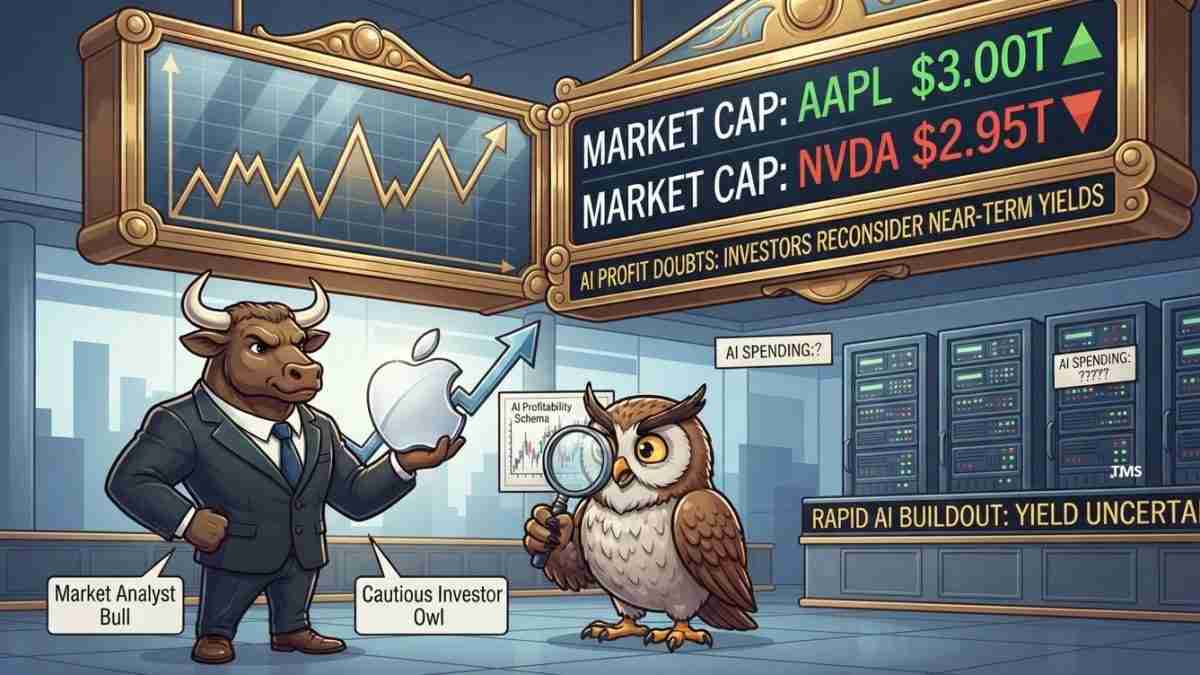
CUPERTINO, Calif., July 18 (San Francisco News Online) — Apple Inc. (AAPL) briefly overtook Nvidia Corp. (NVDA) on Friday to become the world’s most valuable company before Nvidia reclaimed the lead by the closing bell. Market value, or market capitalization, is the price of a company’s shares multiplied by the number of shares it has outstanding. The switch mattered because it showed how quickly Wall Street’s view of AI can change when investors start asking whether huge spending will turn into near-term profits.
What happened?
Reuters reported that Apple moved ahead of Nvidia during the session, then slipped back behind the chipmaker by the end of trading. The move was small in market terms, but large in symbolism: it put two of the biggest names in technology at the center of a new debate over who will benefit most from artificial intelligence.
Why is Nvidia under pressure?
Nvidia has been the clearest public winner of the AI buildout. Its graphics processing units are used in data centers that train large language models, and that demand helped drive the company’s rise. But investors are now questioning whether the heavy spending on chips, servers, electricity and data centers will produce profits soon enough to justify the cost.
Reuters said the Philadelphia Semiconductor index had fallen almost 19% from its highs during a July selloff in AI-related stocks, a sign that the caution is spreading beyond one company.
Why did Apple move ahead?
Apple’s pitch is different. Toni Meadows of BRI Wealth Management told Reuters, “Apple was seen as a laggard in the AI race because it wasn’t spending to develop models, but now sentiment has changed.” Meadows said Apple is less exposed to capital spending intensity and may be better positioned to make money from AI through services, its device ecosystem and hardware upgrades.
In plain terms, some investors appear to prefer a company that can benefit from AI without spending as much up front.
Does everyone see it that way?
No. Benjamin Hall of Segal Marco Advisors told Reuters, “I don’t see any meaningful distinction. Nvidia likely to be a significant participant in whatever happens going forward.” That view suggests Nvidia may stay central to the AI story even if the market is more cautious about how fast the returns will arrive.
What does it mean for investors and other stakeholders?
For investors, the move is a reminder that the AI trade is not only about growth. It is also about timing, cost and profit.
For workers, the stakes are real. Big AI buildouts can support jobs in chip design, software, construction and data-center operations. Slower spending could change hiring and buildout plans.
For customers, the question is when AI features will show up in products and services, and whether companies pass the cost on through higher prices or subscriptions.
For communities, especially those tied to tech offices, factories and data centers, the boom can affect power demand, construction activity and local economic growth.
The bottom line
Apple’s brief move past Nvidia was more than a race for a market-cap title. It showed that investors are balancing two different AI stories: Nvidia as the hardware engine of the boom, and Apple as a company that may be able to profit from AI without betting as heavily on upfront spending.