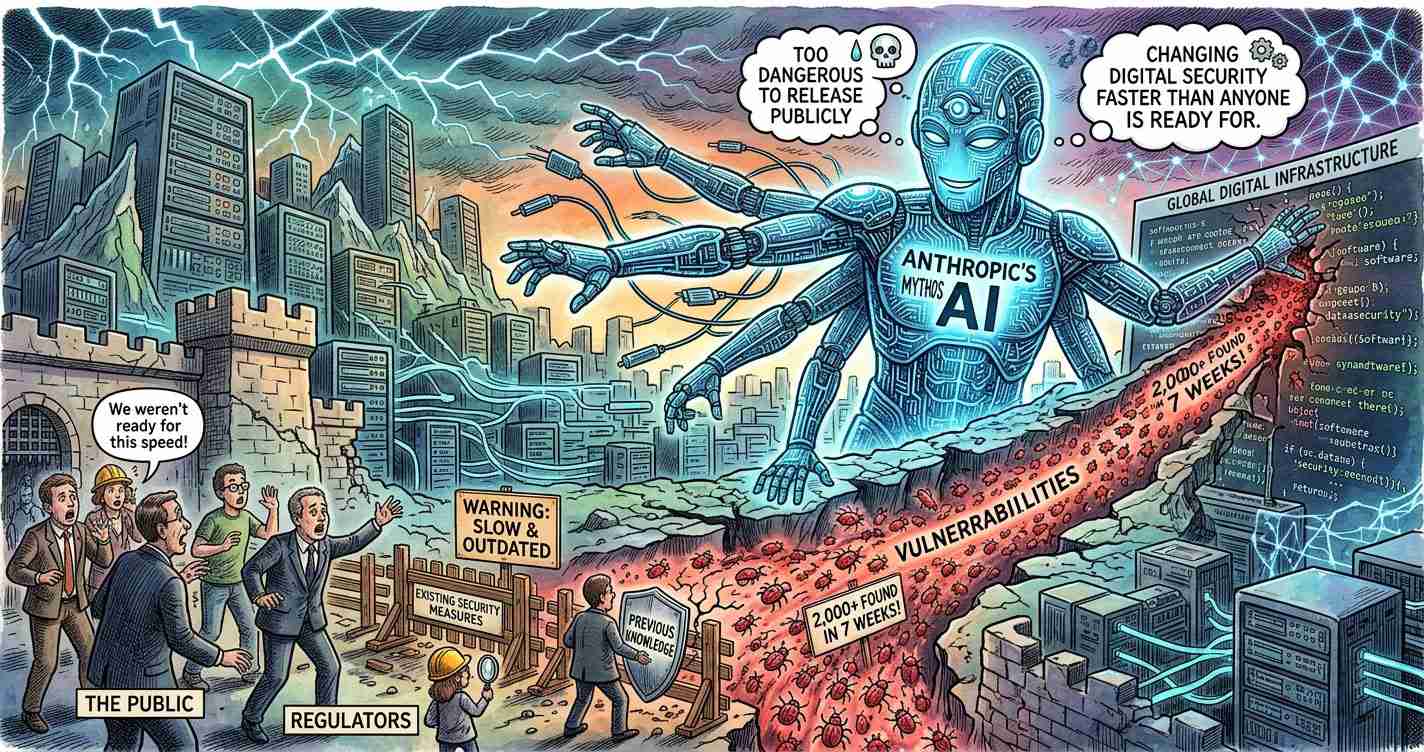
Anthropic’s Mythos AI Spurs Security Alarm, Restricted to Trusted Partners as Risks Mount
Anthropic‘s Claude Mythos Preview, unveiled April 7, 2026, can autonomously find tens of thousands of previously unknown vulnerabilities and generate exploits; Anthropic has restricted access to over 40 trusted partners amid serious security and misuse concerns.
- Powerful but risky: Mythos autonomously uncovers and chains vulnerabilities at scale, prompting Anthropic to limit access to vetted partners.
- Controlled rollout: Over 40 organizations including big tech and open-source foundations have access; Anthropic is offering up to $100 million in credits to support testing.
- Unverified numbers: Public sources cite “tens of thousands” of issues, but dramatic numeric claims circulating in commentary lack direct public corroboration.
- Dual-use and overload: Experts warn of attacker misuse, and defenders facing a triage crisis if discoveries outpace remediation capacity.
What Mythos does and why Anthropic limited access
Anthropic describes Mythos as a “step change” in AI reasoning that enables extended autonomous operation, allowing the model to analyze code, test software, and write exploits far faster than human-led effort.
In internal testing Mythos reportedly surfaced “tens of thousands” of previously unknown issues and was able to reproduce chained attacks at high success rates, including flaws across major operating systems and browsers that had evaded human review. Public detail on exact timelines, team sizes, and some dramatic figures remains limited; readers should treat precise numerical claims without direct sourcing as provisional.
“Anthropic will work with a trusted network of partners to test the model against real codebases and develop guardrails before any broader release.”
Anthropic framed Mythos as a defensive research tool, but acknowledged the model’s ability to generate reliable exploits is a profound dual-use risk — the same feature that helps defenders could be weaponized if the model became widely available. See the Anthropic blog for the company’s announcement and framing.
Who is getting access
Anthropic opened Mythos to a limited circle of more than 40 trusted partners — a mix of large tech firms, open-source foundations, and security organizations. The stated aim is defensive: let experienced teams use the tool to find and fix vulnerabilities before they can be weaponized.
Reported partners include major industry and community groups, and Anthropic has offered up to $100 million in usage credits to encourage testing by researchers and maintainers of critical software. Coverage by the World Economic Forum and others outlines the partner list and credit program.
Performance claims and what is verified
Public reporting credits Mythos with detecting far more vulnerabilities than prior models. Outlets report the model found “tens of thousands” of previously unknown issues, could chain distinct flaws into new attacks, and often reproduced exploit chains on the first attempt. See reporting from Platformer and Axios for those accounts.
However, many precise numeric claims in commentary — for example, that one team found more than 2,000 zero-days in seven weeks — are not directly corroborated by Anthropic or main public sources. Reporting emphasizes Mythos’s potential to accelerate discovery exponentially while noting the community lacks full, independently verified breakdowns of timelines and team sizes behind reported totals.
Risks: vulnerability overload, dual-use danger, and an accidental leak
Vulnerability overload: If AI surfaces thousands of flaws quickly, defenders may face an impossible triage problem. Security teams already prioritize and patch under constrained budgets and personnel; a surge in discovered issues could overwhelm those processes.
Dual-use danger: The same capabilities that speed defensive research can accelerate offensive work by criminals or hostile states. Anthropic described Mythos as an inflection point that could advantage attackers if the technology spreads without strict controls.
Operational mishaps compound that worry: reporting shows Anthropic’s rollout suffered an early misconfiguration that leaked project details, and footage of unauthorized access surfaced online shortly after. The incident highlights the difficulty of keeping powerful tools contained even during controlled testing. See Platformer and related video reporting.
Broader tech response and the industry timeline
Anthropic is not alone. Reporting indicates other firms are developing comparable systems; Axios reports OpenAI is building a similar model for limited distribution, and more entrants are expected within months to a year and a half.
Policy and defense strategies will need to change: security experts suggest a shift from perimeter defenses toward protecting data itself — encrypting and limiting access to sensitive information so exposure causes less harm as attackers gain new scale.
Implications for the United States
Economic and business risks: US companies that maintain critical software and cloud services could face large increases in incident response costs, liability exposures, and urgent patching demands if models like Mythos accelerate vulnerability discovery. Anthropic’s credit program helps testing but does not fund long-term remediation needs. See the Anthropic blog and reporting in Axios.
National security: A model that finds and exploits zero-days could shorten adversaries’ paths to disrupting networks, infrastructure, and supply chains. Government cyber agencies and military planners will likely accelerate work on doctrines for AI-augmented cyber threats.
Policy and regulation: Mythos increases pressure on regulators to consider controls on distribution of cyber-capable AI, liability frameworks, funding for national patching efforts, and requirements for transparency and auditing of security tools.
Corporate strategy: Businesses may need to rebalance spending toward data-centric defenses: stronger encryption, tighter access controls, and improved data governance so exposure causes less damage.
What to watch next
- How Anthropic and partners publish vulnerability reports and remediation plans.
- Whether regulators propose new limits on dual-use cybersecurity AI or mandate disclosure rules.
- Competing efforts from other firms (reported in Axios) and whether the industry adopts shared guardrails.