
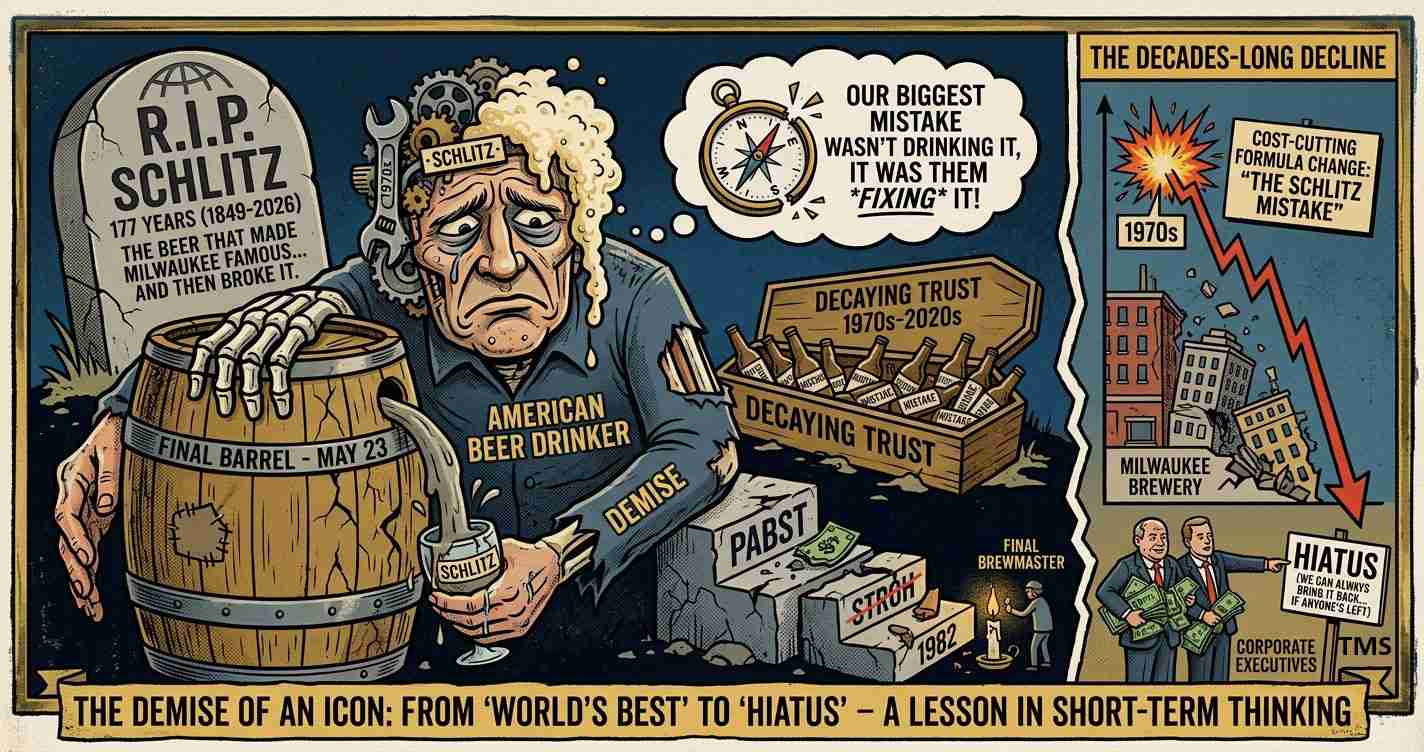
Schlitz Beer Ends Production: Final Batch at Wisconsin Brewery on May 23 Closes 177-Year Chapter
Schlitz, the beer that made Milwaukee famous, brews its final batch on May 23 at a Wisconsin brewery, ending a 177-year run after a national rise, a costly production misstep and decades of competitive decline.
- Final batch: May 23 at a Wisconsin brewery (reported by The Independent).
- Founded: 1849; rose to national prominence in the late 19th century.
- Turning point: a cost-cutting formula change often called the “Schlitz mistake.”
- Ownership: changed hands multiple times; Pabst bought the brand in 1999.
- Reason for retirement: Pabst cites rising costs for storing and shipping certain products (per Milwaukee Magazine).
What’s happening now
Kirby Nelson is scheduled to brew what has been described as the final batch of Schlitz on May 23 at a Wisconsin brewery, reported by The Independent. Pabst, which acquired the Schlitz brand in 1999, says the decision comes after rising costs tied to storing and shipping some products made continued production unsustainable (Milwaukee Magazine). The announcement has stirred a mix of nostalgia, frustration and some derision across social media.
How Schlitz became an American icon
Founded in 1849, Schlitz grew alongside Milwaukee and earned the slogan, “When you’re out of Schlitz, you’re out of beer.” Its national rise accelerated after the Great Chicago Fire of 1871, when Milwaukee breweries expanded across the Midwest. By the post–World War II years, Schlitz ranked among the world’s most popular beers, a symbol of the city’s brewing might (Encyclopedia of Milwaukee).
The turning point — the “Schlitz mistake”
Industry historians and longtime drinkers point to a production change — later dubbed the “Schlitz mistake” — when the company altered its brewing process and ingredients to speed production and cut costs. Consumers noticed differences in taste and perceived quality, eroding trust and opening the door for rivals like Budweiser, Miller and Pabst to gain ground. That backlash set in motion a long-term decline (AmericanCraftBeer.com; Encyclopedia of Milwaukee).
Sales, ownership and steady decline
Schlitz’s decline began in the 1970s as consumer tastes shifted and national competitors invested heavily in marketing and distribution. The brand changed ownership several times; Pabst acquired Schlitz in 1999 and continued limited production, but it never returned to its mass-market dominance. The arc shows how production decisions and competitive pressure can compound over decades (Encyclopedia of Milwaukee; Pabst).
Public reaction — nostalgia, mockery and memories
Social media responses to the retirement of Schlitz range from fond reminiscence to sharp criticism. Many users shared family stories, tailgate memories and college anecdotes tied to the beer. Others mocked the brand’s later reputation, blaming the formula change for creating what some called “swill.”
“My wife’s grandma’s favorite,” one X user wrote, recalling visits where Schlitz bottles were kept chilled in an assisted living apartment.
These reactions highlight the long tail of consumer trust — and how production choices can echo across generations.
The physical legacy — Schlitz Park and Milwaukee’s brewing past
The original Joseph Schlitz Brewing Co. site in Milwaukee is now Schlitz Park, a preserved mixed-use historic space that anchors the brand’s legacy to the city’s landscape. The site serves as a reminder that Schlitz was both an industrial engine and a cultural touchstone; with production ending, its role will increasingly be historical rather than contemporary (Encyclopedia of Milwaukee).
Business reasons for retirement
Pabst’s head of brand strategy, Zac Nadile, told Milwaukee Magazine the decision was driven by “increased costs to store and ship certain products.” For companies managing broad portfolios, higher warehousing and freight costs can make low-volume SKUs unsustainable. The economics of alcohol distribution — regulation, formats and freight — add complexity that can push legacy brands off the shelf (Milwaukee Magazine; Pabst).
Why this matters beyond nostalgia
Schlitz’s end is a case study in brand risk, manufacturing choices and market competition. Small production changes that reduce perceived value can erode loyalty over time; those cumulative losses make brands vulnerable to market shifts. For consumers, the retirement marks a cultural moment: shared rituals and regional identities linked to brands can quietly vanish.
Implications for the United States
Economic impact: Direct effects are limited; Schlitz had not been a major revenue driver for years. Still, the closure highlights logistical pressures facing legacy consumer brands, especially those with complex distribution needs.
Political consequences: Little immediate national political consequence, but the story underscores broader supply-chain and manufacturing issues relevant to policymakers: rising logistics costs and shifting distribution models.
Social and cultural effects: For many, the retirement signals a small cultural loss tied to family stories and regional identity. Sites like Schlitz Park and local museums will carry forward the brand’s history.
Practical applications: Expect short-term spikes in demand for remaining inventory; retailers and distributors may need to manage consumer inquiries and consider alternative heritage or craft offerings.
Sources and further reading
- The Independent (reporting on final batch and timing)
- Encyclopedia of Milwaukee — Joseph Schlitz Brewing Company entry
- Milwaukee Magazine (Pabst quote on costs)
- AmericanCraftBeer.com (history and “Schlitz mistake” discussion)
- Pabst Brewing Company



