
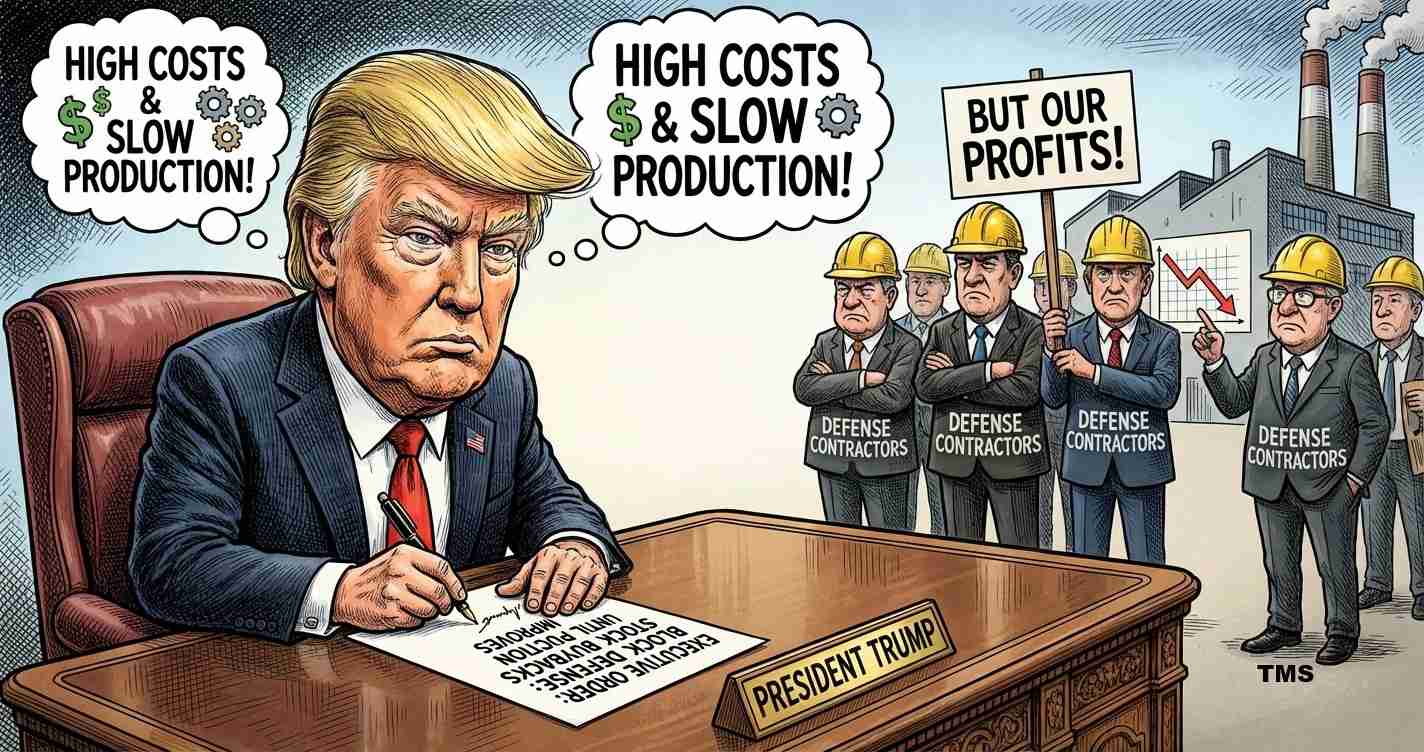
Trump signs executive order blocking dividends and buybacks at underperforming defense firms until weapons production improves
President Donald Trump signed an executive order immediately barring dividends and stock buybacks at U.S. defense contractors judged underperforming until weapons production, on-time delivery and cost performance improve, tying shareholder returns and executive pay to warfighter readiness.
Key takeaways
- The order bars defense contractors judged to be underperforming from paying dividends or conducting stock buybacks until measurable production, delivery and cost improvements occur.
- The White House frames the move as putting the “warfighter” first and aims to align executive pay with contract performance rather than short-term financial metrics via its fact sheet.
- Major defense stocks fell sharply after the announcement, with Lockheed, Northrop and General Dynamics among the hardest hit.
Main
What the order does and how it would work
The executive order, effective immediately, states firms are “not permitted in any way, shape, or form to pay dividends or buy back stock, until such time as they are able to produce a superior product, on time and on budget.” Reporting and the White House fact sheet emphasize the policy will tie shareholder returns and executive pay to delivery and readiness for U.S. forces, while contemporaneous coverage outlines the measure’s immediate scope (Business Insider).
Implementation steps in the order include:
- Identification (about 30 days): The Secretary of War — named in the document as Pete Hegseth — is to identify contractors that are underperforming, not investing in production capacity, or prioritizing payouts over government work. Coverage of the naming and enforcement mechanics appeared in Fox Business.
- Remediation plans (roughly 15 days): Notified firms will have a short window to submit plans showing how they will expand or modernize factories, speed deliveries, and fix sustainment shortfalls, according to reporting from Fox Business and analysis in Defense One.
- Contract clauses (within about 60 days): Future defense contracts and renewals are to include clauses barring buybacks and dividends during underperformance and linking executive incentives to on-time delivery and cost metrics, as previewed by Breaking Defense and Defense One.
The order also signals the government may stop advocating abroad for underperforming firms in foreign arms deals — using export support as leverage to force change, a tactic detailed in Breaking Defense.
Why the White House says it acted
The administration argues defense companies diverted funds from plants and production into “financial engineering” such as buybacks and dividends. The White House fact sheet frames the move as protecting taxpayer money and aligning pay with warfighter outcomes; reporting by Business Insider places the announcement in market context.
“All United State Defense Contractors, and the Defense Industry as a whole, BEWARE. This situation will no longer be allowed or tolerated!”
Who was singled out
The administration and the president publicly called out large primes — Lockheed Martin, RTX (Raytheon), General Dynamics and Northrop Grumman — pointing to roughly $89 billion in buybacks and dividends paid from 2021–2024 as a rationale (Politico, Business Insider). The president singled out Raytheon (RTX) in posts as slow to meet what he described as the Department of War’s needs; the order itself, however, focuses on underperforming firms generally rather than naming companies.
Market reaction
U.S. defense stocks fell after the announcement and the president’s posts. Business Insider reported declines of roughly 4–5% for major contractors; other outlets cited similar drops — Lockheed down about 4.8%, Northrop roughly 5.5%, and General Dynamics near 3.6% in afternoon trading (Politico).
Legal and practical questions
Experts say the order raises major legal questions because dividends, buybacks and pay are typically governed by state corporate law and board decisions. Many observers believe the practical enforcement route will be to embed restrictions as conditions in federal contracts — the mechanism the order emphasizes (Politico, Breaking Defense).
Analysts also warn firms may hesitate to expand capacity without clear, long-term Pentagon commitments; supply-chain and workforce constraints may not be solved by curbs on buybacks alone. The order leaves numeric tests for “underperformance” and “superior product” undefined, giving Pentagon officials broad discretion and creating potential uncertainty for companies and investors (Politico, Defense One).
How this fits broader Trump defense policy
The order continues Mr. Trump’s push for larger defense spending and faster production. He has backed a budget baseline around $901 billion and promoted major projects such as national missile defense and higher Patriot interceptor production. The buyback limits are presented as a companion measure: more spending coupled with conditions on how industry uses profits (Business Insider, Politico).
White House framing and fact sheet
The administration’s document — titled “President Donald J. Trump Prioritizes the Warfighter in Defense Contracting” — stresses taxpayer dollars should not be diverted into buybacks while the Pentagon faces shortfalls. It directs the Secretary of War to review contracts, identify underperformers, insert no-buyback/no-dividend clauses into future contracts during periods of underperformance, and consider curtailing U.S. advocacy for exporters that fail to address problems (White House fact sheet).
Implications for United States of America
- Economic impact: If enforced, curbs on defense buybacks would likely reduce near-term payouts to investors and could depress defense stock prices, affecting retirement funds and other investors; companies might redirect cash toward plants and workforce investment (Politico).
- Political consequences: The order tightens presidential oversight of the defense industrial base and may become a campaign issue about holding industry accountable while preserving readiness (Defense One).
- Social effects: Lower dividends and buybacks could affect household retirement accounts that own defense equities but, if successful, faster deliveries could reduce equipment shortfalls affecting service members and families (Business Insider).
- Cultural relevance: The measure taps into concerns about executives prioritizing stock prices and pay over manufacturing investment — a theme resonating across parties and voters focused on national defense (White House fact sheet).
- Practical applications: Contractors should expect new contract language and faster performance reviews; investors should watch for which firms are named as “underperforming” and how production and delivery metrics are defined (Fox Business, Breaking Defense).



