
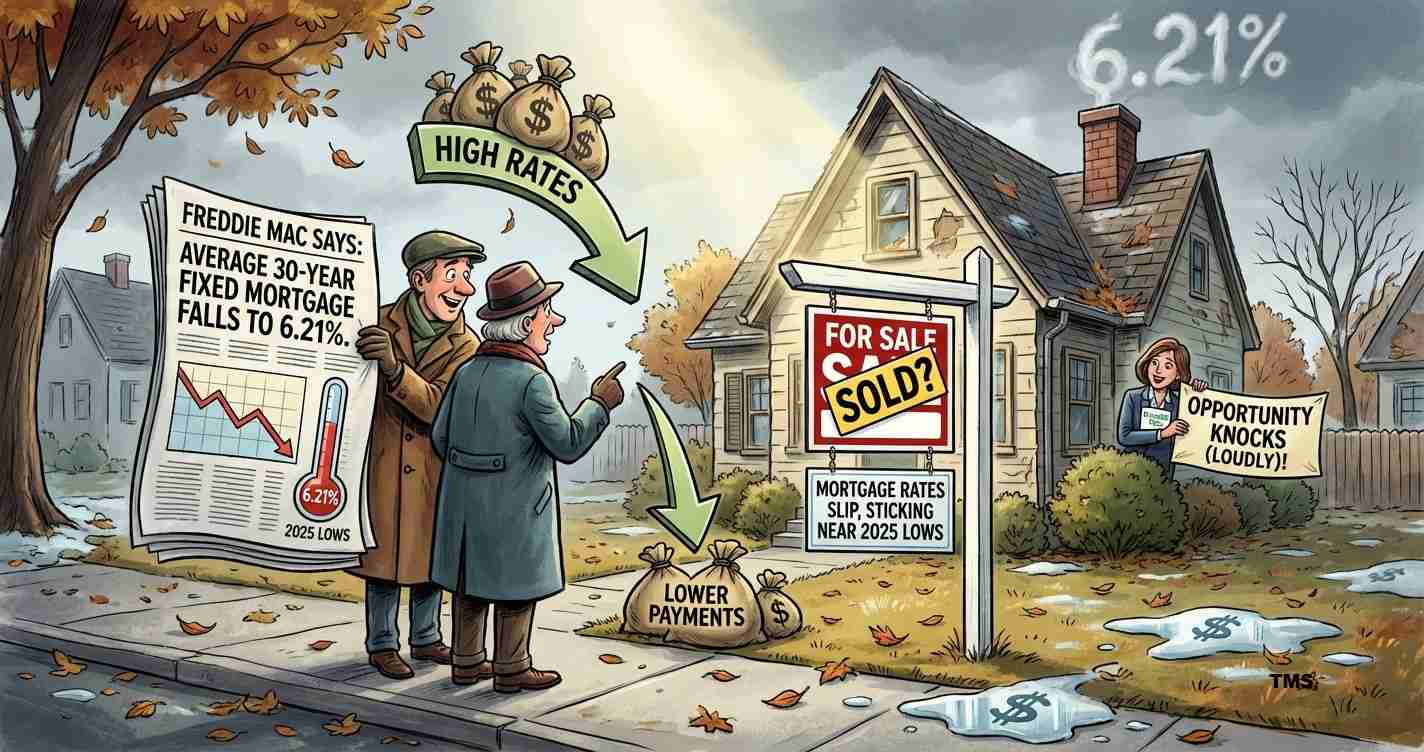
Mortgage rates slip to near-2025 lows as 30-year average falls to 6.21%, tied to 10-year Treasury moves
As of mid-December 2025, 30-year fixed mortgage rates in the U.S. settled near the year’s lows at 6.21%, according to Freddie Mac, mirroring moves in the 10-year Treasury and informing buyers and refinancers as they weigh financing decisions.
Key takeaways
- Freddie Mac’s Primary Mortgage Market Survey shows the 30-year fixed rate at 6.21% for the week ending Dec. 18, 2025 — essentially unchanged week-over-week and down from 6.60% a year earlier.
- Other trackers — Mortgage News Daily, The Mortgage Reports, and Bankrate — report similar mid-6% readings, reinforcing the trend.
- The recent Fed action — a 25-basis-point cut — affects short-term policy, but mortgage pricing remains driven by the 10-year Treasury yield and market spreads.
Why rates moved and what the numbers mean
Mortgage rates follow the market, not the Fed. Lenders price loans based largely on longer-term government yields because investors compare Treasuries and mortgage-backed securities when allocating capital. When the 10-year Treasury moves, mortgage rates typically move with it.
The Federal Reserve cut its federal funds rate by 25 basis points roughly a week before Freddie Mac’s December reading, bringing the target range to 3.5%–3.75%. That cut affects short-term borrowing and market expectations for inflation and growth, which can nudge the 10-year yield — but it does not directly set mortgage rates. See Federal Reserve releases and statements for official details.
“The 10-year Treasury yield is a more direct barometer for the 30-year fixed mortgage than the Fed funds rate.”
What the data shows
Freddie Mac’s reading of 6.21% for the week ending Dec. 18, 2025 ties with the lowest levels so far this year. Other rate providers report consistent mid-6% averages: Mortgage News Daily (~6.22–6.25%), The Mortgage Reports (~6.25%), and Bankrate (~6.25%). These readings reflect a modest easing from 2024 peaks, though rates remain well above the decade’s record lows.
How the 10-year Treasury explains the spread
On the day of the Freddie Mac release the 10-year Treasury yield traded near 4.12%. Historically, the 30-year fixed mortgage sits a couple of percentage points above the 10-year yield to cover lender costs, MBS market dynamics, and credit risk — a gap consistent with the current 6.21% average. See the 30-year mortgage historical series for context.
Lower volatility, clearer choices for borrowers
Rate-watch indexes indicate subdued movement in early December. For example, Bankrate’s variability measures suggested lower-than-average swings, which can reduce the urgency around locking a rate. Lower volatility and a modest slide can encourage buyers and refinancers who value predictability.
Comparing today’s rates with a year ago and long-term context
While mid-6% rates are far from the sub-4% era, they are meaningfully below the 2024 peaks — a roughly 0.8 to 0.9 percentage point improvement versus late 2024 averages. That translates into better affordability for some borrowers: lower monthly payments for the same loan amount or slightly expanded purchasing power in pricier neighborhoods. Still, many households face affordability constraints given higher rates relative to the past decade.
Practical considerations for buyers and refinancers
- Lock timing: With lower volatility, consider locking if you have a solid closing timeline. Lenders commonly offer 30–60 day locks for purchase loans.
- Refinance math: Compare remaining term, closing costs, and the magnitude of any rate drop to calculate break-even points; small rate moves can matter for large balances (The Mortgage Reports, Bankrate tools).
- Credit and down payment: Quoted averages cover diverse borrower profiles — better credit and larger down payments generally yield better pricing.
Sources and data
- Freddie Mac Primary Mortgage Market Survey (Dec. 18, 2025)
- Mortgage News Daily
- The Mortgage Reports live rate tables
- Bankrate mortgage data and analysis
- 30-year mortgage historical series (FRED)
- 10-year Treasury yield series (FRED)
- Federal Reserve public statements and releases
- Coverage of market links between Treasuries and mortgages
Implications for the United States
Economic impact
Modestly lower 30-year rates near 6.21% can ease some pressure on buyers, supporting home sales and construction and, by extension, jobs in real estate and construction. But because rates remain high by historical standards, the demand boost is limited compared with lower-rate periods.
Political consequences
A modest decline in mortgage rates reduces one source of voter pain on housing costs but does not solve long-term affordability. Short-term market relief from the Fed’s cut is helpful, yet policy solutions such as zoning reform, tax incentives, and affordable housing support remain central to lasting improvement.
Social effects
For households on the margin, a small rate drop can make homeownership reachable and produce meaningful monthly savings. However, many renters and low-income buyers still face high down-payment barriers and limited inventory, so broader access remains constrained.
Cultural relevance
Homeownership continues to be a key element of the American dream. A dip in mortgage rates will be welcomed by many families focused on stable budgets and community stability — yet cultural and political debates about housing policy will persist.
Practical applications for everyday Americans
- If you plan to buy soon, speak with lenders about rate locks, especially with a clear closing timeline.
- If your mortgage rate is well above current averages, run refinance scenarios including closing costs to find the break-even point.
- Monitor the 10-year Treasury yield for clues about mortgage direction — it is a better near-term signal than the Fed funds rate.
Note: All data and sources referenced above are preserved from original releases and market services; readers can consult the linked sources for live rate tables and historical series.



