Americans Pick Southern Charm Over Robotic Neutrality — Survey Finds “Human” AI Voices Beat Monotone
A survey of 3,023 users by The Word Finder finds Americans prefer human, regionally flavored AI voices — Southern accents top the list — showing warmth and personality shape trust.
Key takeaways
- Sample size: 3,023 users surveyed.
- Top pick: Southern accent—described as gentle, reassuring and resonant with “calm authority.”
- Preferences: 73% want one consistent accent, 75% prefer human-sounding speech, only 2% want their voice cloned.
- Regional favorites: South, then New York City, BBC English, New England, SoCal/Valley, and Texas.
Main story
Key findings
The Word Finder’s survey of 3,023 users uncovered a clear national preference for AI voices with human character and regional warmth over sterile, monotone delivery. The Southern accent emerged as the most favored for being soothing and authoritative. (Source: The Word Finder)
Why people want human-sounding AI
Respondents said they want technology that feels approachable — even a little theatrical. The survey frames this preference as emotional as much as functional: tone builds trust. Imagine Matthew McConaughey calmly narrating directions or a friendly Alabama librarian recommending a book — that blend of charm and clarity increases comfort.
Accents and what they convey
The study maps accents to perceived traits:
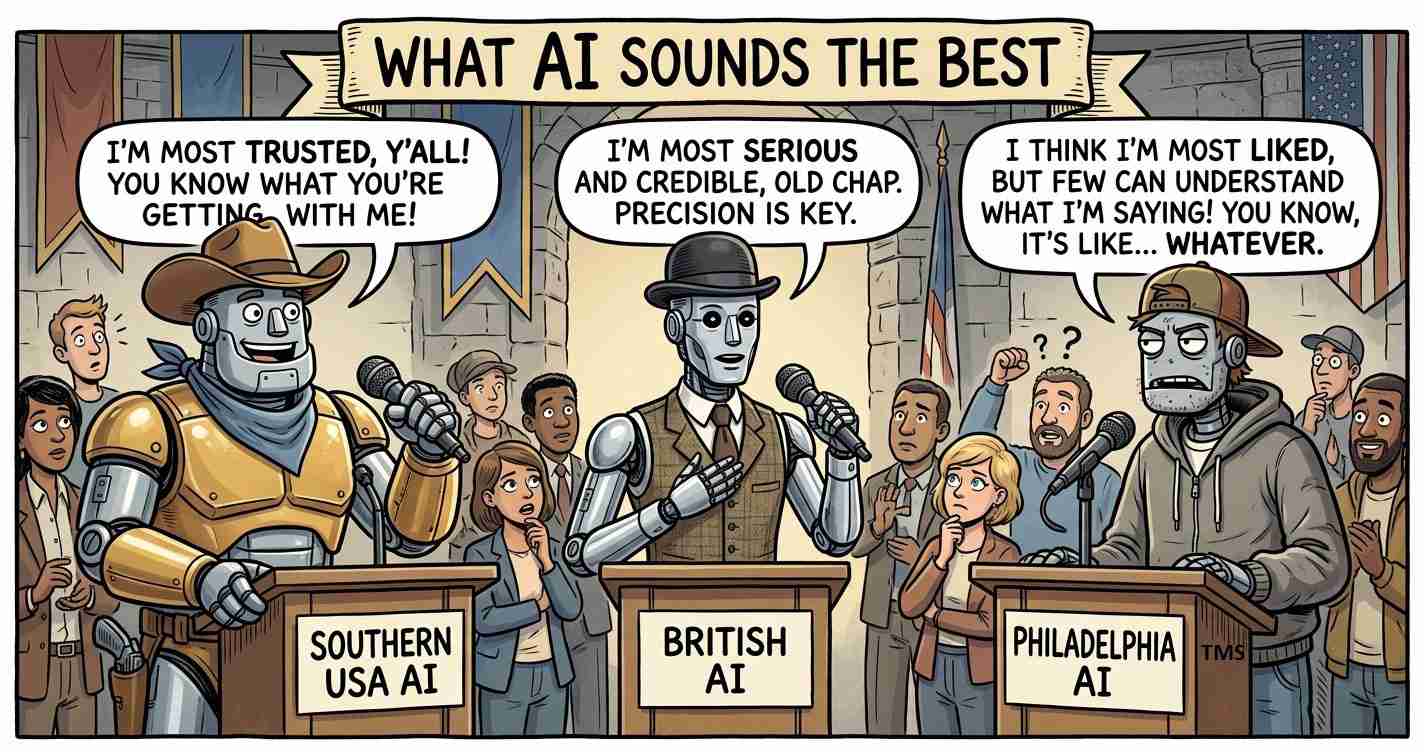
- Southern accent: Soothing, authoritative—described as “calm authority” that comforts in difficult moments.
- New York City: Confidence and efficiency—the no-nonsense, get-it-done voice.
- BBC English: Trust and intelligence—the polished anchor tone associated with reliability.
- New England: Realism and blunt charm—direct and a little wry.
- SoCal/Valley: Relaxed, friendly—the upbeat companion for casual tasks.
- Texas drawl: Storytelling confidence—ideal for narrative-driven experiences.
Regional personalities remain influential: New Jersey’s gritty edge, Philadelphia’s feisty directness, Chicago’s pragmatic heartland grit, and Louisiana’s soulful warmth add distinct flavors to how AI can be “humanized.”
Follow-up insights
Southern voices were not only popular but were also rated the most trusted overall, and nearly tied BBC-style British accents for sounding the smartest. Yet for high-stakes topics such as finance, Midwestern or neutral American accents led in perceived trustworthiness—suggesting steady, familiar tones remain preferred when sober authority is required.
“It’s not just words — it’s the warmth that makes AI feel like a friend.”
— Praveen Latchamsetty, founder of The Word Finder
Expert perspective
Praveen Latchamsetty summarized the emotional angle behind the numbers: users want warmth and a sense of personality from AI. The data support that: 75% prefer human-sounding speech and 73% want one consistent accent within a product.
Implications for United States
The findings carry economic, political, social, cultural, and practical implications:
- Economic: Voice design may become a competitive edge—brands adopting preferred regional tones could see higher engagement and loyalty, affecting customer service, audio branding, and accessibility.
- Political: Politicians and civic systems using AI for outreach should consider regional accents to improve responsiveness and trust among local voters.
- Social: Human-sounding AI could lower barriers for older or less tech‑savvy users who rely on tone and warmth to feel comfortable with digital services.
- Cultural: Choosing a voice reflects identity and values—regional accents carry local culture into technology.
- Practical: Context matters: Midwestern steadiness for finance apps, Southern warmth for care-related interactions, and tailored voice styles for emergency alerts or health advice.
Source
Survey and commentary: The Word Finder AI voice preferences survey. Full survey: Full survey.
Bottom line: As AI becomes smarter, the choice of voice—be it a drawl or a clipped New York cadence—shapes trust, warmth, and credibility. Voice is no longer just a UI element; it’s part of how people experience devices daily.