
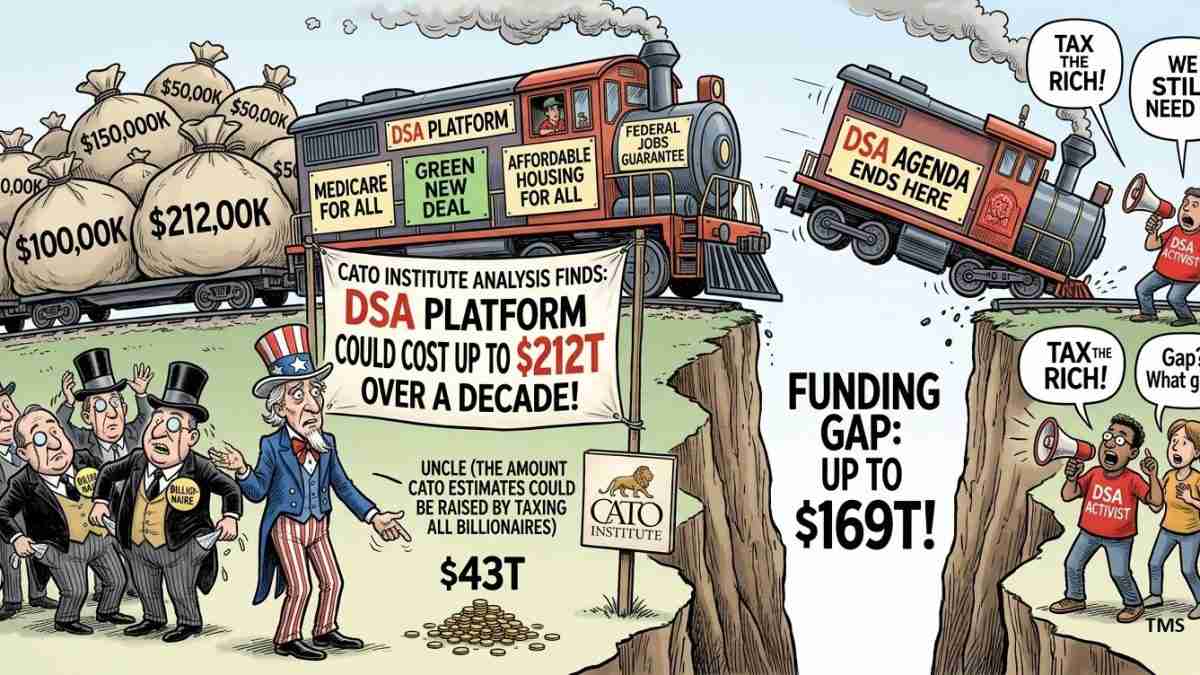
WASHINGTON, Sept. 19 (DC Times Online) — A Washington-based think tank estimates that nine major proposals linked to the Democratic Socialists of America’s platform could require between $71 trillion and $212 trillion in additional federal spending over 10 years.
The estimate, published by the Cato Institute, puts the cost at the equivalent of about 18% to 53% of gross domestic product, or GDP. GDP is the total value of goods and services produced in the U.S. economy.
The figure is not a government budget score. It is an analysis by Adam N. Michel, Cato’s director of tax policy studies. The estimate depends on the assumptions and calculations used by Cato, and the materials available do not include a full table showing the cost of each proposal.
What proposals are included?
Cato examined nine broad policy areas associated with the DSA platform. They include:
- Universal health care modeled on Medicare for All
- A federal jobs guarantee
- Reparations
- Housing programs
- Infrastructure and green-energy investment
- Expanded retirement benefits
- Paid family leave
- No-cost college
The analysis describes these as additional federal spending. It does not mean that the federal government would necessarily spend the entire amount immediately, nor does it establish that the proposals will become law.
Which proposal carries the largest estimate?
Cato estimates that a Medicare-for-All-style health care program would add between $40 trillion and $75 trillion to federal spending over 10 years.
That would shift a large share of health care costs into the federal budget. The estimate concerns federal spending, not necessarily the total amount Americans would spend on health care across the entire economy.
How large is the estimate compared with current spending?
Michel said in a Cato podcast that current federal spending is about $7 trillion a year, or roughly $95 trillion over the next decade, before adding the proposals.
Cato’s analysis also says the agenda would require roughly doubling federal revenue at the low end of its estimate and quadrupling it at the high end. That would be in addition to revenue needed to cover the Congressional Budget Office’s cited projection of a $24 trillion federal deficit over 10 years.
Cato’s analysis says the DSA platform proposes sending the bill to “the richest individuals and corporations.” But the supplied analysis does not provide a detailed tax plan showing how much each group would pay or whether those taxes could raise the full amount.
Why does the range stretch from $71 trillion to $212 trillion?
The range reflects different cost estimates for the same broad policy agenda. The available Cato materials do not provide all of the underlying calculations or explain every assumption behind the low and high ends.
Michel described the total in a Cato podcast as “somewhere between 70 and $212 trillion over 10 years of additional federal spending.” Cato’s written analysis gives the range as $71 trillion to $212 trillion.
The figures should therefore be read as an estimate of the potential scale of the proposals, not as a settled forecast. No official score from the Congressional Budget Office or another federal budget agency is identified in the available material.
What would it mean for workers, customers, investors and communities?
For workers and families, the proposals could involve broader access to government-funded health care, education, paid leave, housing assistance and retirement benefits. The available analysis does not calculate how those benefits would be distributed among households or how they would affect individual taxes and wages.
For businesses and investors, the central issue would be how the federal government financed the spending. Higher taxes, new borrowing or changes in private-sector costs could affect companies and households in different ways. Cato’s analysis discusses the need for substantially more federal revenue but does not provide a complete, independently verified financing plan in the supplied material.
For communities, infrastructure and green-energy spending could direct more federal money to public projects. A federal jobs guarantee could also change the role of government in local labor markets. The available estimate does not identify which communities would receive funding or measure the program’s effects on employment, prices or economic growth.
What is still unknown?
The materials do not include a response from the Democratic Socialists of America, an independent budget analyst or the Congressional Budget Office. They also do not provide the DSA platform’s direct source document, its exact adoption date or a complete breakdown of the nine proposal costs.
As a result, the Cato analysis provides a large-scale estimate of the potential federal spending involved, but it does not settle how the proposals would be designed, financed or implemented. Whether the agenda would become law would depend on congressional action, presidential approval and the details of legislation that has not been enacted.



