
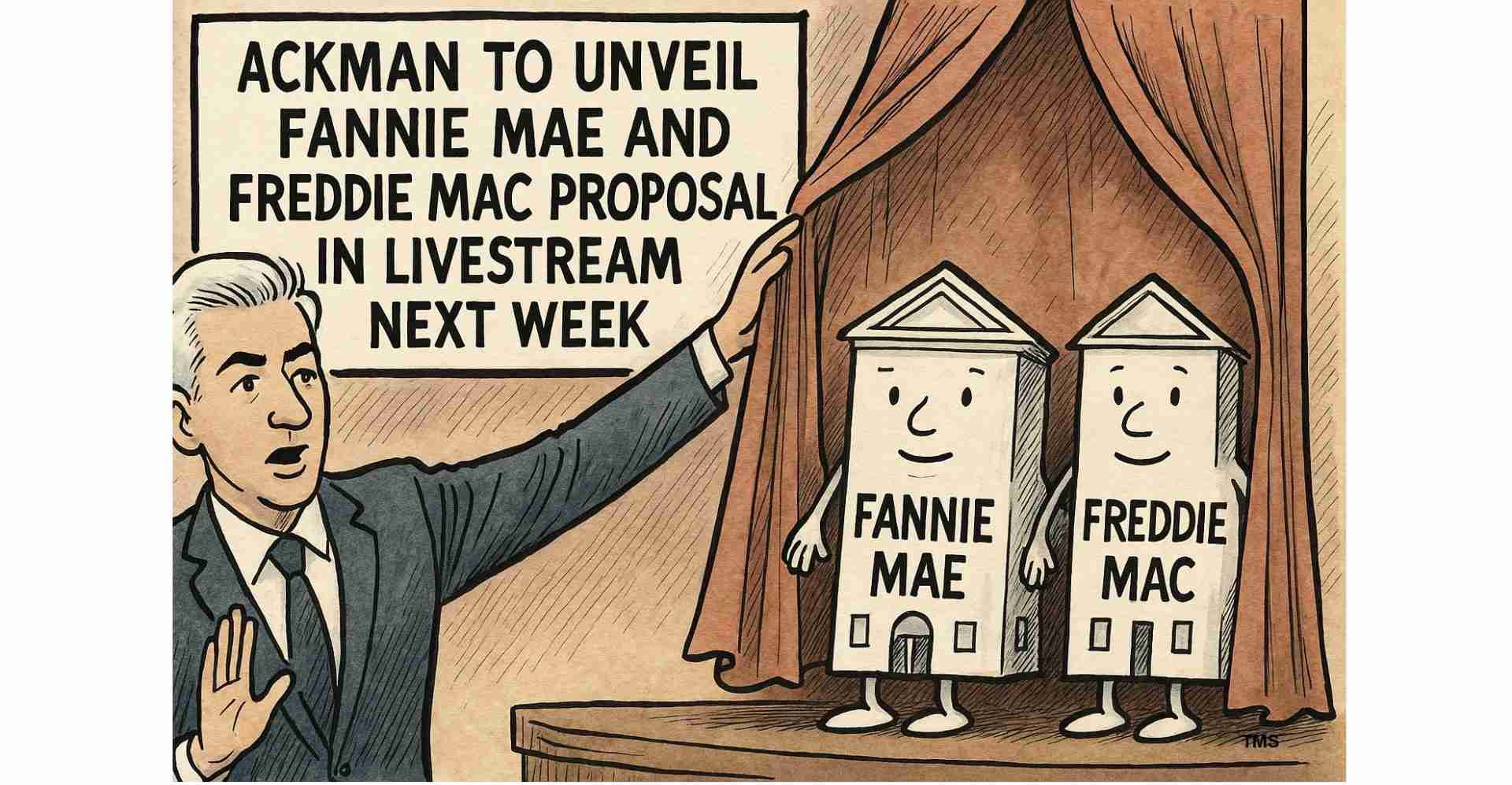
Ackman to unveil plan for Fannie Mae and Freddie Mac merger, saying it could lower mortgage rates and reshape housing finance
Billionaire Bill Ackman will unveil a detailed proposal to merge Fannie Mae and Freddie Mac into a single entity, aiming to lower mortgage rates, streamline oversight, and set a path toward partial privatization and an eventual IPO.
Key takeaways
- Ackman’s proposal: Merge Fannie Mae and Freddie Mac into one company with a plan toward privatization and an IPO; details to be presented in a livestream. (Sources linked below.)
- Potential benefits: Supporters argue consolidation could cut duplicate costs and lower mortgage rates through operational efficiencies.
- Risks and debate: Critics warn consolidation may reduce competition, raise systemic risk, and could increase costs for some homeowners by thousands annually.
Main content
Ackman’s proposal: what he says and what he may seek
Billionaire hedge fund manager Bill Ackman plans to present a comprehensive proposal in a livestream next week. He calls for merging the two government-sponsored enterprises into a single company, arguing that combined operations would remove duplicated functions and create operational efficiencies that could push mortgage rates lower. Sources reporting his intent include Fox Business and Benzinga, with structural and IPO analysis provided by Friedman Vartolo.
Ackman’s pitch: a single GSE that is easier to regulate, cheaper to operate, and positioned for an eventual partial sale or IPO.
Oversight and governance: consolidation under FHFA
The proposal reportedly includes consolidating supervisory responsibilities under the Federal Housing Finance Agency (FHFA). Ackman contends a single entity would simplify regulatory oversight and permit a staged approach toward privatization. Analysts note the FHFA currently runs both firms under conservatorship—an arrangement in place since the 2008 financial crisis—and recent internal agency changes have raised governance questions. See coverage from Friedman Vartolo and Simply Wall St.
Market and investor implications
Investors see both upside and downside. A merged Fannie-Freddie followed by an IPO could unlock substantial value and reduce direct government control. Some estimates suggest a partial sale—selling roughly 15% of the new entity—could raise about $30 billion, potentially making the offering among the largest in U.S. history. Yet valuation, timing, and the path to sale remain uncertain because of regulatory and political hurdles. (Source: Friedman Vartolo.)
Potential effects on mortgage rates and affordability
Ackman emphasizes that consolidation could reduce mortgage rates and improve affordability by cutting duplicative costs. Proponents highlight scale economies and streamlined operations. However, some analysts and housing advocates caution the reverse could occur: privatization or reduced government backing might raise mortgage costs. Estimates cited by analysts suggest private-market pricing could add between $1,800 and $2,800 per year for a typical homeowner, depending on required private returns and changes to consumer protections. (Source: Friedman Vartolo.)
Competition and market stability concerns
Critics warn that merging the two largest backers of U.S. mortgages into one firm could reduce competition in securitization and guarantees, potentially increasing systemic risk. A near-monopoly could amplify shocks: if the merged entity encountered stress, effects could ripple across housing finance and credit markets. Supporters counter that robust capital rules and regulation could mitigate risks while delivering consumer benefits. Coverage and analysis appear at GuruFocus and Friedman Vartolo.
Political stakes and timing
The plan lands amid ongoing federal debate over how to end conservatorship. Support for privatization crosses party lines but faces disagreement: some lawmakers favor shrinking federal exposure, while others prioritize affordability and market stability. Any merger or IPO would require FHFA and congressional buy-in; Ackman’s livestream is likely intended to shape that political conversation. (Sources: Fox Business, Friedman Vartolo.)
Historical context: why this matters now
Fannie Mae and Freddie Mac entered federal conservatorship in 2008 and now back roughly 70% of U.S. residential mortgages. That central role means any structural change would significantly affect borrowers, lenders, investors, and taxpayers. The core debate: whether privatization and consolidation will reduce taxpayer exposure and improve efficiency, or shift costs to homeowners and increase market fragility. (Sources: Friedman Vartolo, Simply Wall St.)
What to watch in Ackman’s livestream
Observers expect Ackman to present: operational details, governance structure, capital and liquidity standards, and the proposed path to an IPO or other privatization steps. Key questions will include how consumer protections and affordable housing mandates would be preserved, what capital rules would apply, and how taxpayer exposure would be limited. Analysts and housing groups will scrutinize those answers. (Sources: Simply Wall St, Benzinga, Fox Business.)
Implications for United States of America
Economic impact: A merger and partial privatization could alter mortgage pricing nationwide. If efficiencies materialize, rates may fall modestly; if private capital demands higher returns or consumer protections weaken, many homeowners could face increased monthly costs in the low-thousands annually. (Sources: Friedman Vartolo, GuruFocus.)
Political consequences: The plan will test bipartisan appetite for reducing federal involvement in housing finance; lawmakers favoring fiscal restraint may support steps that shrink government exposure while others focused on access may resist changes that risk affordability. (Sources: Simply Wall St, Friedman Vartolo.)
Social effects: Changes would affect homebuyers, renters, and lenders. Higher mortgage costs could slow first-time buyers and worsen affordability in costly markets; conversely, better efficiency and clearer oversight could stabilize credit availability if well implemented. (Sources: Friedman Vartolo, Benzinga.)
What comes next
Ackman’s livestream will provide concrete proposals that regulators, lawmakers, housing groups, and markets will evaluate. Any serious merger or privatization move would require statutory, regulatory, and political actions and could take months or years to implement—shaping mortgage rates, home affordability, and the taxpayer role in U.S. housing finance. (Sources: Fox Business, Benzinga, Simply Wall St.)
Sources
- Fox Business — reporting on Ackman’s livestream and proposal.
- Benzinga — coverage of Ackman’s plan and timing.
- Friedman Vartolo — analysis on merger structure, IPO plans, and privatization effects.
- Simply Wall St — regulatory context and FHFA oversight reporting.
- GuruFocus — discussion of strategic implications and critiques.



