
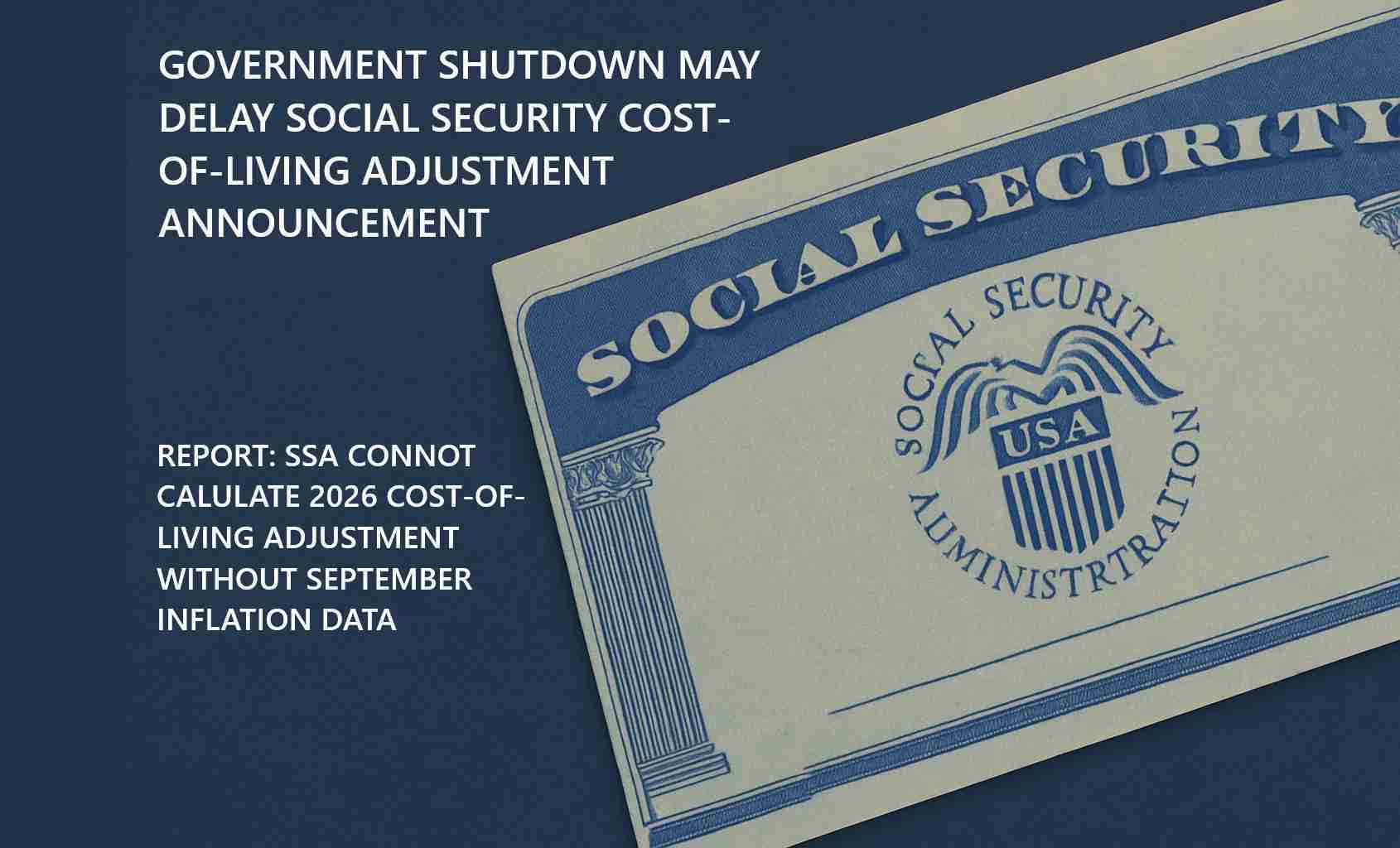
Government shutdown could delay 2026 Social Security COLA announcement, SSA says it needs September inflation data
A looming October 2025 government shutdown could delay the official 2026 Social Security COLA announcement because the SSA needs September inflation data from the BLS, which may not be published on schedule if federal staff are furloughed.
- SSA timing depends on September CPI: The SSA traditionally announces the COLA in mid-October after the BLS posts September CPI figures; the 2026 announcement was scheduled for Oct. 15.
- Shutdown risks publication delays: A partial or full federal shutdown could furlough nearly all BLS staff, delaying the September CPI and other economic reports.
- Benefits continue, announcement may not: Monthly Social Security payments will continue on schedule, but the official COLA cannot be calculated or announced until the BLS posts the September CPI.
Key information
The Social Security Administration (SSA) traditionally announces the annual COLA in mid-October after the Bureau of Labor Statistics (BLS) posts September Consumer Price Index (CPI) figures. For 2026, that announcement was set for Oct. 15 (source: Fox Business; AARP).
A partial or full federal shutdown could furlough nearly all BLS staff except one, delaying the publication of the September CPI and other economic reports (source: Fox Business; AARP).
The SSA has said it cannot calculate or announce the 2026 COLA without the September inflation report (source: Fox Business).
Social Security benefit payments themselves will continue on schedule even if the COLA announcement is delayed, because benefit payments do not depend on the annual appropriations process (source: Fox Business; AARP).
Independent estimates prior to the final data hovered around a 2.7% to 2.8% COLA increase for 2026, but those are unofficial until the BLS publishes September CPI data (source: Fox Business; Nasdaq).
What could cause a delay
The federal government funds operations through annual appropriations. If Congress fails to pass spending bills or stopgap measures before the new fiscal year, many federal agencies must furlough non-essential staff. The BLS, which publishes the CPI, relies on a workforce that gathers and compiles price data nationwide.
“Reporting suggests almost all BLS staff were furloughed during the shutdown, leaving only one employee on duty — a setup that would prevent normal publication of the September CPI on its usual schedule.”
This procedural interruption — furloughing field and analytical staff — could delay the formal publication of the September CPI and thus the SSA’s ability to compute the COLA. Sources: Fox Business; AARP.
Why September inflation data matters
The annual Social Security COLA equals the percentage increase in the Consumer Price Index for Urban Wage Earners and Clerical Workers (CPI-W) from the third quarter of the prior year to the third quarter of the current year. In practice, SSA measures the average CPI-W for July, August and September and compares it with the average for the same three months a year earlier.
Without the September CPI number, the SSA cannot complete that calculation and therefore cannot publish the official COLA. (source: AARP; YouTube video commentary).
What the SSA has said
The SSA has informed officials that it cannot calculate or announce the COLA without the final September CPI release from the BLS. This is a procedural limit: the SSA’s COLA rules depend on official, published data. Agency staff cannot use internal drafts or unofficial figures to make the formal adjustment (source: Fox Business).
Precedent and current data status
A similar delay occurred during the 2013 government shutdown, when federal data release disruptions affected the COLA announcement. While rare, that precedent shows how shutdowns can ripple into retirement planning and benefit adjustments (source: Fox Business).
Some analysts note that much of the raw price data for September may already have been collected before a shutdown. If data collection is complete, the delay could be a pause in publication rather than a loss of information. Still, the SSA cannot finalize its calculation until the BLS formally posts the numbers (source: YouTube).
Independent estimates for 2026 COLA
Before the official September CPI release, several private analysts produced unofficial COLA estimates converging near 2.7%–2.8% for 2026. These unofficial figures are useful for planning but cannot substitute for the formal SSA announcement, which must use the official BLS data (source: Nasdaq; Fox Business).
What a delayed announcement would mean for seniors and households
Monthly Social Security benefit checks would continue on schedule, but without official COLA confirmation, beneficiaries, caregivers and financial planners would lack the formal percentage used to index benefits, Medicare Part B, and other federal payments that tie to COLA.
That uncertainty could complicate household budgeting, retirement planning, and business decisions tied to consumer inflation expectations. Low- and fixed-income beneficiaries are likely to feel the greatest stress from any delay.
Government shutdown impact on other data and services
Beyond the CPI and COLA, a shutdown can delay a range of economic reports that markets and policymakers watch. That increases uncertainty for businesses and investors and reduces near-term transparency about the economy’s direction.
For older Americans and savers, the COLA is a visible, immediate effect; a delayed announcement underscores how interruptions in government operations can have practical effects on everyday life (source: AARP; YouTube).
Sources and reporting
This article draws on reporting and analysis from Fox Business, AARP, video commentary on YouTube and related analyst coverage (including video and Nasdaq).
Implications for United States
Economic impact
Short-term planning: A delayed 2026 COLA announcement would make budgeting harder for millions of retirees who rely on the official percentage to set household spending and plan for Medicare and out-of-pocket costs.
Markets and businesses: Late release of CPI and other economic data can increase uncertainty in markets. Companies that use official inflation measures to adjust wages, rents or contracts may have to rely on estimates, raising operational risk.
Political consequences
A shutdown that halts federal data releases raises public pressure on Congress to pass funding bills. Both parties may face criticism for gridlock that affects retirement income, and lawmakers who prioritize fiscal stability could use disruptions to push for short-term funding or procedural fixes.
Social effects
Low- and fixed-income beneficiaries rely most on predictable COLA adjustments; a delay adds stress and uncertainty to households already balancing health care and housing costs. Routine delays in official data can erode public confidence in government functions.
Cultural relevance
Social Security is a deeply rooted American safety net. Any perceived threat to timely adjustments touches on cultural values about how the nation treats older citizens and people who worked for decades.
Practical applications
- Financial planning: Advisors and beneficiaries should track private COLA estimates but prepare for official confirmation; build short-term buffers when possible.
- Watch official channels: Beneficiaries should follow SSA announcements and BLS releases directly at their official sites and trusted news sources — the SSA cannot finalize the COLA until the BLS posts the September CPI (source: Fox Business; AARP).
Reporting note: This article uses reporting and analysis from Fox Business, AARP, YouTube, YouTube, and Nasdaq to explain how a government shutdown could affect the official 2026 COLA announcement. All referenced links are provided for readers who wish to see source material directly.



