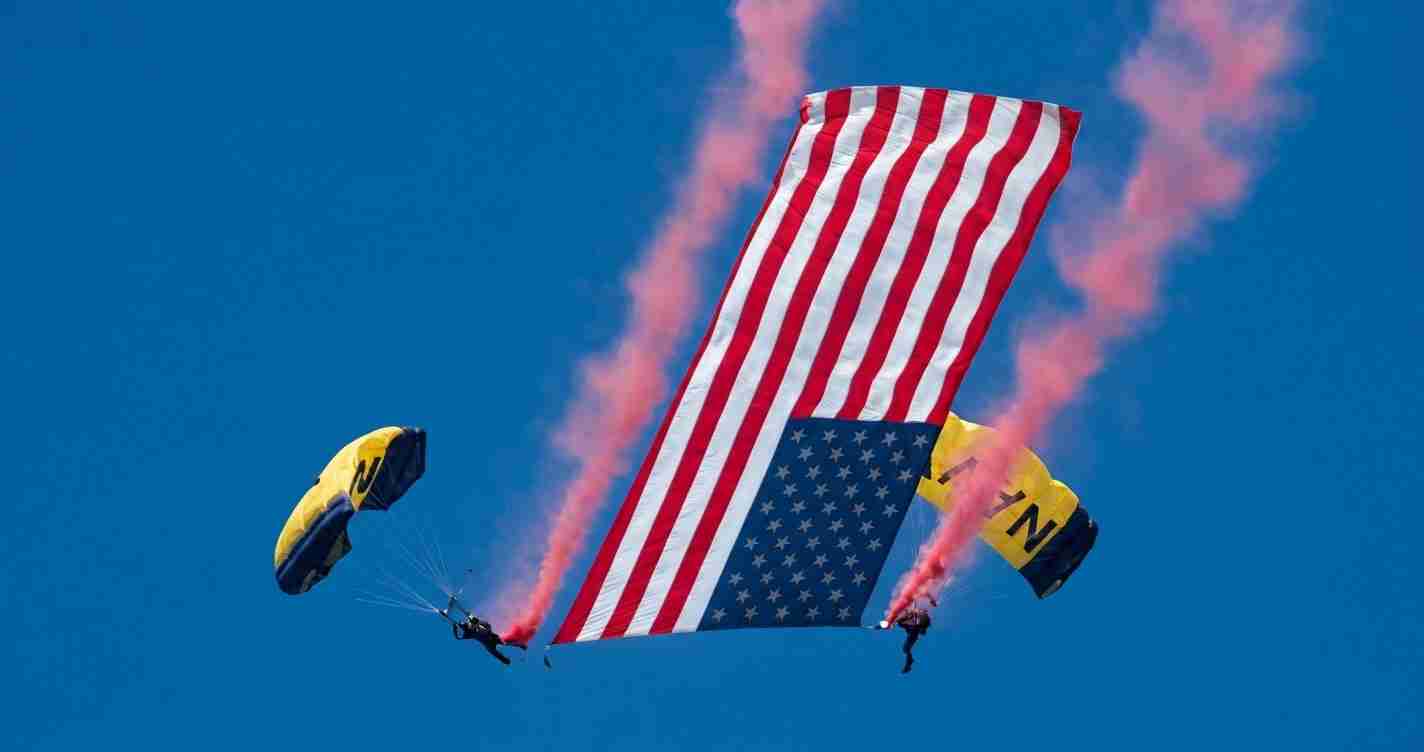
LANCASTER, Ohio, June 25 (DC Times Online) — For travelers who stop at state capitols, the Bob Heft story is a reminder that these buildings can be more than government offices. They can also be places where national history gets displayed, quite literally, overhead.
Heft, a Lancaster, Ohio, high school student, said he designed the 50-star U.S. flag as a class project when he was 17. In his StoryCorps oral history, Heft said he learned to make the flag in part by watching his mother sew, then turned the assignment into a new design for the nation’s flag.
How did a school project become the U.S. flag?
According to Heft’s StoryCorps interview, his history teacher, Stanley Pratt, gave him a B- for the project and told him, “If you don’t like the grade, get it accepted in Washington then come back and see me.” Heft said that challenge pushed him to keep going.
He later said he sent the flag to President Dwight D. Eisenhower in 1959, asking him to adopt it for the country’s new flag as the Union was set to grow. Historical accounts in Ohio Magazine and other retellings place the project in the period when Alaska and Hawaii were becoming states, which is why a 50-star flag was needed.
What happened after Heft mailed it?
Fox News reported that White House chief of staff Wilton B. Persons sent Heft a letter thanking him. In correspondence cited by Fox News and WFMD, Heft later said he had made and flown the first 50-star flag in the United States and that it was first flown on March 7, 1959.
The exact documentary record behind that first-flight claim is not shown in the snippets reviewed, but the story’s broader timeline is clear: the 50-star flag was created before official adoption, and the Eisenhower administration later chose it.
StoryCorps says Heft later received a call inviting him to Washington, D.C., for a ceremony tied to the flag’s adoption. Heft said his teacher then changed the grade to an A.
When did the 50-star flag become official?
The 50-star version became the official U.S. flag on July 4, 1960, after the Eisenhower administration adopted it. Heft’s original handmade flag was already part of the public story by then.
Why do state capitols matter in this story?
Fox News reported that Heft later got his flag flown over at least 40 state capitol buildings from 1960 to 1962. The list in that report included New York, California, Massachusetts, Michigan, Pennsylvania, Illinois, Mississippi, Alabama, Arkansas, Iowa, Utah, Nebraska and Alaska.
One of the clearest examples came in Texas. Fox News reported that the flag flew for five hours over the Texas State Capitol in Austin on Oct. 5, 1960. Gov. Price Daniel said it would have been displayed all day except for rain and high wind that began around noon.
Fox News also quoted Ohio Gov. Michael DiSalle as writing that he was “pleased to verify your story that yours was the first 50-star flag displayed in Ohio on Ohio property.”
What is certain, and what is still a claim?
The key facts supported by the sources are straightforward: Heft said he made the flag as a teenager, sent it to Washington, and later saw it become the official 50-star flag.
Some of the wider claims around the story are harder to pin down from the snippets alone. The sources do not independently document the full White House letter, the full Ohio governor’s letter, or archival proof of the first-flight claim. The number of capitols and embassies where the flag was displayed also varies across retellings.
Still, the core lesson is easy to follow for anyone visiting a state capitol or other civic landmark: the symbols on display there often have local stories behind them. In this case, one of the most familiar symbols in the country traces back to a teenager in Lancaster, Ohio, who said he made it for class and then kept working until Washington noticed.