
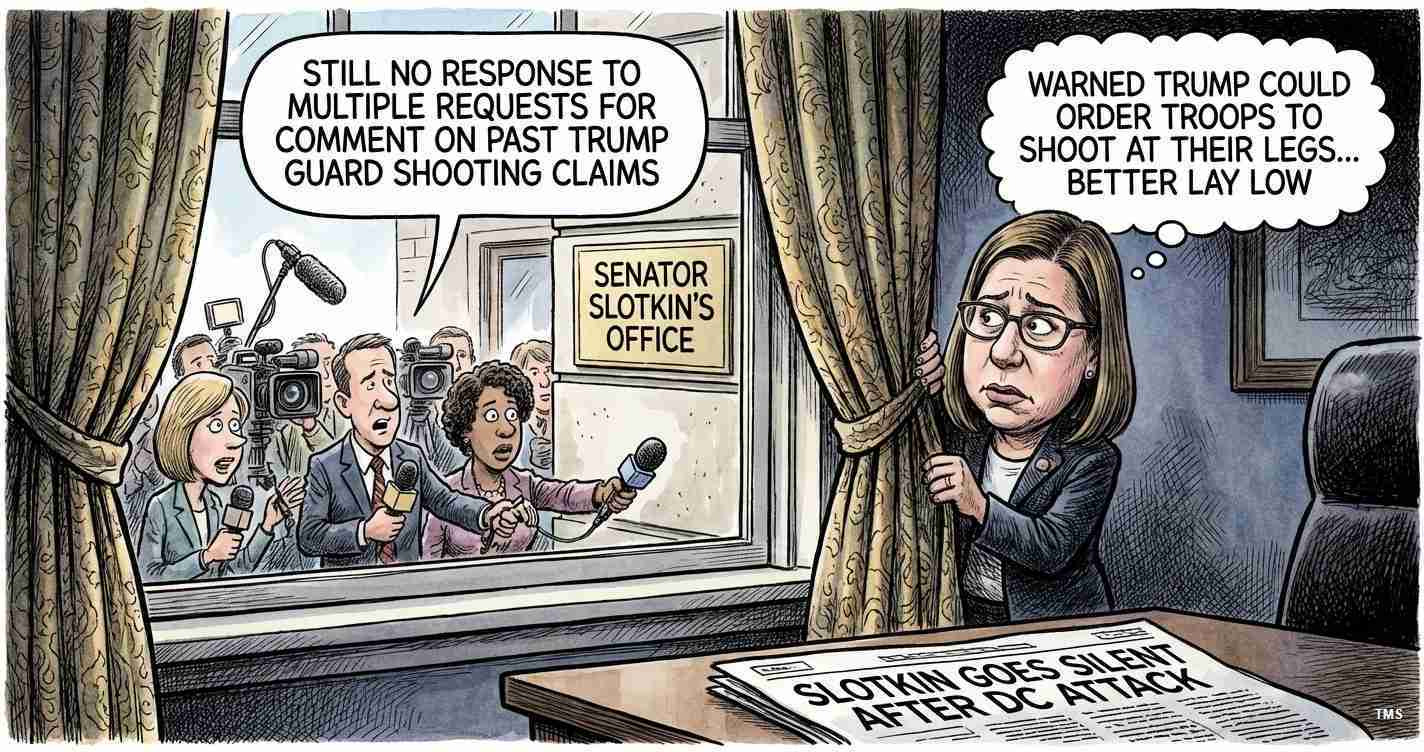
Senator Elissa Slotkin Goes Silent When Pressed on Past Trump Guard Shooting Claims After DC National Guard Shooting
Sen. Elissa Slotkin declined to comment Friday on her past claims that former President Donald Trump urged military force during protests, amid an FBI counterterrorism inquiry and heightened threats after a National Guard shooting in Washington, D.C.
- Senator declined to answer questions about quoting an alleged Trump remark urging soldiers to “shoot at their legs,” according to reporting from Fox News.
- DC shooting renewed scrutiny: Two National Guard members were shot, one fatally; the suspect, 29-year-old Afghan national Rahmanullah Lakanwal, faces first-degree murder charges and an FBI terrorism inquiry.
- FBI counterterrorism inquiry: The bureau has opened an inquiry into Slotkin and other lawmakers who released a video urging service members to refuse illegal orders, a move that coincided with increased threats against lawmakers.
Background: Slotkin’s warning about alleged Trump remarks
Sen. Elissa Slotkin has referenced testimony and accounts tied to former Defense Secretary Mark Esper’s memoir, saying records include an instance in which President Trump asked Esper to send the 82nd Airborne into Washington, D.C., and reportedly asked, “if necessary, can’t you just ‘shoot at their legs?’” President Trump has denied making the comments. Reporting on Slotkin’s earlier remarks and the Esper account is detailed here.
The congressional video and the “illegal orders” warning
In early November, Slotkin and six other Democrats — all veterans or former intelligence officers — released a video directed to active-duty military and intelligence personnel urging them to refuse unlawful commands. The video stated, “You can refuse illegal orders. You must refuse illegal orders.” The lawmakers used the alleged “shoot at their legs” remark as an example of the kind of order that would violate law and the Uniform Code of Military Justice.
The video featured Sen. Mark Kelly (D-Ariz.) and Representatives Jason Crow (D-Colo.), Chris Deluzio (D-Pa.), Chrissy Houlahan (D-Pa.) and Maggie Goodlander (D-N.H.), among others.
Trump’s response and the escalation
Former President Trump reacted on social media, calling the lawmakers’ actions “SEDITIOUS BEHAVIOR, punishable by DEATH.” The remark sparked swift backlash and concerns about incendiary rhetoric directed at members of Congress; the White House later said Trump did not plan to execute lawmakers.
FBI investigation and Slotkin’s response
Slotkin has said the FBI’s counterterrorism unit opened an inquiry that includes her and other members involved in the video. She framed the probe as evidence of why the video was necessary, saying, “If he wants to use the FBI and [FBI director] Kash Patel against us, that is his choice. But it just reaffirms why we made this video in the first place.” All six lawmakers who appeared in the video have military or intelligence backgrounds; Slotkin sits on the Senate Armed Services Committee. Reporting on the inquiry is available from Michigan Public.
Threats and personal impact on Slotkin
Slotkin reported a sharp rise in death threats and harassment after the video and then-President Trump’s posts. She said her family received a bomb threat at their farm and that harassment increased dramatically. Despite the threats, she has stated she remains committed to her work and resisting what she described as dangerous rhetoric and misuse of government power.
The D.C. shooting that renewed questions
On Wednesday, two National Guard members were shot in Washington, D.C.; one later died and another remained in critical condition. Authorities identified the suspect as 29-year-old Afghan national Rahmanullah Lakanwal, who has been charged with first-degree murder. The FBI said it is treating the attack as an act of terrorism while the motive remains under investigation. The incident revived questions about civilian leadership, military orders and public safety. Source reporting: Fox News.
Why the video was made, according to Slotkin
Lawmakers involved say the video was prompted by direct appeals from active-duty personnel and intelligence community members worried about being put in situations requiring illegal action. Slotkin described receiving numerous calls from service members asking how to respond if asked to carry out orders they believed unlawful — reflecting anxiety over legal gray areas and a need for clarity and oversight. More on Slotkin’s explanation is available at Michigan Public.
Implications for the United States
Rule of law and military command: The debate highlights tension between civilian political leaders and military obedience. Military personnel are trained to follow lawful orders; the video’s message underscores the need for safeguards to protect both service members and civilians.
Domestic security and morale: The DC National Guard shooting and the arrest of a suspect on terrorism charges highlight vulnerabilities in homeland security and risk undermining morale among troops assigned to domestic duties.
Political polarization and threats: The episode demonstrates how political rhetoric can have real safety consequences; Slotkin reported increased death threats and harassment after the video and presidential remarks.
Legal and investigative boundaries: The FBI inquiry raises constitutional questions about free speech, public safety and the role of federal law enforcement when lawmakers urge refusal of orders.
Public trust and oversight: Calls for clarity about what constitutes an illegal order and how civilian leaders should communicate with the military are likely to intensify, prompting pressure for improved training, oversight and transparency.
Reporting and sources
This article draws on reporting from Fox News and Michigan Public Radio. Key source material is available at:
“If he wants to use the FBI and [FBI director] Kash Patel against us, that is his choice. But it just reaffirms why we made this video in the first place.” — Sen. Elissa Slotkin


