Democrats Shift From Impeachment to Courts, Testing Limits of Presidential Power as Portland National Guard Deployment Sparks New Lawsuits
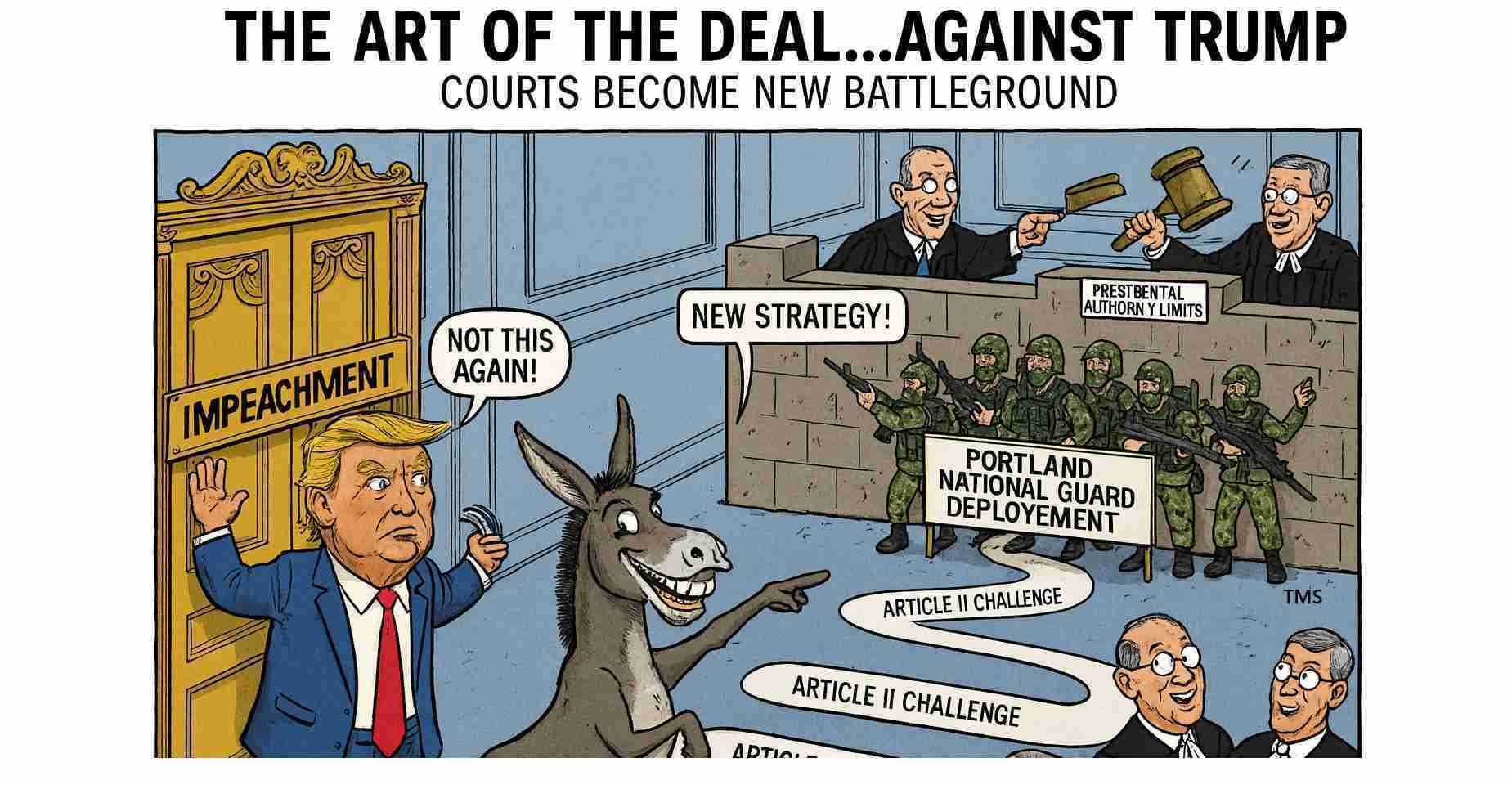
Democrats and advocacy groups increasingly challenge President Trump’s Article II actions through federal courts rather than impeachment, using litigation to test executive limits — courts have paused orders and now weigh National Guard deployment in Portland as a sweeping test.
Key takeaways
- Litigation over impeachment: Democrats and allied groups pursue Article II challenges in federal courts to block or limit White House actions, using the courts as a primary check rather than impeachment.
- Judicial intervention: Federal judges have issued temporary restraining orders and injunctions — see the The Regulatory Review analysis and a Callabor Law summary of a Maryland ruling.
- Volume of suits: More than 100 lawsuits and over 50 restraining orders target administration actions, tracked by the Just Security tracker.
Article II challenges instead of impeachment
Rather than launching time-consuming impeachment efforts, Democrats and advocacy groups are filing suits that focus on the Constitution’s Article II framework. Plaintiffs contend that certain presidential acts exceed the scope of authority Article II permits.
Why litigation? Lawsuits can halt actions quickly via restraining orders, build a factual and legal record for appeal, and avoid the political obstacles of impeachment in a narrowly divided Congress. Legal analysts describe this as a long-term effort to shape the law through court precedent rather than only through votes.
Judicial pushback on executive orders
Federal courts have actively reviewed and in many cases temporarily blocked enforcement of presidential executive orders. Judges have issued temporary restraining orders and preliminary injunctions, including a Maryland federal court decision that temporarily barred key parts of two orders targeting diversity, equity, and inclusion programs (see the Callabor Law summary).
Legal trackers show the breadth of litigation: >100 lawsuits and more than 50 restraining orders challenging administration actions, underscoring how judicial review has become a primary arena for disputes that once may have unfolded in Congress or the political sphere (see the Just Security tracker).
The Portland National Guard deployment as a test case
The deployment of federal forces, including the National Guard, to Portland has become a central battleground. Courts are deciding whether the President may order Guard or federal forces into domestic unrest without new congressional authorization or explicit state consent.
Litigants argue such deployments risk eroding limits on military involvement in civilian policing and can undermine state authority and civil liberties. The administration contends the President must “take care” that laws are faithfully executed and can act to secure federal interests and public safety.
“Sending troops into American cities for law enforcement purposes raises fundamental questions about federalism, civil liberties, and the constitutional separation of powers.”
Judges in Portland-related cases must weigh public safety, state and local rights, and constitutional constraints on domestic use of force. These rulings could redefine when and how a President may deploy federal forces to cities.
Supreme Court trends and presidential authority
Recent Supreme Court decisions in several areas have favored presidential control over elements of the executive branch, reinforcing presidential authority to direct or remove certain officials. Constitutional scholars warn such rulings may concentrate power in the presidency.
Nevertheless, lower courts continue to issue orders that limit executive actions on statutory or constitutional grounds. This split between the high and lower courts makes litigation attractive: even when the Supreme Court shows deference, lower-court rulings can delay or block policies for months or years.
Separation of powers and congressional oversight
Scholars warn of a weakening of traditional checks and balances. Critics say aggressive uses of Article II—such as relying on executive orders to bypass Congress or reorganizing agencies without statutory authority—amount to an “open warfare” on the separation of powers (analysis at the The Regulatory Review).
Congress retains tools—appropriations, investigations, and clarifying statutes—but partisan divides and narrow majorities often blunt robust oversight, pushing opponents toward courts as the realistic venue for challenge.
Litigation as political and policy strategy
Advantages: Litigation can create binding rulings, force public defenses by the administration, generate delays that blunt policy effects, and produce favorable precedent for future checks on executive power.
Limits: Courts may dismiss suits on standing grounds, judges may side with the administration, and the Supreme Court could ultimately uphold expansive presidential authority. Still, opponents treat courts as a primary tool rather than a last resort.
Voices from across the aisle
Moderate conservatives may support careful judicial review to protect property, speech, and due process. Advocates of limited government worry about unchecked executive action and may back legal challenges to test presidential reach.
Supporters of the President argue swift executive measures are sometimes necessary in crises and caution against judicial overreach that could second-guess policy judgments. The tension between quick executive action and deliberate judicial processes is central to the dispute.
Implications for the United States
Economic and administrative impact: Litigation that halts executive orders can disrupt agencies, contractors, and funding flows—e.g., a blocked order on federal diversity programs affects hiring, contracting, and training plans nationwide (see Callabor Law summary).
Political consequences: Shifting battles from impeachment to courthouses reduces immediate electoral stakes but produces long-term constitutional battles shaping presidential power.
Social effects: Court fights over federal deployments raise civil liberties and public safety concerns; communities may seek legal protections while others push for strong executive responses to unrest.
Cultural relevance: The debate taps into anxieties about federal power versus local control and forces the nation to re-evaluate how security and liberty balance in modern crises.
Practical effects: Federal rulings affect daily life—agency actions, job opportunities, services, and local policing strategies hinge on whether executive orders are allowed or blocked.
Sources and further reading
- The Regulatory Review, “Spotlight: The Uncertain Future of the Separation of Powers,” August 24, 2025
- Just Security, litigation tracker on legal challenges to the Trump administration
- Callabor Law summary of Maryland federal court blocking parts of Trump executive orders on diversity, equity, and inclusion