
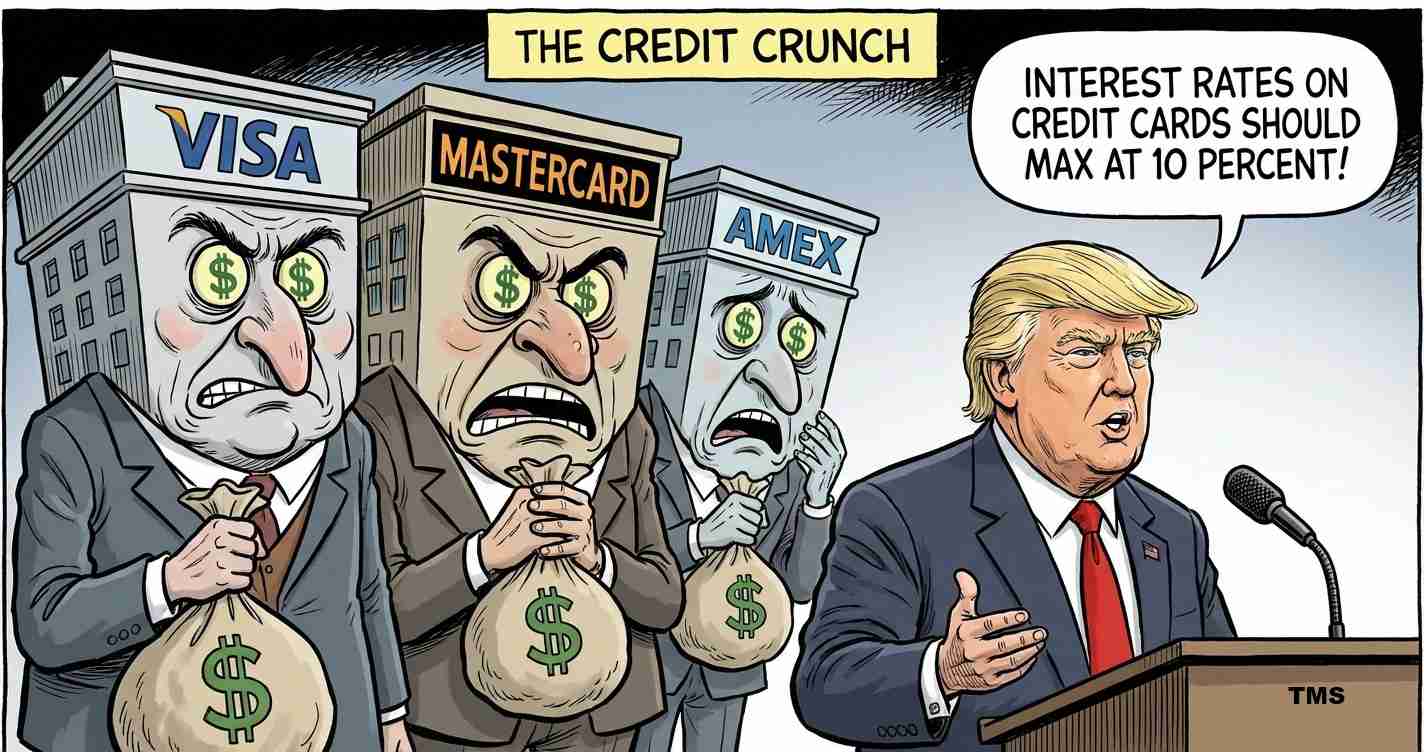
Trump calls for 1‑year, nationwide 10% cap on credit card interest rates, sets Jan. 20, 2026 target
Donald Trump called for a one-year, nationwide 10% cap on credit card interest rates beginning January 20, 2026, proposing immediate relief for consumers while raising legal, market and policy questions about feasibility and economic consequences.
- Presidential announcement: Trump announced a one-year, nationwide 10% cap on credit card APRs to begin Jan. 20, 2026, via a Truth Social post, framing it as protection against high issuer rates (Fox Business, CBS News, Business Insider).
- Big gap with current rates: The average U.S. credit‑card APR is above 20%, so a 10% cap would be a major reduction (CBS News).
- Legal and market concerns: Experts say a president cannot unilaterally impose such a cap; legislation or complex regulatory measures would likely be required (Business Insider).
What Trump said
“Please be informed that we will no longer let the American Public be ‘ripped off’ by Credit Card Companies that are charging Interest Rates of 20 to 30%, and even more, which festered unimpeded during the Sleepy Joe Biden Administration.”
“AFFORDABILITY! Effective January 20, 2026, I, as President of the United States, am calling for a one year cap on Credit Card Interest Rates of 10%.”
The post tied the start date to the one‑year anniversary of his return to the White House. Reporting on the announcement appeared in Fox Business, CBS News and Business Insider.
Context on current credit‑card interest rates
Federal Reserve data cited by reporters show the average U.S. credit‑card APR is now above 20%. That high average has increased public attention on card interest and the cost of carrying balances; supporters say issuers posted strong profits as households carried rising debt (CBS News).
How the proposal fits into Trump’s broader agenda
Part of a push to lower borrowing costs: Earlier the same week, Trump directed the federal government to buy $200 billion in mortgage‑backed securities via Fannie Mae and Freddie Mac to try to push down mortgage rates and monthly payments. He has also publicly pressed the Federal Reserve to cut policy rates more aggressively and suggested he may nominate a Fed chair who is more dovish on interest rates (CBS News; Business Insider).
Authority the president has — and doesn’t
Legal constraints: Legal experts emphasize that a president cannot, by executive order alone, impose a nationwide interest‑rate ceiling on credit cards. A statutory cap would require new legislation from Congress or a complex regulatory path involving banking regulators and likely major legal fights. Prior bills proposing a 10% cap were introduced but never became law (Business Insider).
Administration response: CBS News reported that neither the White House nor major card issuers immediately responded to requests for details on how a cap would be imposed or whether the administration planned to pursue legislation or use existing regulatory tools (CBS News).
Bipartisan history of similar 10%‑cap proposals
Interest in a 10% cap has surfaced across parties. In the Senate, Republican Josh Hawley and independent Bernie Sanders introduced a bill to cap APRs at 10%. In the House, Democrat Alexandria Ocasio‑Cortez and Republican Anna Paulina Luna sponsored a similar measure. Those efforts reflect a populist push but stalled before becoming law (CBS News; Business Insider).
Supporters’ arguments for a 10% cap
- Immediate relief: A 10% cap would lower monthly interest costs for millions who carry balances.
- Record or near‑record outstanding balances mean high finance charges squeeze household budgets for essentials like housing, food and transportation (CBS News).
- Proponents argue large issuers reported strong profits and could temporarily absorb lower rates without collapsing (CBS News).
Opponents and industry reaction
Industry concerns: Banks, card issuers and trade groups warn a hard 10% ceiling would shrink access to credit and could harm consumers the policy intends to help. A coalition including the American Bankers Association and the Bank Policy Institute told CBS News the cap “would reduce credit availability and be devastating for millions of American families and small business owners who rely on and value their credit cards.” The BPI estimated more than 14 million households that rarely pay balances in full could lose access or face cuts to credit limits under a 10% cap (CBS News).
Risk of credit tightening: Industry groups say issuers set rates to cover risk and costs, and a one‑size‑fits‑all cap could force lenders to serve only lower‑risk borrowers, pushing higher‑risk consumers toward less‑regulated, higher‑cost lenders (CBS News).
Political and regulatory backdrop
Reporting noted the administration cut funding for the Consumer Financial Protection Bureau in early months of the second term — the agency that enforces consumer finance rules, including on credit cards. Critics say the administration has both weakened an enforcement agency and now pledged a strict cap, complicating the policy picture and credibility (Business Insider).
Observers also highlighted the political tone: Trump’s post echoed a populist, anti‑corporate message aimed at big banks and card issuers. The timing came hours after Bernie Sanders publicly criticized Trump for not following through on a prior campaign promise to cap rates, suggesting the post may have been a rapid response to political pressure (Business Insider).
Key open questions
- Implementation: Will the administration pursue new legislation, use banking regulators, or rely on persuasion and voluntary issuer moves? Reporting does not specify the path forward (CBS News; Business Insider).
- Scope: Would a 10% APR apply to all cards, all balances (new and existing), cash advances, store cards and credit unions? Reports do not specify.
- Legal risks: A nationwide cap would likely draw lawsuits and complex questions tied to state usury laws and national bank interest exportation; legal experts expect litigation if a cap moved forward (Business Insider).
Implications for the United States
Economic impact
- Short‑term relief: If enforced, many consumers carrying balances would see monthly interest costs fall sharply, freeing income for other expenses and potentially boosting near‑term household budgets (CBS News).
- Credit supply risks: Lenders say a hard cap could force cuts to credit lines or stop lending to higher‑risk borrowers, reducing mainstream credit access and shifting demand to less‑regulated lenders (CBS News).
- Market uncertainty: Sudden regulatory change or prolonged fights could roil markets tied to consumer credit as banks, issuers and investors recalibrate risk models (Business Insider).
Political consequences
- Populist appeal: The proposal appeals to voters frustrated with living costs and corporate profits and could strengthen Trump’s standing among those who see banks as responsible for high borrowing costs (Business Insider; CBS News).
- Congressional test: Passing a 10% cap would require bipartisan action or major congressional shifts and could become a flashpoint between consumer-protection advocates and market-leaning lawmakers (Business Insider).
Social effects
- Relief for indebted households: Lower rates could reduce short‑term financial stress and lower delinquency rates for some borrowers (CBS News).
- Risk of reduced access: If issuers limit credit or close accounts to manage risk under a cap, vulnerable households could lose emergency funding or paid perks tied to cards (CBS News).
Practical applications for everyday Americans
Borrowers: Those who carry balances should watch announcements closely; a real cap could lower monthly payments, but any policy that reduces access could require planning for changes in credit availability (CBS News).
Small businesses: Businesses that rely on business credit cards could face term changes or limits if lenders reassess risk under a strict APR cap (CBS News).
Reporting notes and sources
This article draws on coverage and expert reaction from Fox Business, CBS News and Business Insider, including reporting on Trump’s Truth Social post, average APR data, industry responses, and legal and political context.



