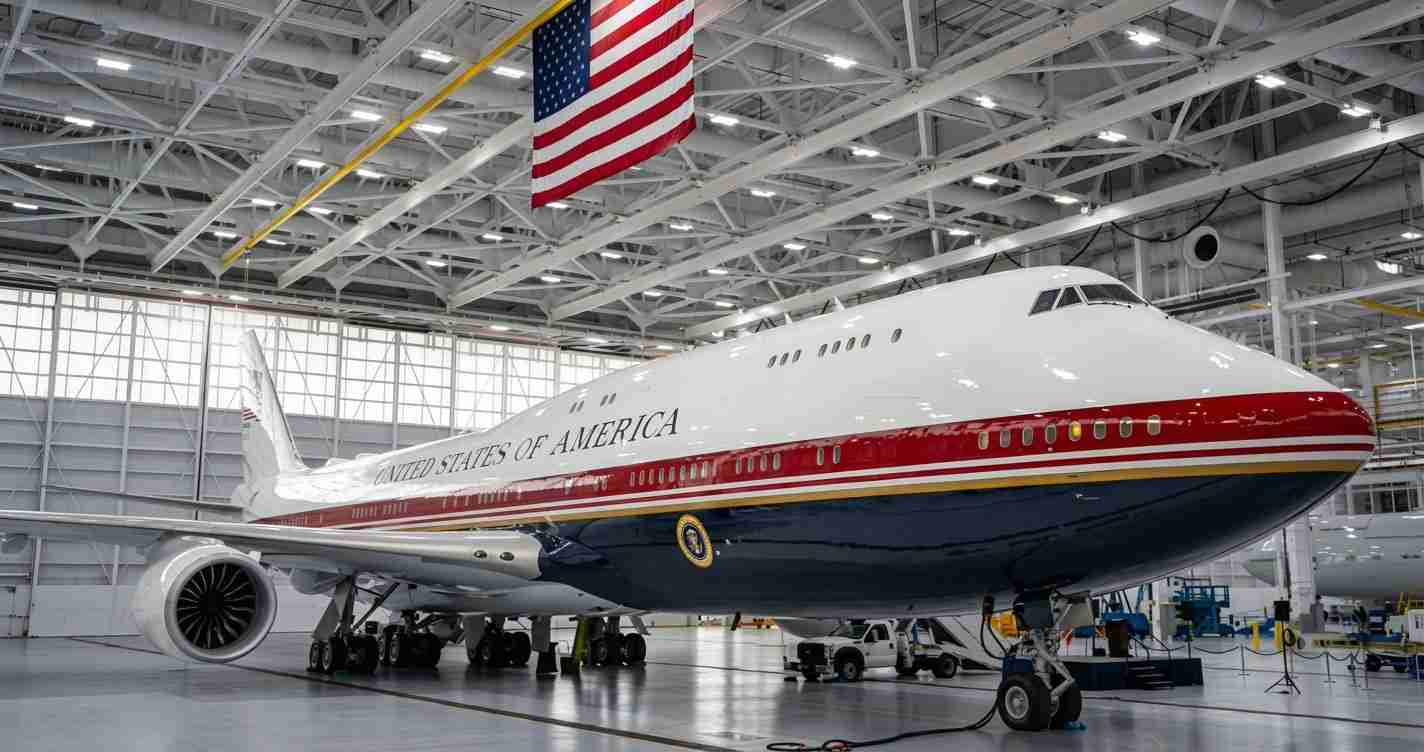
WASHINGTON, June 19 (DC Times Online) — The Air Force’s presidential transport fleet is moving toward a new interim plane after President Donald Trump unveiled a refurbished Boeing 747-8i at Joint Base Andrews in Washington, D.C., a stopgap meant to keep Air Force One service running while Boeing finishes replacement jets.
The aircraft, donated by the government of Qatar and modified for presidential use, is not yet in operational service. The Air Force said it will next begin commissioning flights, a final phase of testing before the jet can enter service with the presidential airlift fleet.
Trump unveiled the aircraft on June 19 and described it as a flying White House. The appearance capped months of work on the widebody jet, which the Air Force said had already completed modification and flight testing.
The airplane is intended to serve as a bridge aircraft until Boeing completes two VC-25B replacement planes for presidential use. CNBC reported that the White House expects the Boeing aircraft to arrive in 2028, although the exact delivery date has not been formally documented in the materials reviewed for this report.
The bridge role matters because the presidential airlift mission depends on a long-range aircraft that can be kept ready for government travel at short notice. A refurbished 747-8i gives the Air Force another option while the larger replacement program remains in development.
The plane also represents a visible change in the look of presidential air travel. The Air Force said the aircraft is being painted in a red, white and blue livery that replaces the traditional light blue-and-white scheme associated with the Kennedy era.
According to the Air Force, the updated exterior will become the standard across the presidential and executive airlift fleet, including the VC-25B aircraft under development. That means the color change is not limited to this one aircraft; it is part of a broader visual update for the fleet that carries the president and other senior officials.
The move from test aircraft to commissioning flights marks an important operational step. Commissioning flights are the final check before an aircraft can be accepted for regular use, and the Air Force said those flights will come before the jet enters operational service.
By May, the Air Force had already said the former Qatari jet had finished modification and flight testing and was being repainted. NPR and Bloomberg reported at the time that the aircraft was being readied for summer delivery, setting up the June unveiling at Joint Base Andrews.
The aircraft’s donor status also underscores how unusual the temporary solution is. The plane was not built as a presidential jet from the start; it was acquired from Qatar and then modified for use in the U.S. presidential transport system.
Trump’s remarks at the unveiling centered on the aircraft’s new role and appearance. He said the jet had been transformed into a presidential aircraft with a higher level of luxury than previous planes, while the Air Force kept its focus on the technical step still ahead: commissioning flights before service.
The administration’s use of the aircraft as an interim Air Force One gives the presidential airlift fleet a bridge while Boeing continues work on the VC-25B replacements. Those aircraft are intended to become the next permanent presidential transports, but they remain under development.
The project also illustrates the gap between a planned replacement and an aircraft that can actually be used. The bridge jet has been modified, tested and repainted, but it still must clear the Air Force’s final commissioning stage before it can carry out operational missions.
Air Force announcements in May and June showed the aircraft moving through those stages in sequence: modification, flight testing, repainting, unveiling and now commissioning flights. The next step will determine when the jet can formally join the presidential airlift fleet.
For now, the refurbished 747-8i stands as the temporary answer to a long-delayed replacement program, with a donated airframe, federal modification work and a planned commissioning phase all aimed at keeping presidential air travel on schedule until Boeing’s new aircraft are ready.