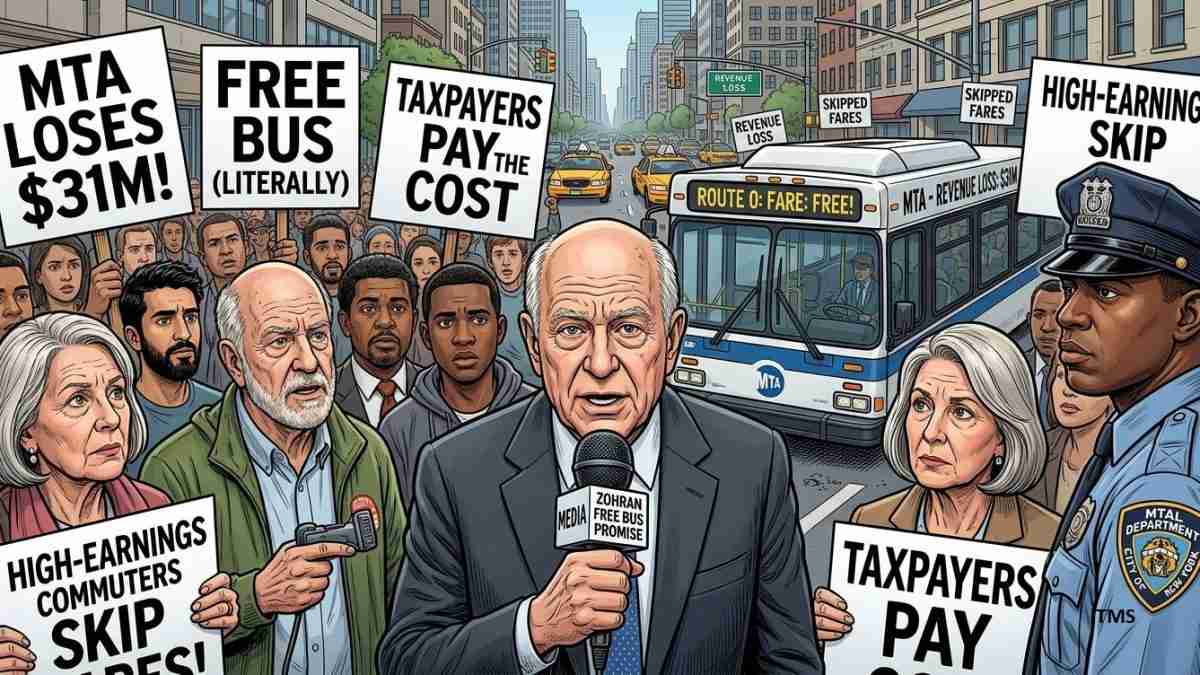
NEW YORK, Aug. 15 (Our New York News) — New York City bus riders are increasingly treating Mayor Zohran Mamdani’s campaign promise of fare-free buses as if it is already policy, MTA records show. The result: paid bus ridership fell 7.7% year over year in June 2026, while bus fare revenue in the first six months of the year was reported to be $31 million below the same period in 2025.
The figures have sharpened a debate over who would pay for a free bus system — and whether public discussion of the proposal is already affecting the transit agency’s finances.
What happened to bus fare collections?
MTA records show that paid bus ridership in June was 7.7% lower than in June 2025. The comparison month had 1.32 million paid bus riders.
Separate MTA revenue data showed that bus fare collections during the first six months of 2026 were $31 million lower than during the first half of 2025. MTA budget documents also showed collections $35.7 million below the agency’s budget estimate for that six-month period.
Those figures measure different gaps: one compares 2026 revenue with the previous year, while the other compares revenue with the MTA’s budget forecast.
MTA data cited in public reports also put fare evasion — riding without paying the required fare — at 44% in the third quarter of 2025. Through the second quarter of 2026, the rate was reported at 48.5%, or nearly half of bus riders.
The available figures do not show how many dollars were lost specifically to fare evasion, or how much of the change came from other factors such as ridership patterns, enforcement or payment problems.
Why is Mamdani’s promise part of the dispute?
Mamdani campaigned on making New York City buses free. On July 8, 2026, he said he would continue working toward that goal.
Janno Lieber, the MTA’s chair and chief executive, said public discussion of free buses was contributing to the increase in fare evasion. “With malice towards none I say all of the talk of free buses, it has an impact,” Lieber said after an MTA board meeting, according to reports of his remarks.
Lieber also argued that riders who avoid the fare do not make the cost disappear. “You’re just passing along the cost to another taxpayer. Somebody’s going to have to pay for that ride,” he said.
Neal Zuckerman, chair of the MTA Finance Committee, made a similar point, saying that “a perception that something is free is being treated as free.”
Mamdani’s administration pushed back on Lieber’s criticism. A mayoral spokesperson said, “This is exactly why Mayor Mamdani is pushing for a fare free system.”
The reported data show that fare evasion rose during the period when the free-bus proposal was being discussed. They do not establish that the mayor’s statements caused the increase, and the MTA has not provided a causal analysis in the information available here.
Are New York City buses free now?
No. The city’s bus fare remains in place.
Mamdani is the city’s mayor, but the MTA is overseen through New York State. That means the mayor cannot unilaterally make the entire city bus system free. The 2026 state budget did not include a free-local-bus program for New York City.
The available records also do not show that a systemwide free-bus program has been formally approved, funded or given a start date.
That distinction matters for riders and for the MTA’s budget. A campaign promise is not the same as an operating policy. Until a program is approved and funded, riders are still expected to pay the existing fare.
How much would a free-bus system cost?
The estimates vary by source. The Mamdani administration estimated the annual cost at $700 million. The MTA put the figure at about $1 billion, while the Independent Budget Office was cited as estimating roughly $1.1 billion a year.
The estimates reflect different assumptions about lost fare revenue, operating costs and how a program would be designed. They also show the central issue in the debate: eliminating fares would remove money the MTA currently uses while requiring another source of funding to replace it.
MTA documents said the agency had expected changes in fare enforcement to reduce evasion by about 2% in 2026. Instead, the reported evasion rate through June was higher than the rate recorded in the third quarter of 2025.
What happens next?
For now, the free-bus proposal remains a policy goal rather than an implemented MTA program. The transit agency continues to collect fares, and its budget is absorbing lower-than-expected bus fare revenue.
The next steps would require decisions by the MTA and New York State, along with a funding plan. Until those steps occur, the financial impact is being measured through missed fare collections, while the debate continues over whether free buses would improve access enough to justify the cost to taxpayers.