
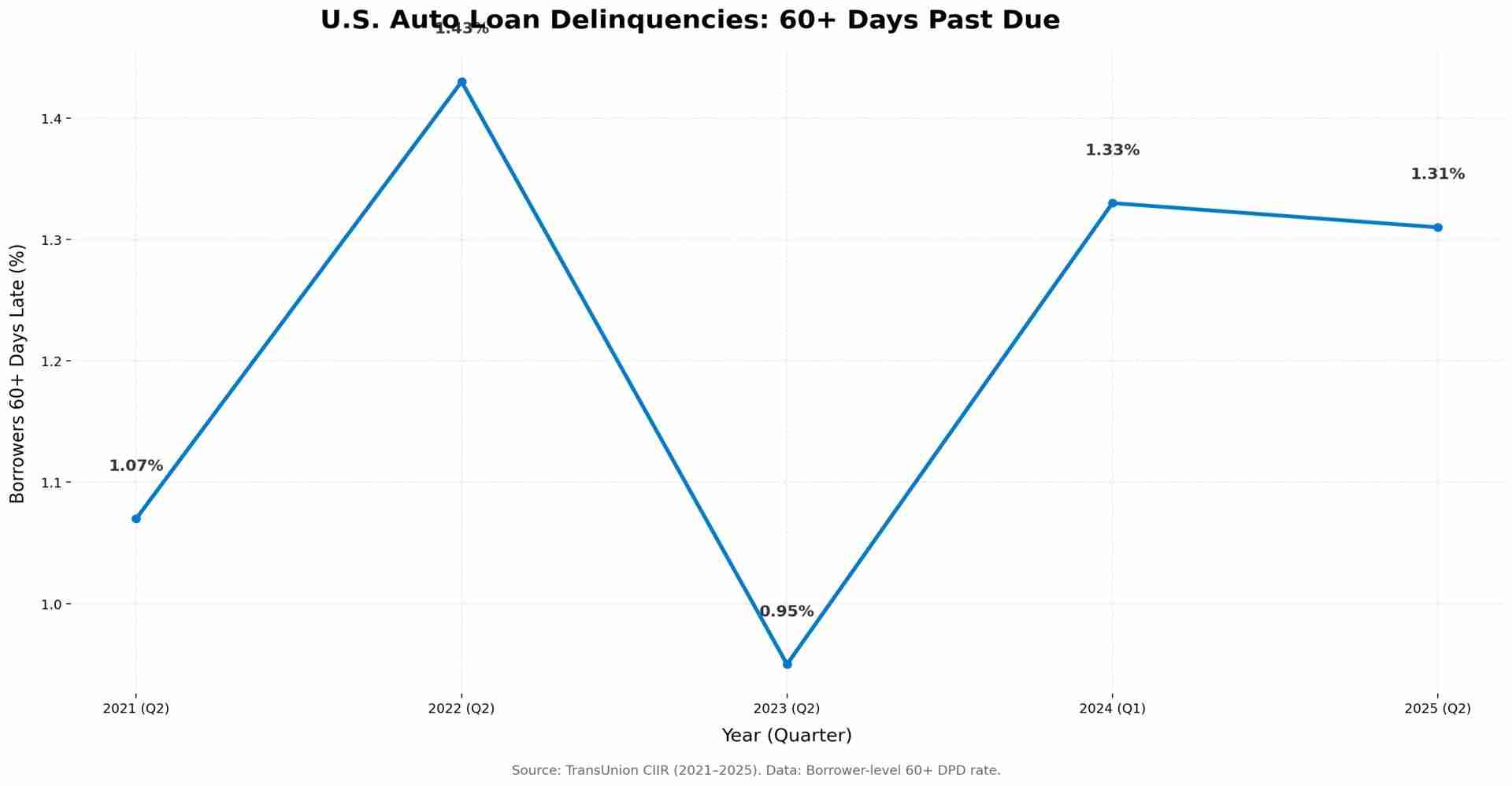
More Americans Fall Behind on Auto Loan Payments as Delinquencies Near Historic Highs
More Americans are falling behind on auto loan payments, pushing 90‑day delinquency rates to 5.0% in Q2 2025 — near the 2010 peak — amid rising balances, longer terms and renewed student‑loan reporting, and worsening consumer credit scores nationwide.
Key takeaways
- 90‑day delinquencies: 5.0% of outstanding auto debt was at least 90 days past due in Q2 2025, up 12.6% year over year — per LendingTree’s auto statistics.
- Short‑term delinquencies: 8.0% of auto loans were 30 days past due in Q2 2025, unchanged from Q2 2024, according to LendingTree.
- Rising balances: Total outstanding auto debt reached $1.66 trillion in Q2 2025 and average balances rose by more than $400 year over year — reported by VantageScore’s CreditGauge and the New York Fed.
- Longer loan terms: Average terms lengthened to 68.9 months for new cars and 67.2 months for used cars, increasing payment vulnerability (LendingTree).
Auto loan delinquencies climb toward past peaks
Auto loan delinquencies have increased across the board. The share of outstanding auto debt at least 90 days late rose to 5.0% in Q2 2025, a 12.6% jump from a year earlier and only slightly below the 5.3% high reached in Q4 2010 during the aftermath of the financial crisis — according to LendingTree’s auto statistics.
Shorter-term delinquencies also remain elevated: 8.0% of loans were 30 days past due in Q2 2025, the same level as Q2 2024 (LendingTree).
Different measures show similar stress. VantageScore’s CreditGauge reports a noticeable rise in late-stage delinquencies (more than 90 days past due), which climbed by 25 basis points month-over-month to 0.45% as of February 2025. Part of that increase is tied to the resumption of student loan credit reporting, which altered how some borrowers’ balances and repayment histories appear on credit files.
Rising auto loan balances and longer terms raise monthly strain
A clear driver of rising delinquencies is growth in loan sizes. Average auto loan balances increased, and total outstanding auto debt reached $1.66 trillion in Q2 2025. On a per-borrower basis, balances were up by more than $400 from a year earlier, adding to monthly payment pressures — data highlighted by VantageScore and the New York Federal Reserve.
At the same time, Americans are taking longer to pay off vehicles: average loan terms stretched to 68.9 months for new cars and 67.2 months for used cars. While longer terms can lower monthly payments initially, they increase total interest costs and leave borrowers exposed if rates rise or incomes fall.
Together, higher balances and lengthening terms create a fragile mix. A small rate increase, an unexpected repair bill, or reduced work hours can push a borrower into delinquency.
Late-stage delinquencies, student loan reporting and the risk of defaults
Late-stage delinquencies (more than 90 days past due) are the most concerning because they are likeliest to end in repossession or charge-offs. VantageScore flagged a sharp rise in deeply overdue accounts early in 2025 and linked part of the jump to changes in student loan reporting. When student loan balances and repayment status reappeared on credit reports, some borrowers’ overall credit pictures worsened — pushing previously near‑current auto loans into late-stage delinquency.
“It is unusual to see a decline of this size,” said Susan Fahy, Chief Digital Officer at VantageScore, describing the drop in average scores tied to higher car loan balances and student debt repayment.
The rise in late-stage delinquencies raises the specter of more car payment defaults, which can erode household mobility, complicate employment, and increase losses for lenders.
Who is lending and who is most exposed
Banks hold the largest share of new auto financing at 29.9%, followed by credit unions at 23.9% and captive finance arms of automakers at 18.6% (LendingTree).
Borrowers with prime or super-prime scores (661+) still make up nearly 70% of retail vehicle financing, while those with scores ≤600 account for about 15.1% of financing. A risky segment is the buy‑here, pay‑here market, which can represent up to 15.9% of used-car financing and often serves lower-credit borrowers with high rates, extra fees, and rapid repossession mechanisms (LendingTree).
Credit scores slip as pressure builds
The strain from rising auto loan balances and the return of student loan data is showing up in credit scores: the average VantageScore fell to 701 in February 2025, down from 702 after an 11‑month stretch at that level. VantageScore tied the decline to the twin pressures of higher car loan balances and renewed student debt reporting (VantageScore).
Lower scores make credit more expensive and harder to obtain, pushing some borrowers toward higher‑cost lenders and increasing the risk of future missed payments.
What this means for borrowers, lenders and the market
For borrowers: elevated delinquencies can mean lost transportation, damaged credit, and limited access to cheaper financing. Those consequences can ripple through employment and daily life.
For lenders: more serious delinquencies mean higher losses and likely tighter underwriting, which can translate to higher rates and reduced lending availability.
For the economy: rising delinquencies and growing outstanding auto debt could slow consumer spending — cars are central to work and mobility — and pressure automakers, dealers and related industries (LendingTree; VantageScore).
Implications for United States
Economic impact: Higher auto loan delinquencies and rising outstanding debt may reduce consumer spending and lead lenders to tighten credit, which would pressure automakers and dealers (LendingTree; VantageScore).
Political consequences: Lawmakers may face pressure to act on consumer protections, disclosure of fees, and repossession rules as defaults and high-cost lending attract attention.
Social effects: Losing a car can mean losing a job or access to health care in many areas; communities with limited transit are especially vulnerable, potentially widening inequality.
Cultural relevance: rising delinquencies may shift attitudes about car ownership — some consumers may delay purchases, choose older used cars, or accept longer, costlier loans.
Practical applications: Borrowers should review budgets, compare refinancing, and speak early with lenders if struggling. Consumers with credit challenges should be wary of buy‑here, pay‑here offers and understand repossession terms. Policymakers and consumer groups may expand outreach on loan modification and counseling (LendingTree; VantageScore).
Reporting and data sources
This article draws on auto debt and delinquency data from LendingTree’s auto statistics, VantageScore’s CreditGauge, and broader credit research from the New York Federal Reserve.



