
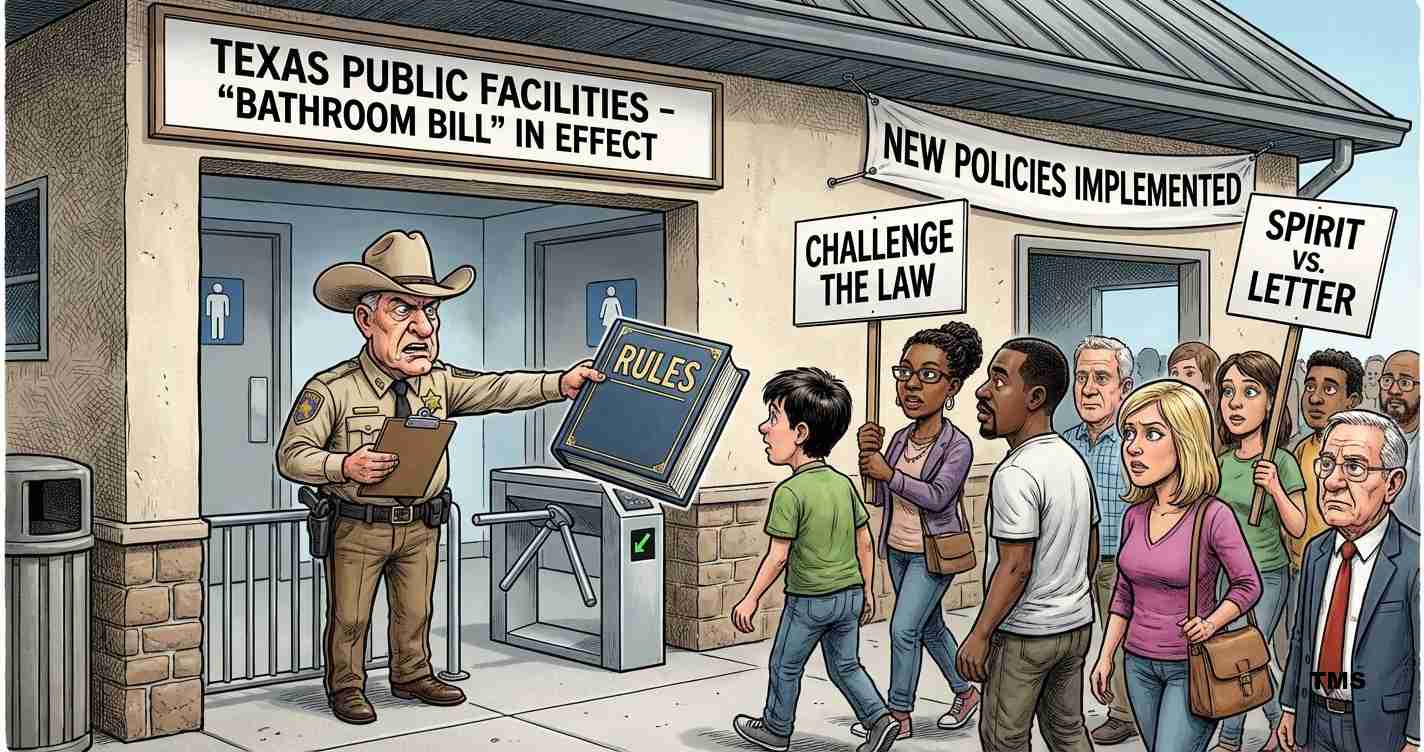
Enforcement of Texas Senate Bill 8 Sparks Early Challenges as Public Facilities Rush to Rewrite Restroom Policies
Texas’s Senate Bill 8, the “Texas Women’s Privacy Act,” restricts access to multi‑user restrooms in government buildings by a person’s sex assigned at birth, triggering protests, enforcement questions, heavy penalties and swift policy changes across agencies, schools and cities.
Key takeaways
- SB 8 limits use of multi‑user restrooms, locker rooms and similar government‑controlled facilities by sex assigned at birth; see The Texas Tribune and Equality Texas guidance.
- Enforcement targets institutions, not individual users, but creates steep civil fines and private‑suit mechanisms noted by Texas Policy Research and The Texas Tribune.
- Within days of taking effect, activists tested enforcement at the Capitol and local governments rushed to revise policies to limit exposure.
What SB 8 does — and does not
SB 8 directs state agencies, state‑owned buildings, cities, counties, public schools and public universities to restrict access to multi‑user restrooms and similar spaces based on the sex a person was assigned at birth. The statutory text and official summaries indicate the rule applies to government‑controlled facilities and institutions. For reporting and guidance see The Texas Tribune and Equality Texas.
The law does not create a new criminal offense for individuals who use a restroom that does not match their birth sex. There is no arrest or jail penalty in SB 8 for individual restroom users; enforcement mechanisms are aimed at institutions that “fail to comply.” See analysis at The Texas Tribune.
How enforcement works on paper
SB 8 places the enforcement burden on institutions and combines public and private tools. Complaints may be filed first with the controlling institution and also with the Texas Attorney General’s Office (AG). The AG may investigate and bring civil actions; private citizens can also sue institutions under the statute — a structure comparable to earlier private enforcement models in Texas, discussed by Texas Policy Research and The Texas Tribune.
The bill imposes steep fines: $25,000 for a first violation and $125,000 per day for each subsequent violation. Those escalators—added via an amendment by Rep. Steve Toth—make SB 8 among the most financially punitive restroom laws in the country.
The statute also narrows courts’ power to halt enforcement, centralizes appeals in the Fifteenth Court of Appeals, and includes fee‑shifting provisions that could require unsuccessful challengers to pay the state’s legal costs. Critics argue these features raise the cost and risk of constitutional challenges (see Texas Policy Research).
Early enforcement challenges and the Capitol protest test
In the first week after SB 8 took effect, opponents highlighted the absence of practical guidance for enforcement without invasive or discriminatory practices. Key operational questions emerged: Who checks a person’s sex assigned at birth? What documentation, if any, may be requested? How can staff avoid profiling or harassment when encountering gender‑nonconforming people? (Reporting from The Texas Tribune and resources from Equality Texas.)
“No consistent enforceable standards,” said protester Matilda Miller after a Dec. 6 demonstration at the Texas Capitol, where some trans women were briefly detained or issued warnings while others used facilities without intervention.
Organizers, including Ry Vazquez of the 6W Project, said participants were briefly detained by the Texas Department of Public Safety and given trespass warnings—events critics say underscore the gap between the statute’s language and on‑the‑ground enforcement (see The Texas Tribune).
Public facilities scramble to respond
Because SB 8 targets institutions, many cities, counties, school districts and agencies moved quickly to revise policies to limit legal exposure. Responses have varied across categories:
- State agencies and public buildings: Conservative group Texas Values urged agencies to adopt rules assigning multi‑user facilities by biological sex. Agencies are reviewing signage, internal rules and complaint tracking to document compliance (reporting at The Texas Tribune).
- Cities and counties: The Austin City Council passed a resolution asking the city manager to identify ways to replace multi‑stall restrooms covered by SB 8 with single‑user, all‑gender restrooms in city buildings—framed as a compliance strategy while attempting to remain welcoming. Video and meeting coverage is available as public‑meeting footage and discussion.
- Public schools: SB 8 explicitly covers K–12 districts and public universities. The Texas Education Agency had not issued statewide implementation guidance in the first week, leaving districts to set their own rules. Districts with existing biological sex‑based policies, such as Carroll ISD, may rely on current rules—creating a patchwork of approaches and uneven enforcement risk (see The Texas Tribune and Equality Texas).
Conservative advocates, including Texas Values president Jonathan Saenz and lobbyist Mary Elizabeth Castle, praised compliance efforts and argued that allowing access by individuals whose current gender differs from birth sex would violate women’s privacy (coverage at The Texas Tribune).
Legal, safety and civil‑rights critiques
Civil‑rights groups, including Equality Texas, warn SB 8 could chill behavior beyond government buildings: private businesses and nonprofits may adopt similar restrictions out of caution. Advocates note that high fines, private lawsuits, anti‑injunction rules and fee‑shifting are likely intended to deter legal challenges (Texas Policy Research).
Service providers such as shelters and family‑violence advocates caution that strict sex‑at‑birth rules could force difficult choices for people fleeing abuse—potentially separating families or excluding older teenage boys from women’s shelter spaces.
Supporters’ framing
Supporters of SB 8 argue the law protects women’s privacy and preserves sex‑segregated spaces in public settings. They emphasize the statute targets institutions rather than individuals and contend steep penalties are necessary to ensure compliance by local governments and school districts (Texas Policy Research, The Texas Tribune).
Open questions moving forward
Key unknowns in the coming weeks include:
- Will state agencies or the Texas Attorney General issue formal guidance on verification and enforcement? (The Texas Tribune).
- How many complaints and private lawsuits will be filed, and which institutions will be targeted? (Texas Policy Research).
- Can constitutional or federal legal challenges overcome SB 8’s anti‑injunction and fee‑shifting provisions? (Texas Policy Research, Equality Texas).
- Will more cities convert facilities to single‑user restrooms to reduce conflict? (The Texas Tribune).
Implications for the United States of America
Legal ripple effects: SB 8’s mix of private suits, high fines and limits on injunctions could be adopted by other states seeking to enforce sex‑based rules without criminal penalties, raising strategic questions for national civil‑rights litigation and federal courts (Texas Policy Research).
School policy pressures nationwide: Varied district implementations in Texas may influence other states’ education agencies and school boards and shape debates on student safety and privacy (The Texas Tribune, Equality Texas).
Local governments and costs: Municipalities face choices—reconfigure restrooms to single‑user models, defend policies in court, or risk fines—decisions that could strain budgets and reallocate priorities (The Texas Tribune, Texas Policy Research).
Social and safety trade‑offs: Advocates warn strict enforcement could increase confrontations, profiling or cause private actors to adopt restrictive rules, altering community approaches to inclusion, privacy and public safety (The Texas Tribune, Equality Texas).
Sources and further reading
For ongoing reporting and document links see: The Texas Tribune’s coverage; guidance from Equality Texas resources; and policy analysis at Texas Policy Research. Additional public‑meeting footage and discussion on local policy responses is available as video.
Note: All original facts, statements and source URLs from the initial report have been preserved and linked above for verification.


