
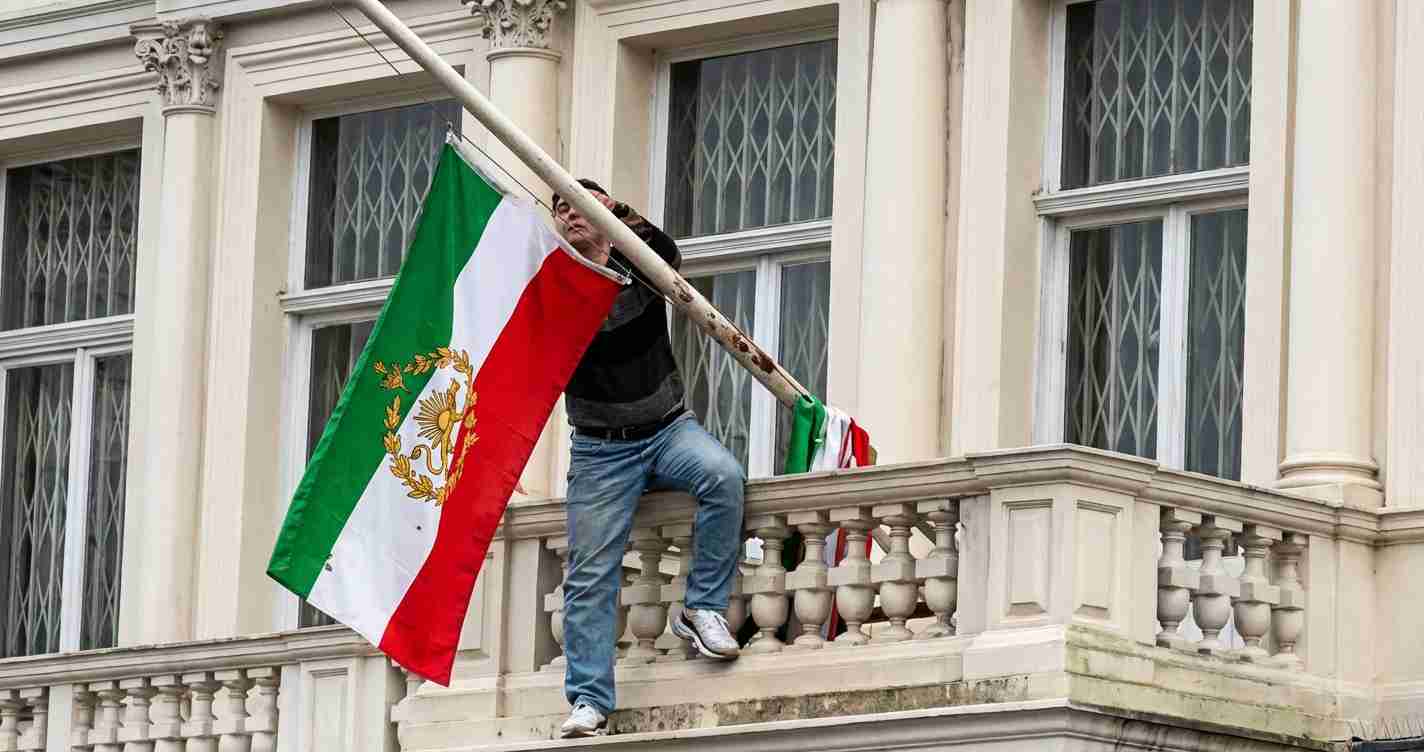
Protester scales Iranian embassy in London, rips down regime flag and raises Shah-era banner as diaspora rallies sweep Europe
A protester climbed the Iranian Embassy in Kensington on Jan 10, 2026, tore down the Islamic Republic flag and briefly hoisted the pre‑1979 lion-and-sun Shah-era banner amid cheers during a large diaspora rally in London.
- Flag replacement visible to hundreds: Video shows the demonstrator removing the Islamic Republic flag and unfurling the Shah-era lion-and-sun banner — coverage amplified by Times of Israel and The Telegraph.
- Police action: Metropolitan Police made two arrests and sought at least one other person for trespass after the incident; officers were deployed to protect the embassy and prevent disorder (see reporting by Times of Israel).
- Part of wider diaspora mobilization: The London action occurred amid coordinated demonstrations across European capitals and outside the White House, linked to calls by exiled figure Reza Pahlavi (coverage by Iran International).
- Casualties and detentions inside Iran: Rights groups and local reporting — including HRANA summaries cited by media — reported at least 72 killed and more than 2,300 detained during nationwide protests.
The embassy incident: what happened and what we know
Publicly shared video shows a man scaling the front façade of the Iranian Embassy in Kensington, reaching the balcony where national emblems fly. He removed the Islamic Republic flag and unfurled the tricolour bearing the lion-and-sun emblem that served as Iran’s national standard before the 1979 Islamic Revolution.
The action lasted only minutes but drew loud applause from the crowd gathered below and immediate attention from international media and political figures. Reporting and footage are available from Times of Israel, The Telegraph and video of the incident (video).
“The symbolic act intensified international focus on the Iranian diaspora’s calls for change,” observers said, as the image circulated widely online.
The Shah-era flag and its meaning in protests
The lion-and-sun emblem has deep historical roots in Iran and was the official national symbol under the monarchy before 1979. Lately it has re-emerged at demonstrations both inside Iran and among diaspora communities.
For many demonstrators, the Shah-era flag is a visible rejection of the current theocratic regime and a call for a secular, democratic future. Yet the emblem carries complex political baggage: it evokes a royalist past and remains divisive among Iranians with divergent visions for the nation’s future.
Crowd mood and the role of Reza Pahlavi
Witnesses at the London rally said hundreds chanted in Persian and English — slogans included “Democracy for Iran,” “Shah Reza Pahlavi,” and “Free Iran.” Many held placards referencing Reza Pahlavi, the exiled crown prince who has urged synchronized protests, strikes and occupation of city centres.
In statements to Persian-language media cited by Times of Israel, Pahlavi called for coordinated demonstrations and has said he would return to Iran when conditions permit. Iran International reported he advocated synchronized rallies at 6 p.m. Tehran time to show global solidarity.
Police response and legal fallout in London
The Metropolitan Police reported two arrests in connection with the protests — one for aggravated trespass and assault on an emergency worker, another for aggravated trespass — and said officers sought at least one additional person following the flag incident.
Police emphasized their responsibility to protect diplomatic premises under international law while balancing the right to lawful protest. Extra officers were deployed to prevent disorder as crowds gathered outside the embassy (Times of Israel).
Solidarity protests across Europe and beyond
The London incident occurred amid a wave of demonstrations by Iranian communities across Europe. Reported rallies took place in Berlin, Cologne, Stockholm, Paris and Brussels, and protests were also reported outside the White House in Washington, D.C.
Coverage by Iran International and other outlets noted that diaspora rallies often mixed human rights demands and calls for regime change with monarchist symbols and slogans urging strikes and public mobilization inside Iran.
Crackdown inside Iran and casualty figures
Reporting from inside Iran describes security forces using live ammunition, tear gas and mass arrests to disperse demonstrations. Authorities have also implemented internet shutdowns in some areas, complicating independent reporting and verification.
Rights groups and independent monitors have recorded deaths and detentions; the U.S.-based Human Rights Activists News Agency (HRANA) reported at least 72 people killed and more than 2,300 detained as of Saturday, according to media summaries and rights group citations.
Political amplification and official reactions
The flag-replacement drew swift online amplification, including commentary from former U.S. officials and other public figures framing the act as support for change in Tehran. In the U.K., the Foreign Secretary condemned killings of protesters and urged Tehran to respect peaceful protest rights.
Iranian state media denounced diaspora demonstrations as foreign interference and cautioned families to keep children off the streets; rhetoric highlighted a sharp contrast in narratives between diaspora voices and official Tehran statements (Iran International).
Implications for United States of America
Political and policy impact: The surge in diaspora protests, and symbolic acts such as the London embassy incident, may intensify pressure on U.S. policymakers to take clearer stances on human rights in Iran, potentially prompting targeted sanctions, visa restrictions, or renewed diplomatic measures.
Domestic politics: An engaged Iranian-American community could increase lobbying and local activism, affecting congressional races and public debate ahead of national elections.
Security and law enforcement: U.S. diplomatic missions may face heightened demonstrations requiring increased security at embassies and consulates and closer coordination between federal and local authorities.
Social and cultural effects: The reappearance of the Shah-era flag highlights divisions within the diaspora that could spark campus debates, public forums and community discussions on democracy, secularism and human rights.
Economic considerations: While immediate market shocks are unlikely, sustained instability in Iran could affect regional energy dynamics and risk assessments that influence policy in Washington.
Practical effects for U.S. residents: Americans with relatives in Iran may face communication blackouts and information scarcity during internet restrictions. Diaspora groups organizing rallies should coordinate with local authorities to ensure lawful, safe demonstrations.
Sources and further reading
Reporting compiled from Times Media Service and publicly available footage and reports. All original facts, information and the URLs above are preserved.



