
Trump orders halt to federal payments to sanctuary cities, cites fraud and crime; Minnesota singled out
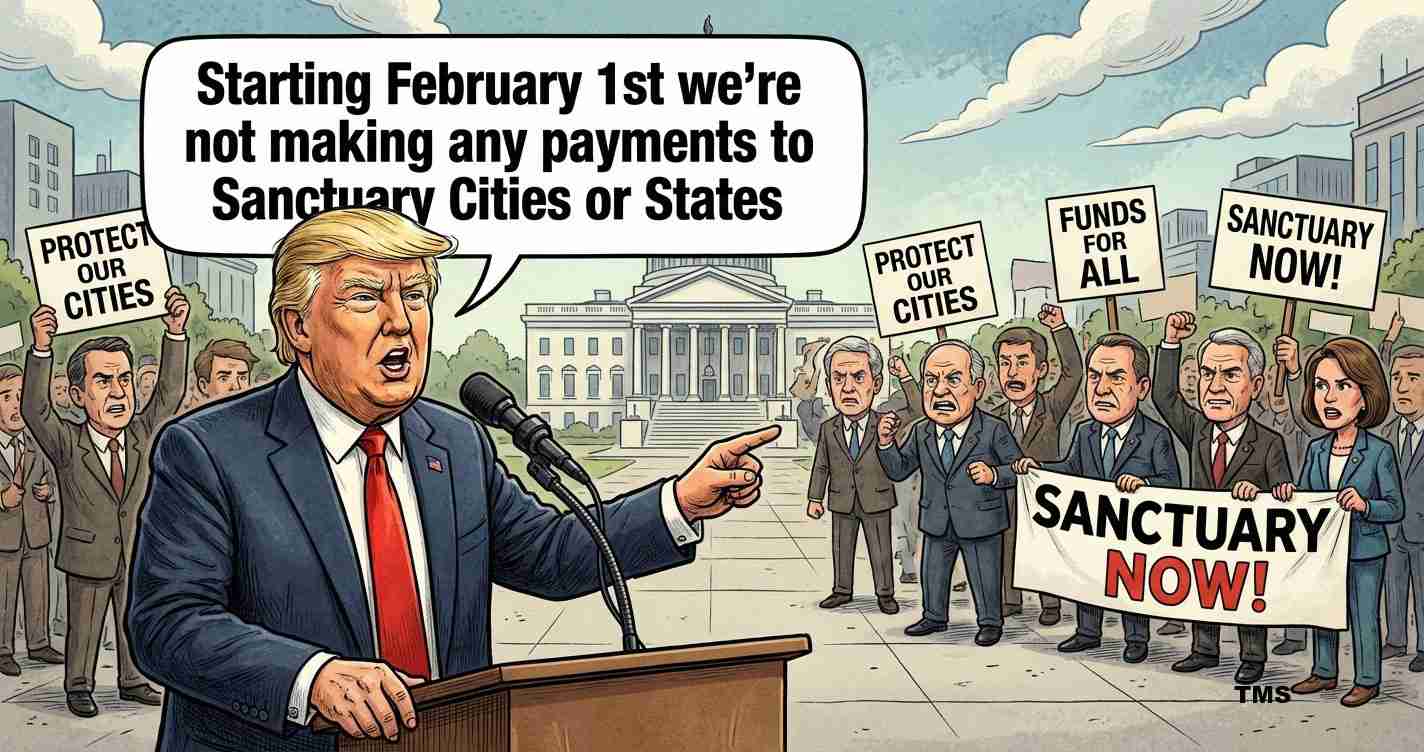
President Donald Trump announced at the Detroit Economic Club on Jan. 13, 2026, his administration will stop federal payments to sanctuary cities and states beginning Feb. 1, 2026, citing alleged fraud, crime and protection of criminals.
Key takeaways
- Payments to sanctuary jurisdictions to halt Feb. 1, 2026, announced at the Detroit speech.
- Minnesota singled out: Trump said payments tied to suspected scammers were suspended and attacked Gov. Tim Walz by name (WTOV9 report).
- HHS has withheld program funds in five states over fraud concerns per administration notices (Fox News HHS report).
- Courts are intervening: a federal judge temporarily blocked a funding halt earlier in January (court ruling).
Trump’s announcement and language used
At the Detroit Economic Club speech, Mr. Trump described sanctuary policies as enabling crime and fraud. He said,
“Starting Feb. 1, we’re not making any payments to sanctuary cities or states having sanctuary cities because they do everything possible to protect criminals at the expense of American citizens,”
and added,
“And it breeds fraud and crime and all the other problems that come. So we’re not making any payment to anybody that supports sanctuary.”
The remarks echoed earlier administration attempts to link federal funding to local cooperation on immigration enforcement (Detroit speech).
Minnesota fraud allegations and sharp remarks about state leadership
Mr. Trump specifically targeted Minnesota, saying payments tied to “suspected scammers” had been suspended. He stated: “We have also suspended payments tied to suspected scammers in Minnesota, of which there are many. It’s a great state. It was a great state. Now it’s getting destroyed by that stupid governor.” He accused Gov. Tim Walz of corruption and suggested state leadership could not have missed the alleged fraud (KRCRTV, Fox News).
The administration points to specific HHS actions
The U.S. Department of Health and Human Services has already withheld funds tied to programs serving low-income families in several states. The administration says funds from the Child Care and Development Fund, TANF and the Social Services Block Grant were withheld in California, Colorado, Illinois, Minnesota and New York because of alleged fraud. HHS Deputy Secretary Jim O’Neill emphasized families deserve confidence that resources are used lawfully (Fox News HHS report).
Legal challenges and court intervention
Tying federal dollars to sanctuary cooperation has faced legal resistance before. Judges have required clearer legal grounding before allowing funding cuts. On Jan. 9, U.S. District Judge Arun Subramanian temporarily blocked the administration’s funding halt, preserving payments while courts consider arguments; the order did not decide the overall legality of the policy (court coverage, ABC7 summary).
Scope of the administration’s sanctuary policy actions
The Department of Homeland Security compiled a summer 2025 list of more than 500 non-compliant jurisdictions for failing to meet cooperation standards. The Justice Department has filed lawsuits against cities including Los Angeles, Chicago, Newark, Hoboken, Jersey City, Paterson and Rochester, and sued states such as Illinois, Colorado and New York over sanctuary rules. DOJ has identified dozens of jurisdictions as sanctuary areas in previous lists (KRCRTV, ABC7).
What is unclear: which federal payments would be cut, and how
Officials have not published a full list of payments or grants subject to the Feb. 1 cutoff. Reporting confirms HHS moves tied to child care and welfare programs in several states, but other major funding streams—transportation grants, housing programs, public safety funds and disaster relief—were not specifically listed. Expanding from targeting cities to threatening whole states raises questions about scope and legal footing. As of Jan. 14, 2026, no source details exact payments beyond the Minnesota-related programs (ABC7, KRCRTV).
Administration rationale: law, fraud and fiscal responsibility
The administration frames the policy as enforcing lawful use of federal dollars and preventing diversion by corrupt actors or jurisdictions that impede federal immigration law. HHS officials argue families should trust benefits are administered lawfully, grounding the effort in concerns about waste, fraud and public safety (Fox News).
Pushback from cities, states and advocacy groups
Targeted cities and states and legal advocates call such cuts unlawful and politically motivated, arguing withholding funds for local policy decisions interferes with state and local authority and harms vulnerable residents. Courts have previously restrained similar executive actions when legal requirements were deemed unmet (ABC7, KRCRTV).
Broader national context and possible ripple effects
Cutting payments could affect budgets for child care, public health, housing, transportation and policing partnerships. States losing block grants or program dollars may force local agencies into sudden shortfalls, program cuts or tax increases. Political pressure could mount on governors and mayors to change sanctuary policies or defend them in court (KRCRTV, ABC7).
Implications for the United States
Economic impact: Suspending payments to sanctuary jurisdictions could reduce funding for child care, welfare and social services in major urban areas and affected states, straining provider networks and local budgets (Fox News).
Political consequences: The order raises stakes for state and local elections; targeted officials may face pressure to alter policies or litigate to preserve funding (KRCRTV).
Social effects: Cuts or delays could leave vulnerable populations without child care, housing support and basic services, heightening demand on charities and safety nets (ABC7).
Legal and governance implications: Expanding enforcement from cities to states will test executive authority boundaries; temporary injunctions (such as the Jan. 9 order) may delay implementation and require stronger legal justification (court coverage).
Practical applications for local officials
City and state leaders should assess federal grant exposure, model budget scenarios for reduced or delayed payments, and prepare contingency plans. Social service providers and schools that depend on federal support should plan for interruptions and communicate proactively with families about continuity.
Reporting notes and sources
This article is based on reporting of President Trump’s Detroit Economic Club remarks and administration actions as of Jan. 14, 2026. Sources include local and national reporting and administration statements:
- KRCRTV — Detroit Economic Club reporting and sanctuary policy
- WTOV9 — Minnesota reporting
- KATV
- Fox News — policy and HHS reporting
- Fox News — court coverage
- ABC7 — summary of past legal challenges
Editors’ note: Reporting continues on which specific federal payments would be cut after Feb. 1 and on court responses to the new announcement.



