
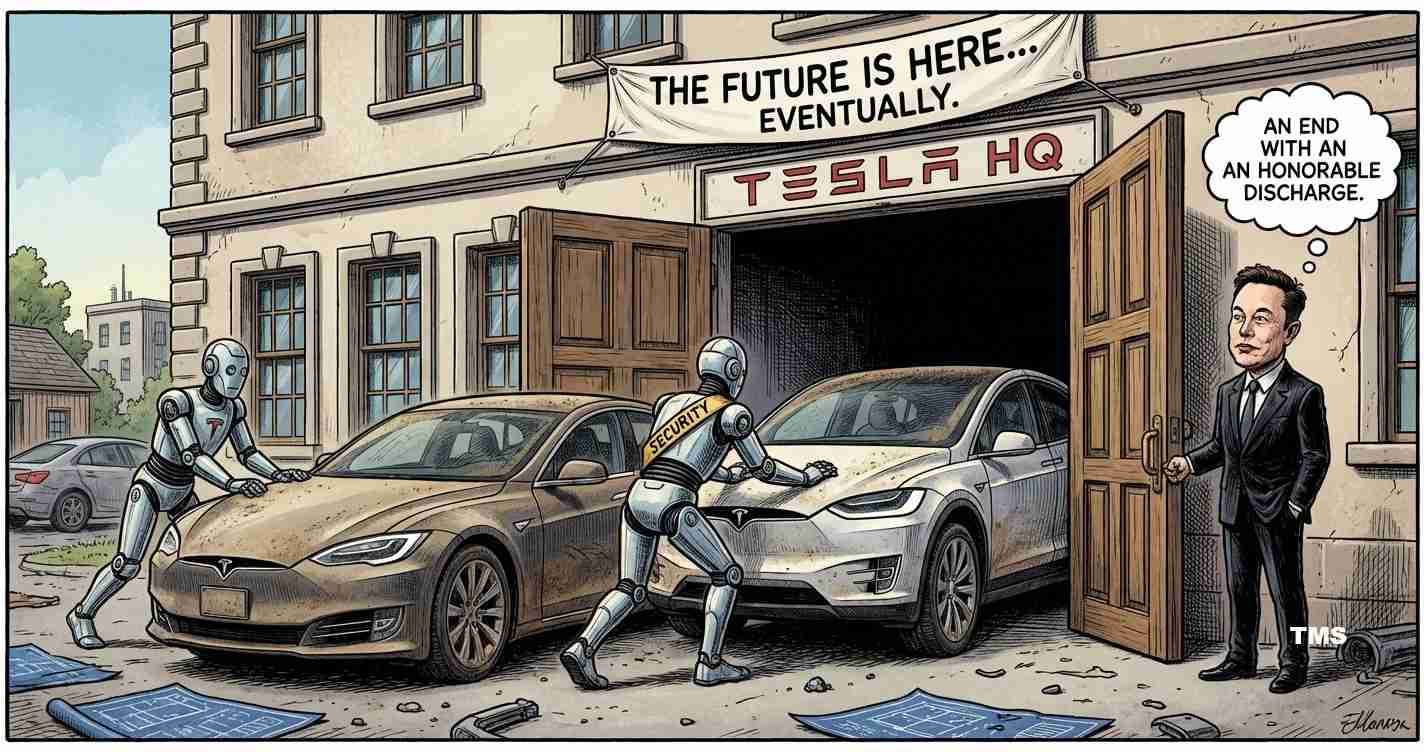
Tesla Model S, Model X Ends: Musk Says Fremont Factory Will Be Repurposed for Optimus Robot Production
Elon Musk announced on Tesla’s Q4 2025 earnings call that production of the Model S and Model X will end by the close of Q2 2026 as the Fremont factory is repurposed to build Optimus humanoid robots.
Key takeaways
- Production timeline: Model S and Model X will wind down in Q1 2026 and stop by the end of Q2 2026; buyers were urged to order now (Fox Business, Electrek).
- Factory repurpose: Fremont lines will be redeployed for Optimus humanoid robot production, with Tesla claiming potential line capacity up to 1 million units annually (Fox Business).
- Financial context: Q4 revenue down 3% to $24.9 billion; full-year 2025 revenue $94.8 billion (-3%). EV sales fell 16% in Q4; 2025 deliveries were 1.64 million (-9%) (Fox Business, Edmunds).
- Strategic shift: No direct replacements planned; Tesla is reallocating investment toward autonomy, robotics and energy products (Electrek, Fox Business).
Key information
Announcement: Elon Musk said production of the Model S and Model X will wind down in Q1 2026 and stop completely by the end of Q2 2026. He described the move as giving the programs an “honorable discharge” and urged interested buyers to order now (Fox Business; Electrek).
Fremont factory repurpose
Tesla plans to repurpose space at its Fremont, California, factory — currently used for S/X assembly — to manufacture Optimus humanoid robots. The company says it will introduce Optimus Gen 3 in the current quarter and build a new supply chain for robots, claiming eventual per-line capacity up to 1 million units annually, though analysts call such scale unproven (Fox Business; Electrek).
Production timeline
Musk said S/X production will wind down in Q1 2026 and cease by the end of Q2 2026. Fremont previously housed lines capable of roughly 100,000 S/X units annually; Tesla intends to redeploy that capacity across vehicles, robots, energy storage and batteries with plans for six new production lines in 2026 (Fox Business; Electrek).
Financial context and market pressures
Tesla reported Q4 2025 revenue of $24.9 billion, down 3% year-over-year, and full-year 2025 revenue of $94.8 billion, also down 3%. EV sales fell 16% in Q4 versus a year earlier; total 2025 deliveries were 1.64 million, down 9% from 2024. Model 3 and Model Y represent roughly 97% of deliveries (Fox Business; Edmunds).
Decline of S and X
The Model S (launched 2012) and Model X (launched 2015) once served as Tesla’s flagship offerings and helped fund expansion to lower-priced models. Sales for these platforms have declined for years as Tesla prioritized the Model 3 and Model Y and rivals introduced luxury EV competitors. Delivery counts labeled “other models” (which groups S/X with Cybertruck and Semi) totaled about 50,850 in 2025; actual S/X deliveries likely near 30,000 — under 3% of total deliveries (Electrek; Edmunds).
Workforce, supply chain and manufacturing questions
Repurposing a major assembly line raises practical questions about tooling, training and suppliers. Tesla says it will use existing infrastructure where possible and invest across clean energy, transport, autonomy and robots in 2026, but independent verification of robot capacity and timelines is limited. Analysts note that high-volume robot production requires complex electronics, sensors, actuators and software integration — a different challenge than mass car manufacturing (Fox Business; Electrek).
Market reaction and stock movement
On the day of the reports, Tesla shares closed at $430.46, down roughly 0.10% amid news that the S and X programs will end. Investors are balancing the potential of a bold new product line against near-term revenue pressures and execution risk (Fox Business).
Historical role of Model S and Model X
The S and X played outsized roles in Tesla’s early growth as premium offerings that helped finance mass-market scale. The platforms received updates over time — including Plaid variants, a brief refresh in June 2025 and pricing moves — but those efforts did not reverse long-term declines. Musk’s decision effectively closes a chapter on Tesla’s original flagships (Electrek; Edmunds).
Implications for the United States of America
Economic and industrial impact
Shifting Fremont from premium cars to robots could alter the local skill mix. Robot production may increase demand for software engineers, electrical technicians and precision manufacturing workers, while assembly-line workers may face retraining or redeployment. Local suppliers that supported S/X production may need to adapt to new robot components (Fox Business).
National competitiveness and innovation
A U.S.-based push toward mass-market humanoid robots would keep advanced manufacturing and R&D on American soil. If Tesla succeeds, adoption of automation could accelerate productivity gains. But failure or delays could dampen investor confidence in ambitious industrial pivots; policymakers will monitor broader effects on private-sector investment (Fox Business).
Workforce policy and retraining
The change highlights the need for targeted workforce programs. Federal and state leaders may consider partnering with industry on retraining funds, apprenticeships and certifications to help technicians transition from auto assembly to robotics, software and electronics roles — aligning with private-sector-driven training models.
Consumer choices and market structure
Tesla’s retreat from the luxury sedan and SUV segments opens space for competitors such as Lucid, Rivian and legacy automakers to capture high-end EV buyers. Consumers may see more choices and intensified competition in luxury EV features and pricing (Electrek; Edmunds).
Regulatory and safety considerations
A pivot to humanoid robots will raise new regulatory questions for federal agencies overseeing workplace safety and consumer products. Lawmakers and regulators may need to clarify standards for robots operating in public or workplace settings and reassess oversight of advanced AI and robotic systems.
Sources and reporting notes
Reporting draws on Tesla’s Q4 2025 earnings call and coverage from Fox Business, Electrek, Edmunds, CarBuzz and a Tesla Motors Club forum thread (Tesla Motors Club), which document Musk’s remarks, the production timeline, delivery figures and Tesla’s financial results.
Note: This report will be updated as Tesla provides more detail on timelines, workforce plans and Optimus robot production milestones.



