
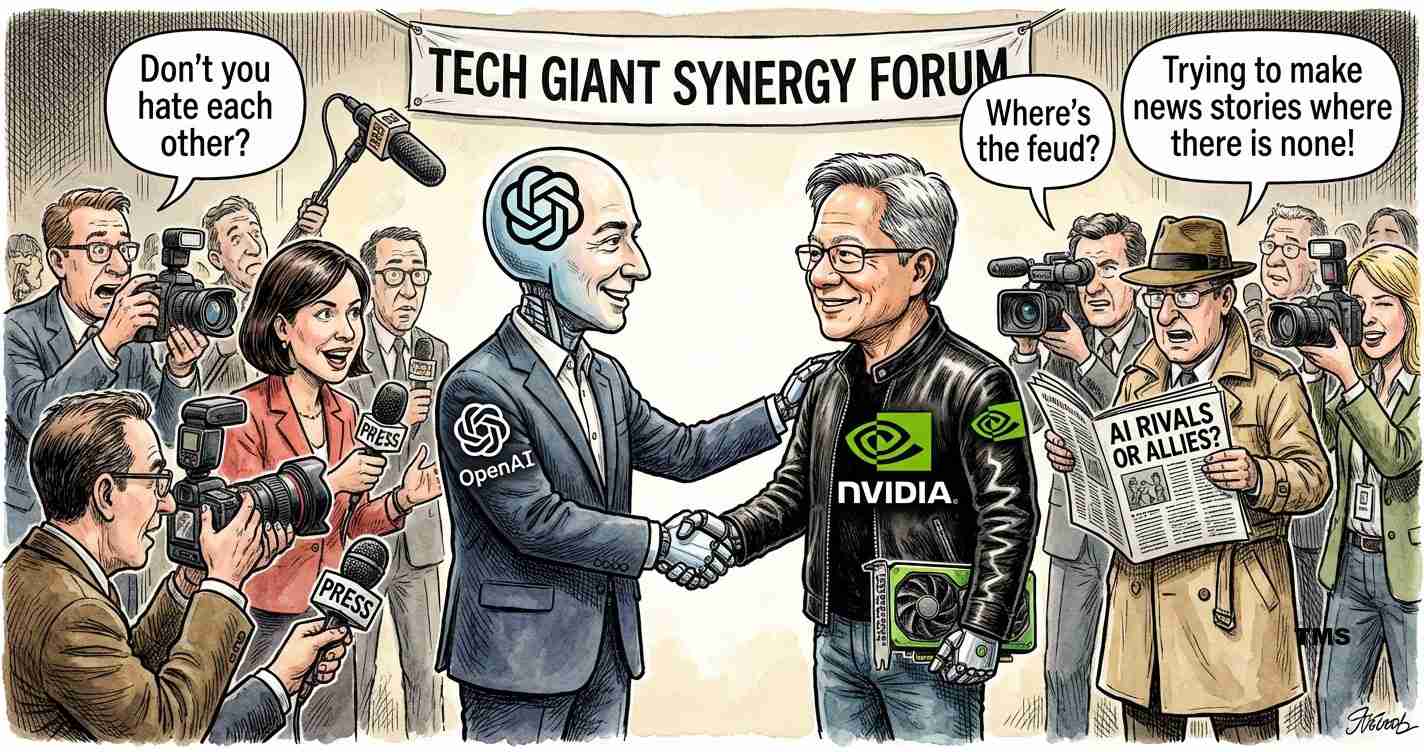
Nvidia CEO Jensen Huang says company will make a “huge” investment in OpenAI, denies $100 billion plan has stalled
Nvidia CEO Jensen Huang confirmed January 31, 2026, that Nvidia will participate in OpenAI’s fundraising round, calling reports the $100 billion plan had stalled “nonsense,” and emphasizing Nvidia’s continued strategic partnership and commitment to AI infrastructure.
- TechCrunch: Huang said Nvidia will “definitely participate” and described the backing as potentially its largest investment ever.
- Nvidia investor release: The September 22, 2025 letter of intent described intent to invest up to $100 billion and to deploy at least 10 gigawatts of systems.
- MLQ / TechCrunch: Reports said some Nvidia executives questioned the scale and timing of the original deal.
Huang’s public pushback and what he said in Taipei
Speaking to reporters in Taipei, Huang pushed back strongly on reports that the deal had stalled or that he was unhappy with OpenAI. He called suggestions of a breakdown “nonsense.” Huang said Nvidia believes OpenAI is “one of the most consequential companies of our time.”
He confirmed Nvidia plans to “invest a great deal of money” and that the company will “definitely participate” in OpenAI’s current fundraising round, while declining to confirm the precise figure. Huang deferred detailed fundraising numbers to OpenAI CEO Sam Altman (TechCrunch; BloomingBit).
The Wall Street Journal report and internal debate
A Wall Street Journal report — summarized in TechCrunch — said some Nvidia executives expressed doubts about the $100 billion letter of intent. According to that coverage, leaders questioned whether the scale was appropriate and considered shifting toward a smaller equity commitment in the tens of billions (MLQ).
Huang had privately noted the September agreement was non-binding, according to reporting summarized by TechCrunch.
Such internal concerns mirror common themes in large tech deals: executives balance capital risk, competitive positioning, and the speed of AI compute scaling. Nvidia managers must also plan how and when to deploy tens of gigawatts of data‑center systems (Nvidia investor release).
Background: the September 2025 letter of intent
On September 22, 2025, Nvidia and OpenAI announced a strategic partnership in which Nvidia said it intended to invest up to $100 billion progressively, tied to deploying at least 10 gigawatts of Nvidia systems and to co‑optimizing hardware and software roadmaps. The plan was framed as a long-term effort to help build OpenAI’s “AI factory,” beginning with deployment on the Vera Rubin platform in late 2026 (Nvidia investor release).
From the outset Nvidia described the letter as non-binding and subject to further agreement, standard for multi-year capital and infrastructure commitments tied to milestones, market conditions, and reviews (Nvidia investor release).
OpenAI’s position and the broader fundraising round
OpenAI has sought a large fundraising round with reports of a $100 billion target that attracted interest from Nvidia, Microsoft, Amazon, and SoftBank. OpenAI maintains that the partnership with Nvidia remains central and that both companies are working through fundraising details (TechCrunch).
Huang has also privately criticized OpenAI’s business discipline in recent months, according to reporting, while publicly pledging Nvidia will back OpenAI in a “huge” way but leaving size and structure for negotiation among participants (TechCrunch; BloomingBit).
What remains unclear
- Final dollar amounts and timelines: Huang declined to confirm specific figures beyond Nvidia’s participation (TechCrunch).
- Investment mix: It is unclear how equity, hardware credits, or other forms of capital will be combined; the September letter tied commitments to hardware deployment (Nvidia investor release).
- Regulatory or national‑security reviews: Large AI infrastructure investments can draw scrutiny that may affect timing or structure.
Implications for United States
Economic impact
A major Nvidia‑OpenAI investment could shift U.S. capital flows in tech. If Nvidia provides funding and hardware, demand for U.S.‑made AI chips and data‑center equipment would likely rise, supporting suppliers, creating manufacturing and construction jobs, and increasing tax revenues. At the same time, concentrated investments can heighten market concentration and risk leaving smaller players behind (Nvidia investor release; TechCrunch.)
Political consequences
For policymakers and moderate conservatives, the deal raises questions of corporate governance and oversight. Internal Nvidia debate, if accurate, suggests board-level scrutiny over large equity stakes. Lawmakers may probe how funding affects competition, national security, and supply-chain resilience (TechCrunch).
Social effects
Rapid deployment of advanced AI could reshape labor markets: productivity gains may be offset by pressure on routine jobs. Communities hosting data centers could gain jobs and tax revenue but face infrastructure, energy, and housing concerns. The plan’s scale — 10 gigawatts — signals substantial new energy demand (Nvidia investor release).
Cultural relevance
The potential Nvidia‑OpenAI investment touches on values of technological leadership, economic opportunity, and competitiveness. Readers may weigh benefits of U.S. AI leadership against concerns about market concentration and accountability in developing powerful AI systems (TechCrunch).
Practical applications for residents
If Nvidia helps fund and scale OpenAI, consumers could see faster rollouts of new AI-enabled products in search, productivity tools, cloud services, and enterprise software. Businesses should plan for compute costs and workforce shifts. Local governments should prepare for infrastructure and energy impacts where large data centers expand (Nvidia investor release; TechCrunch.)
Reporting and next steps
Nvidia’s Taipei statements make clear the company intends to play a major role in OpenAI’s fundraising round, but specifics remain subject to negotiation, market forces, and potential regulatory review. Journalists and readers should watch for official filings, board statements, and final terms from both companies.
Key sources cited in this report include the Nvidia investor release, coverage of Huang’s remarks and the WSJ report by TechCrunch, a Taipei summary by BloomingBit, and industry reporting on internal company debate (MLQ).



