Breeze Airways announces major U.S. expansion with 12 new routes, international service — what travelers should know
Breeze Airways announced a major expansion on January 28, 2026, adding 12 new U.S. routes and international service to Nassau and Cancun, focused on direct flights to underserved markets and low fares for leisure travelers.
Key takeaways
- Breeze Airways expands with 12 new domestic routes and new international service, growing its network to roughly 81 cities and 300+ routes.
- New service includes first-time or returning markets such as Atlantic City, Brownsville, and a return to San Antonio, plus Nassau and Cancun internationally.
- Promotional base fares advertised as low as $79 one-way on select routes, but the airline uses an unbundled model — check baggage and seat fees before purchase (consumer reporting).
- Aircraft include Airbus A220-300 and Embraer 190; Breeze touts free family seating, Wi‑Fi, and no change/cancellation fees on many fares (route launch coverage).
Expansion details and routes
Breeze’s January 28 announcement expands the carrier’s route map with 12 new domestic routes and new international service, part of a wider push that has grown the network to about 81 U.S. and international cities serving more than 300 routes. The company emphasized direct flights to smaller or underserved airports.
The press release and booking calendar list newly added U.S. origin and destination cities — including Raleigh‑Durham, Hartford, Columbus — and the decision to serve Atlantic City and Brownsville for the first time or in renewed fashion. See the official announcement for the full calendar and booking details.
“We’re eager to introduce Brownsville and Atlantic City to our unique, elevated product offering,” said founder and CEO David Neeleman in the company statement.
Pricing, fees and what travelers should expect
Breeze positions itself as a low-cost carrier aimed at price-conscious leisure travelers. Promotional base fares have been advertised as low as $79 one-way on select routes (for example, certain Brownsville–Orlando dates). These fares reflect the industry practice of unbundling, where the basic ticket often excludes checked baggage, preferred seats, and priority boarding.
What the airline highlights: Breeze cites customer-friendly policies such as no change or cancellation fees, free family seating, and onboard Wi‑Fi on many flights. Travelers should still compare the final landed cost after adding baggage and seating fees — consumer reporting warns that advertised fares can rise quickly once ancillaries are added (Fox News coverage).
Fleet, operations and international certification
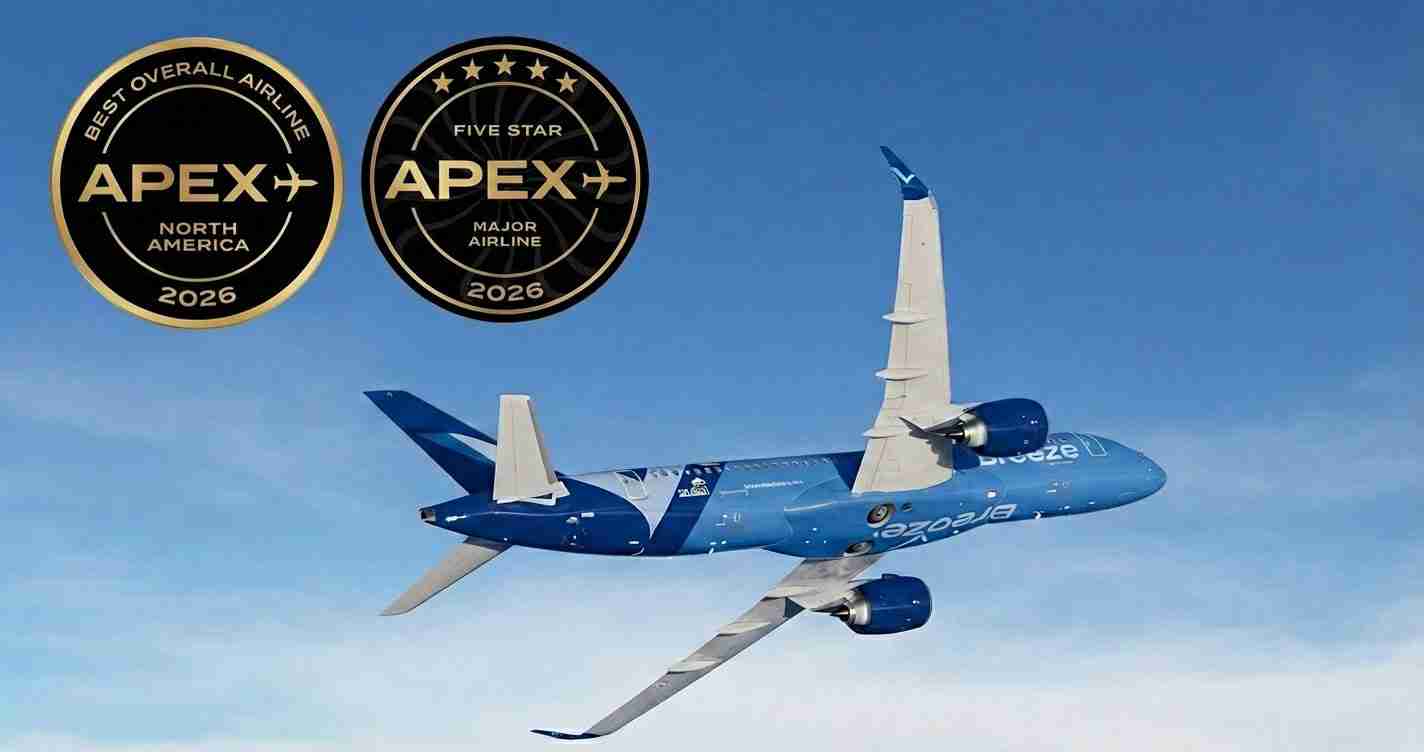
Breeze operates newer narrow-body jets — Airbus A220-300s and Embraer 190s — used to serve lower-demand nonstop markets with comfortable cabins and lower per-seat costs. The carrier has expanded international leisure routes to destinations such as Cancun and Nassau.
The airline obtained U.S. Flag Carrier certification required for some international services and is building crew and operational bases in markets including New Orleans, enabling routes like New Orleans–Cancun and other nonstop flights added since 2021 (New Orleans route launch).
Recent international and domestic growth
Breeze continued adding both domestic and international flights through early 2026. Notable recent inaugurations include:
- New Orleans–Cancun: inaugural nonstop on Feb. 7, 2026, operated with an A220-300 and marketed as Breeze’s first international service from MSY.
- Providence–Cancun and Norfolk–Cancun: added in February and January, following a string of leisure routes to Mexico and the Caribbean (Aviation Week route tracking).
Industry trackers note the carrier’s rapid growth since launch in May 2021; the rollout of over 50 new routes into early 2026 reflects a strategy to capture summer leisure demand and to provide direct service between previously underserved city pairs (Simple Flying analysis).
Competitive context and consumer cautions
Breeze’s expansion comes as domestic airfares have eased from decade highs but the trend toward unbundled pricing remains. Travelers should:
- Compare final ticket costs across carriers — including baggage and seat fees — before purchase.
- Check Breeze’s fee schedule and baggage rules on the carrier’s support pages (route & support information).
- Be aware that low base fares may not include the extras many travelers expect; consumer groups advise careful comparison (consumer reporting).
Implications for U.S. cities, travelers and carriers
Economic impact: New nonstop service can boost tourism spending and airport revenues in smaller and mid-size cities — parking, concessions and hotels may see gains from added flights to places like Brownsville and Atlantic City.
Consumer choice and fares: More nonstop options generally increase competition and can lower headline fares, but travelers should plan for ancillary fees and compare landed costs across carriers.
Competition with legacy carriers: Breeze’s point‑to‑point model pressures legacy hub networks and may prompt competitive pricing and schedule adjustments that benefit consumers, while raising market‑structure questions at smaller airports.
Operational risks: Rapid expansion carries risks: new routes require sustained demand, crew and ground resources, and reliable scheduling. Frequent cancellations or rescheduling could undermine the value of direct service.
Practical advice for travelers
Before booking, travelers should:
- Shop the total ticket price (base fare plus ancillaries).
- Confirm baggage allowances, seat policies and any fees on Breeze’s support pages (Breeze support).
- Weigh direct service versus connecting itineraries for schedule reliability and customer protections on international trips.
- Monitor booking calendars and promotions on Breeze’s site (official news).
Sources and reporting
This article draws on Breeze’s official announcement and booking information (Breeze news; Breeze support), industry coverage of route additions (Simple Flying), reporting on low fares and ancillary fees (Fox News), local route-launch coverage (New Orleans CityBusiness), and aviation trade reporting (Aviation Week).