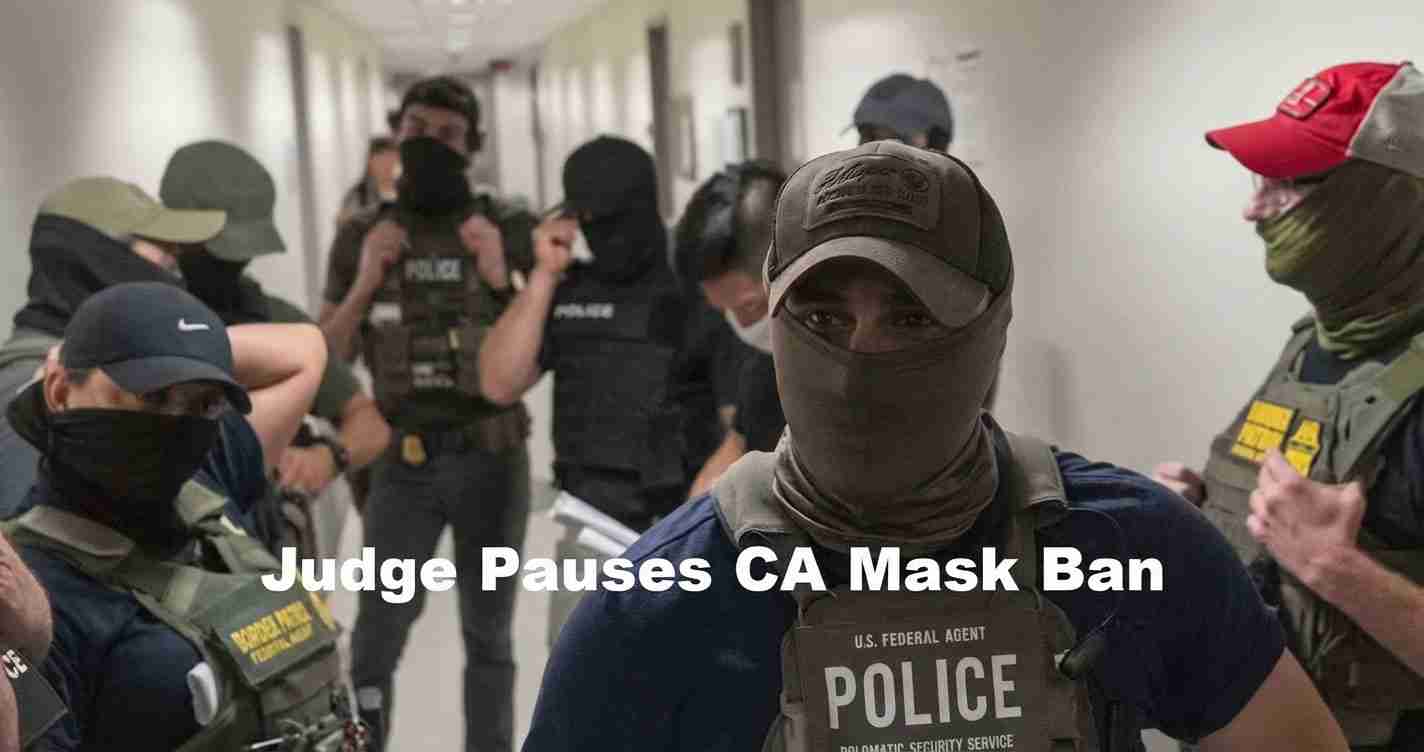
Federal Judge Blocks California Mask Ban for ICE and Other Feds, Upholds ID Rule in Split Ruling
A U.S. District Judge in Los Angeles issued a preliminary injunction stopping California’s SB 627 from singling out federal officers’ mask use under the Supremacy Clause, while separately upholding SB 805 requiring officers to display identification.
- Preliminary injunction: Judge Christina A. Snyder blocked enforcement of SB 627 as written because it discriminates against federal officers (calonews.com, foxla.com, dailyjournal.com).
- ID rule upheld: Snyder preserved SB 805’s requirement that officers display names or badge numbers while on duty (calonews.com).
- Next steps: The DOJ’s suit continues; California could amend SB 627 to apply uniformly to state and federal officers to address the court’s Supremacy Clause concerns (calonews.com).
What the ruling says
Judge Christina A. Snyder concluded that SB 627 — the “No Secret Police Act” — singles out federal officers by treating them differently from state and local officers, in conflict with the Supremacy Clause. The court emphasized that a state law cannot lawfully apply only to federal agents while exempting state personnel, and therefore granted a preliminary injunction preventing enforcement of SB 627 as currently written (calonews.com, dailyjournal.com).
Background and context
California’s twin bills emerged after high-profile Department of Homeland Security and ICE operations in Southern California in summer 2025, during which masked federal agents were perceived as insufficiently identified. Lawmakers and immigrant-rights groups raised concerns about secrecy, community trust and accountability, prompting passage of SB 627 (mask restrictions for federal officers) and SB 805 (identification requirements) — the latter intended to make officers more identifiable to residents (calonews.com, foxla.com).
The federal suit and legal fight
The U.S. Department of Justice sued California in November, naming Governor Gavin Newsom and Attorney General Rob Bonta, arguing that SB 627 would impede federal law-enforcement operations and endanger officers by encouraging doxing and harassment. The DOJ sought an injunction to block SB 627 while the litigation proceeds and indicated it would not comply if the law took effect; Judge Snyder’s preliminary injunction temporarily grants that relief (calonews.com).
What the court left in place
While SB 627 was enjoined, Snyder upheld SB 805 — the “No Vigilantes Act” — finding that a requirement for officers to display names, badge numbers or other identifying information does not regulate federal functions and therefore does not violate the Supremacy Clause. That means California may enforce identification rules even as the mask restriction remains paused (calonews.com).
Reactions from Washington and Sacramento
Federal response: Pamela Bondi, formerly Florida’s attorney general and now in a federal role, praised the injunction on X, warning the law could have increased safety risks for agents and claiming federal officers were being targeted (foxla.com).
State response: Governor Gavin Newsom called the ID ruling a “clear win for the rule of law” and framed SB 805 as advancing accountability. Sen. Scott Wiener (D-11), author of SB 627, said he will consult experts and the governor’s office and pursue immediate legislation to extend mask restrictions to state officers as well to remove the legal discrimination the judge identified. Sen. Lena Gonzalez (D-33), chair of the California Latino Legislative Caucus, thanked the court for upholding the ID law and reaffirmed concerns about federal actions that she says erode community trust (calonews.com).
What’s next in court and in the legislature
The preliminary injunction is an early procedural step; the DOJ’s lawsuit continues and could proceed to summary judgment or trial on the merits. California lawmakers can respond by amending SB 627 to apply equally to state and federal officers or by crafting a different measure designed to survive Supremacy Clause review. Governor Newsom has not announced whether he would sign a revised bill. The federal government has said it will not comply with SB 627 if it remains in force (calonews.com).
Nationwide stakes and legal precedent
Legal experts say the case tests the boundary between state public-safety regulation and federal supremacy over national law enforcement. If states could single out federal officers for different treatment, a patchwork of rules would risk disrupting federal operations across jurisdictions. Courts will likely scrutinize whether state laws treat federal and state officers alike when a law affects federal functions (dailyjournal.com, calonews.com).
Practical effects now
- Mask rule paused: Federal agents operating in California will not be required to remove masks under SB 627 while the injunction stands (calonews.com).
- ID rule effective: Officers, including federal agents, may still be required to display identification under SB 805 (calonews.com).
- Legislative options: Lawmakers may attempt to redraft SB 627 to apply uniformly to all officers to withstand federal-court review (calonews.com).
Implications for United States
Economic impact: The injunction reduces short-term friction between federal law enforcement and California officials and may avoid enforcement clashes or further litigation costs. If states adopt laws that treat federal officers differently, businesses and agencies could face legal uncertainty around federal operations (calonews.com).
Political consequences: The ruling sharpens national debate over immigration enforcement and state constraints on federal actions. For some conservatives it underscores federal supremacy; for others it highlights the tension between accountability measures and constitutional limits. Expect both parties to use the decision in public messaging (foxla.com, calonews.com).
Social effects: Communities advocating for the bills sought greater protections for immigrant neighborhoods and transparency after controversial raids; the injunction may be seen as a setback, though the upheld ID rule offers a tool for accountability and could ease tensions by making personnel identifiable during encounters (calonews.com).
Practical applications for residents and officials
Residents should note that federal agents remain able to wear masks while the injunction is in place, but may also see officers wearing clear identification. Local officials seeking limits on federal practices can consider laws that apply uniformly to all law enforcement or seek cooperative federal-state agreements to set standards that better withstand constitutional scrutiny (calonews.com).
Final note
Legal watchers say the next moves — whether California revises SB 627, the DOJ presses forward, or higher courts take the case — will shape how far states can go to regulate the conduct of federal officers within their borders (calonews.com, dailyjournal.com).