
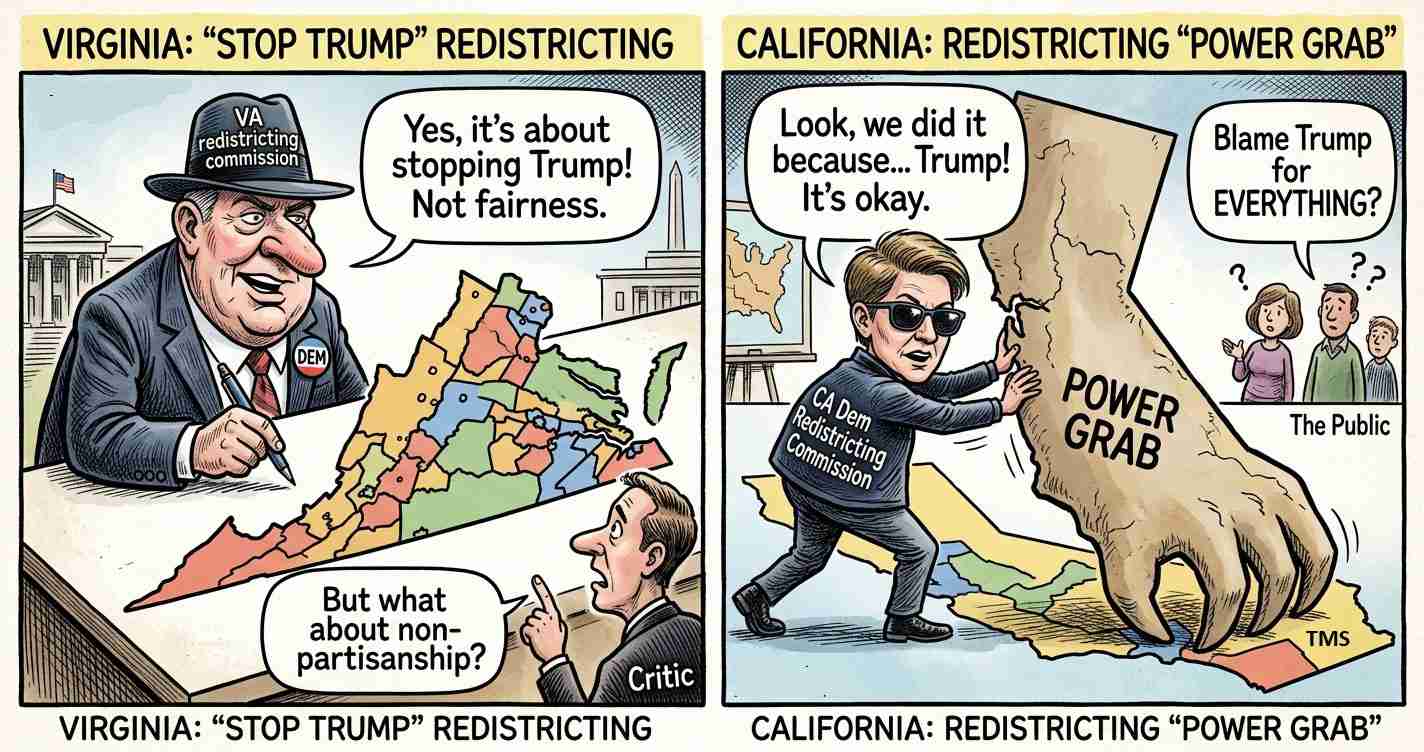
Virginia Democrats push last‑minute redistricting amendment as critics say it’s aimed at stopping Trump and tilting power
Virginia Democrats advanced a constitutional amendment to hold an April 21, 2026 special election that would suspend the bipartisan redistricting commission and let lawmakers redraw congressional districts, igniting national legal fights and accusations of partisan gerrymandering.
Key takeaways
- Legislative move: The General Assembly passed an amendment allowing lawmakers to adopt new Virginia congressional districts immediately if voters approve the change in the April 21, 2026 special election — YouTube (https://www.youtube.com/watch?v=RXC6Q4VJ6z4).
- Partisan debate: Supporters call it a temporary fix to “restore fairness”; opponents call it a partisan power grab that could flip a 6D-5R delegation to a potential 10D-1R map — YouTube (https://www.youtube.com/watch?v=RXC6Q4VJ6z4).
- Legal fights & national attention: Republicans and national groups have pressed lawsuits and appeals as the fight draws broader attention ahead of the 2026 midterms — YouTube (https://www.youtube.com/watch?v=tb2WGxnNc98) · Fox5DC video (https://www.fox5dc.com/video/1733769).
Main content
Background and proposal details
Democratic leaders in Richmond — including House Speaker Don Scott and Senate Majority Leader Scott Surovell — sponsored the amendment during the 2026 session. The bills cleared the General Assembly on party-line votes: 55-45 in the House and 21-19 in the Senate, according to coverage of the legislative push. See: YouTube (https://www.youtube.com/watch?v=RXC6Q4VJ6z4).
If voters approve the April 21, 2026 special election measure, the amendment would permit the General Assembly to temporarily redraw the state’s congressional map for the upcoming elections. Proponents say this is a short-term corrective to respond to partisan moves elsewhere and to protect a bipartisan system going forward; opponents call that rationale disingenuous.
What the proposed maps look like
Public discussion and early maps shared by both proponents and critics reveal unusual, elongated shapes. Some districts snake from Fairfax County into distant parts of the state — designs critics label “spaghetti” or “scorpion” districts. Those proposals would split Fairfax into as many as five districts and Prince William County into three, pulling urban/suburban voters into districts that reach deep into rural regions. See sample coverage: YouTube (https://www.youtube.com/watch?v=RXC6Q4VJ6z4) · YouTube (https://www.youtube.com/watch?v=EbBKFw2Gdxg).
Current delegation: Virginia now has six Democrats and five Republicans in Congress. Opponents and analysts warn the new maps advanced by Richmond Democrats could transform that into a potential 10-1 Democratic advantage; proponents say courts and voters should decide whether the maps are fair. See: YouTube (https://www.youtube.com/watch?v=SdsyJ-FMWwM) · YouTube (https://www.youtube.com/watch?v=RXC6Q4VJ6z4).
Key statements and reactions
- Rep. Donald Beyer (D-Alexandria/Fairfax): Reporting highlighted remarks critics say tie the effort to a national aim to help Democrats retake the U.S. House; conservative coverage cites selective phrasing that has not been independently verified in a full transcript — YouTube (https://www.youtube.com/watch?v=RXC6Q4VJ6z4).
- Gov. Abigail Spanberger (D): Has urged a “yes” vote, framing the plan as temporary protection of Virginia’s bipartisan process, though critics note earlier statements she had no plan to redistrict — YouTube (https://www.youtube.com/watch?v=RXC6Q4VJ6z4).
- House Minority Leader Terry Kilgore (R-Gate City): Called the move “manifestly unfair” for a near-even state and warned it would silence almost half the voters.
- Senate Minority Leader Ryan McDougle (R-Hanover): Labeled the effort a “partisan power grab,” calling the fairness claim “phony.”
- Rep. Ben Cline (R-Va.): Said the plan “isn’t about fairness” and accused Democrats of trying to “rig the map to take back the House”; his district would be split under the proposed plan — coverage: YouTube (https://www.youtube.com/watch?v=RXC6Q4VJ6z4).
“A partisan power grab” — Republican leaders and critics in media interviews and statements.
Experts weigh in
Academic observers call the move unusual and overtly partisan. Virginia Tech professor Karen Hult told reporters the proposal underscores national tensions over who controls mapmaking and the rules that govern it — YouTube (https://www.youtube.com/watch?v=SdsyJ-FMWwM).
Timeline and legal fights
The push accelerated in late 2025 when Democrats extended a special session and began plotting maps targeting several Republican-held seats — see coverage: YouTube (https://www.youtube.com/watch?v=SdsyJ-FMWwM) · YouTube (https://www.youtube.com/watch?v=MxPGQXWu-LE).
By February 2026 Democrats had advanced a map favoring Democrats 10-1 and pushed the measure forward despite legal challenges from Republican groups, including filings and appeals — YouTube (https://www.youtube.com/watch?v=tb2WGxnNc98) · Fox5DC video (https://www.fox5dc.com/video/1733769).
Early voting for the April 21 ballot began amid an intense campaign season. Both sides have deployed billboards, ads, and organizing: for example, Page County Democrats urged a “yes” vote via local outreach — coverage: YouTube (https://www.youtube.com/watch?v=RXC6Q4VJ6z4).
National context
Virginia’s dispute is part of a broader national pattern of reactive redistricting: Republican-led maps in states such as Texas and Democratic moves elsewhere have prompted tit-for-tat responses and elevated stakes for control of the U.S. House. Observers warn Virginia’s outcome could influence redistricting strategies in other states heading into the 2026 midterms — see analysis: CBS News (https://www.cbsnews.com/video/what-virginia-democrats-redistricting-effort-could-mean-control-house/) · YouTube (https://www.youtube.com/watch?v=RXC6Q4VJ6z4).
Implications for United States
Economic impact
- Federal dollars: A shift in House control could change federal spending priorities and influence grant flows to local infrastructure, health care, and development projects.
- Business climate: Corporations monitor political control for tax and regulatory trends; perceived partisan tilts can affect lobbying, campaign giving, and investment decisions.
Political consequences
- House control: The amendment is tied directly to the battle for the U.S. House; critics say redrawing Virginia to favor Democrats could help flip seats nationwide and reshape committee power.
- Precedent: A voter-approved override of a bipartisan commission might encourage similar moves in other states, further politicizing mapmaking.
- Voter trust: Actions seen as partisan may deepen public cynicism about fair representation and boost turnout among motivated voters on both sides.
Social effects
- Voter representation: Drawing most district populations from densely Democratic Northern Virginia could leave rural and exurban voters feeling unheard, potentially worsening polarization.
- Local politics: Lawmakers facing new boundaries may see constituencies reshaped, altering local priorities, constituent services, and community ties.
Cultural relevance
- National narrative: The fight feeds a broader story about whether parties prioritize power over fairness; moderate conservatives warn such moves threaten democratic norms.
- Identity politics: Redrawing districts around partisan strongholds can harden divides between urban/suburban and rural voters and shape culture-driven policy debates.
Practical applications for residents
- Voting changes: If the amendment passes, many voters will encounter new district lines before the 2026 midterms, potentially changing ballots, polling places, and representation.
- Campaign attention: Redrawn districts could reallocate campaign resources, shifting attention away from some communities and toward others deemed competitive.
- Legal recourse: Residents and civic groups may be drawn into legal battles over representation; those suits could affect ballot access and timing.
Sources and further reading
- YouTube (https://www.youtube.com/watch?v=RXC6Q4VJ6z4)
- YouTube (https://www.youtube.com/watch?v=tb2WGxnNc98)
- CBS News (https://www.cbsnews.com/video/what-virginia-democrats-redistricting-effort-could-mean-control-house/)
- YouTube (https://www.youtube.com/watch?v=dAZCPHhXk5Y)
- YouTube (https://www.youtube.com/watch?v=SdsyJ-FMWwM)
- YouTube (https://www.youtube.com/watch?v=EbBKFw2Gdxg)
- YouTube (https://www.youtube.com/watch?v=MxPGQXWu-LE)
- YouTube (https://www.youtube.com/watch?v=ttGDc5b6J9E)
- Fox5DC video (https://www.fox5dc.com/video/1733769)
Reporting includes legislative records and broadcast coverage cited above. Sources include on‑the‑record statements captured in news coverage and analyst commentary.



