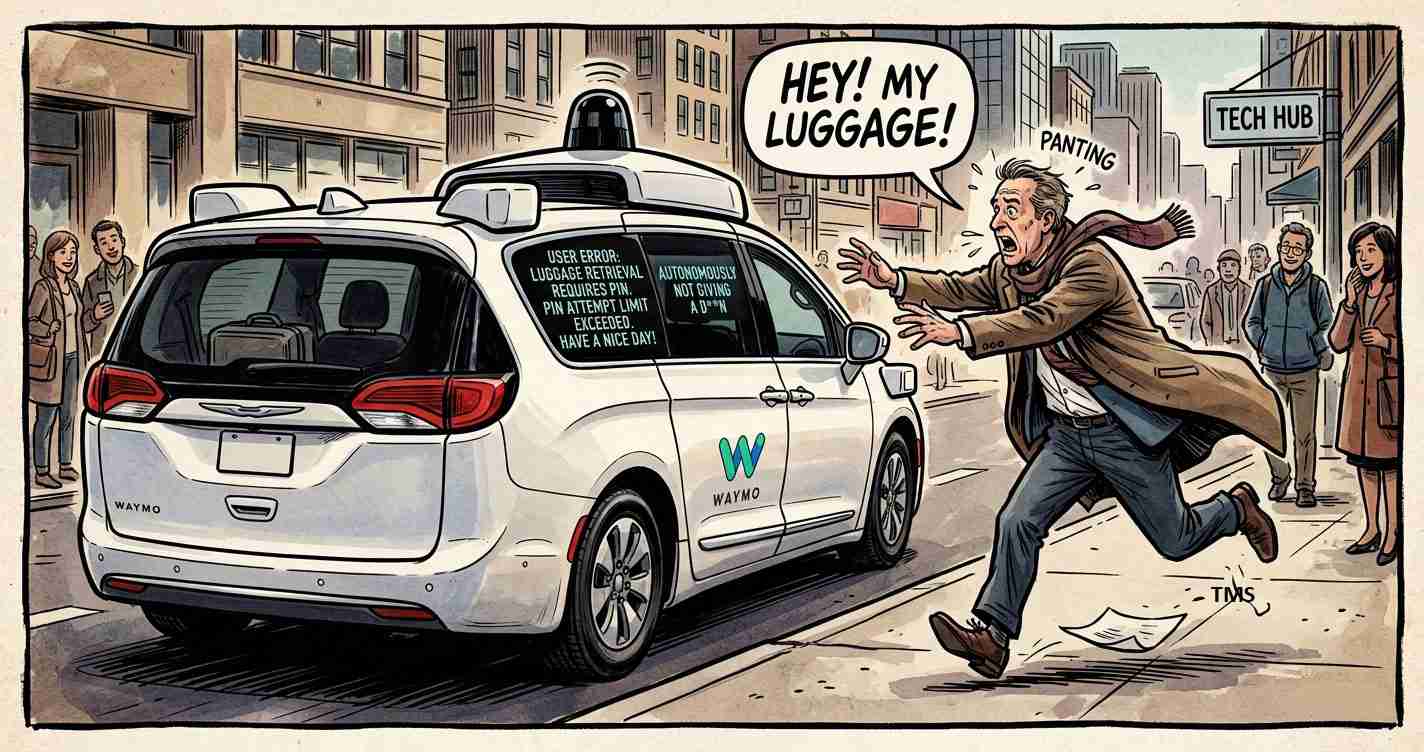
Waymo robotaxi drives off with passenger’s luggage at San José airport, raising questions about trunk access and lost-item policies
A Waymo robotaxi at San José Mineta International Airport drove off with passenger Di Jin’s suitcase after its trunk wouldn’t open, leaving him temporarily stranded and prompting scrutiny of trunk-access procedures, lost-item recovery and company responsibility for returning belongings.
- Passenger: Di Jin rode a Waymo robotaxi from Sunnyvale to San José Mineta International Airport and left his suitcase inside when the trunk failed to open.
- Company response: Waymo later said the bag was secured at a depot and, after initial reluctance, agreed to cover shipping costs to return it.
- Policy concern: Waymo’s help pages state it won’t reimburse the value of items left behind and cannot guarantee prompt or undamaged returns.
- Broader issue: The incident highlights gaps in traveler protections at airport curbs when no human driver is available to assist.
What happened at SJC
Di Jin took his first Waymo ride from Sunnyvale to San José Mineta International Airport for a business trip. According to Jin’s account to reporters, the trip itself was normal. At SJC, he says he exited the vehicle and tried to open the trunk. He pressed the trunk release button above the license plate and used the app’s “Open trunk” feature, but nothing worked. The driverless car then drove away, Jin said, leaving his suitcase — containing clothes and work notes — inside.
“I pressed the button and used the app. The car left with my bag,” Jin told reporters, describing being left at the curb with no human driver to flag down.
With no human driver to stop or assist, Jin contacted Waymo customer support immediately and was told the vehicle was already en route to a depot and could not be redirected. Waymo later emailed to say the luggage had been secured at a Waymo facility. That resolved the immediate worry that the bag was lost; the next question was who would pay to get it back.
Waymo initially offered to ship the bag but would not cover shipping or courier fees, and reportedly offered two free rides for Jin to pick it up himself. After pushing back, Jin says Waymo agreed to cover the shipping cost and he accepted that solution. Waymo did not comment on the specific incident when contacted by reporters.
How Waymo says trunk and lost-item processes work
Waymo’s official guidance explains trunk access is designed to operate via the exterior release button above the license plate or the in-app “Open trunk” control. The company says the trunk will also automatically open at a rider’s destination — provided the trip has officially ended and the vehicle has fully stopped. Waymo warns the trunk may not open if a rider exits before the vehicle has completed its stop and the trip is closed in the app. See the Waymo help pages for step-by-step instructions.
On lost items, Waymo’s lost-and-found guidance states support will attempt to reunite riders with items left in a vehicle but cannot guarantee items will be found, returned promptly, or delivered undamaged. The company also states it is not responsible for items left behind after a trip and does not reimburse the value of lost items — policies central to why this story drew attention. See Waymo help pages.
How common are airport problems for robotaxis?
The Jin incident is one of several recent complaints about automated rides at airports, where curbside rules, luggage handling and heavy pedestrian traffic raise complexity. Local reporting and user posts describe robotaxis looping through airport lots, repositioning after drop-offs, or failing to reach curbside where travelers expect them to stop.
A January 2025 example recounted a Waymo vehicle looping in a parking area; that aviation blog item shows similar airport-edge-case behavior. Public videos of autonomous rides to airports show mixed results — some smooth, others revealing edge cases that can leave travelers exposed when juggling bags and flights. Examples include a Waymo PHX airport test video and a Tesla robotaxi airport drop at SJC.
Safety filings and agency reports point to airport zones as higher-risk environments for autonomous vehicle operations because of complex curb rules, pedestrian flows and rapid repositioning demands. Regulators such as the National Highway Traffic Safety Administration and state DMVs like the California Department of Motor Vehicles collect incident and disengagement data that consumer advocates and policymakers monitor closely.
Why Waymo’s policy matters to travelers
When a human driver is present, passengers can often flag down a vehicle or find immediate assistance. With driverless cars, that fallback disappears. Passengers depend on in-app controls, a support line and remote fleet operations. If a trunk won’t open or the vehicle begins a routine return to depot, travelers may be left at the curb with little immediate recourse.
That reality raises concerns for consumers — especially business travelers who rely on luggage and documents. The possibility that a company policy could leave passengers paying shipping costs for items its vehicle took has drawn criticism. Consumer advocates argue autonomous fleets should offer clearer, faster and more consumer-friendly lost-item processes; some lawmakers have suggested federal standards may be needed.
Broader context and reporting
Independent reporting and user complaints show the Jin incident fits a pattern of airport-related hiccups with AV services. Tech outlets and local newspapers have documented rider frustration with post-drop repositions and limited curb access. One tech outlet noted trunk glitches in a nontrivial share of rider feedback after Waymo expanded airport access — see TechCrunch. Local coverage and forums — including reporting in the San Francisco Chronicle — have noted multiple Sunnyvale–SJC rider complaints.
Public opinion shapes the backdrop: a March 2026 Pew Research poll found roughly two-thirds of Americans express unease about riding driverless vehicles, with airport scenarios — where luggage and timing matter — among the top concerns. Legal databases show few lawsuits specifically about luggage left in robotaxis as of mid-2026, though debate over AV responsibilities continues; see federal court records at PACER.
What regulators and companies say
Waymo emphasizes safety and provides step-by-step guides for trunk access and lost items but its legal terms and support pages stop short of accepting liability for the value of lost or damaged items. That limited stance leaves space for consumer complaints to become policy fights.
Regulators such as the NHTSA and state DMVs are monitoring AV deployments and incident reports. Consumer advocates and members of Congress have called for clearer obligations around passenger property and immediate on-the-ground support at airports — proposals that could surface in upcoming federal AV rulemaking.
Implications for the United States
Economic impact: Airports and business travel are a large slice of U.S. travel spending. Friction in driverless airport pickups could raise costs for travelers and employers through extra shipping charges, missed meetings or last-minute changes. If AV services routinely leave customers to handle lost-item recovery, businesses may avoid robotaxis for employee travel.
Political consequences: The incident fuels bipartisan calls for clearer rules governing autonomous vehicles. Some policymakers may back targeted regulations that preserve innovation while protecting travelers — for example, requiring real-time human assistance options at airports or mandatory reimbursement in certain lost-item scenarios.
Social and cultural effects: The story reinforces public unease about driverless cars in sensitive moments — curbside pickups, airport transfers and other high-stress situations. When a high-tech service leaves a customer bearing costs for a company error, it raises questions about fairness and corporate accountability that cross political lines.
Practical applications for travelers
- Confirm trip end: Only close and secure luggage in the trunk after the app shows the trip has ended and the vehicle is fully stopped.
- Carry essentials: Keep essential documents and at least one outfit in a personal carry-on.
- Document the vehicle: Photograph the vehicle and its license plate immediately.
- Contact support: Immediately contact in-app support and the phone line if an item goes missing, and review provider policies in advance.
Reporting and sources
- Waymo help pages and lost-and-found guidance
- Aviation blog on Waymo airport looping incident (700WLW iHeart)
- Waymo PHX airport test video
- Tesla robotaxi SJC drop video
- National Highway Traffic Safety Administration (NHTSA)
- California Department of Motor Vehicles
- TechCrunch
- San Francisco Chronicle
- Pew Research Center
- PACER federal court records
Reporting by Times Media Service