
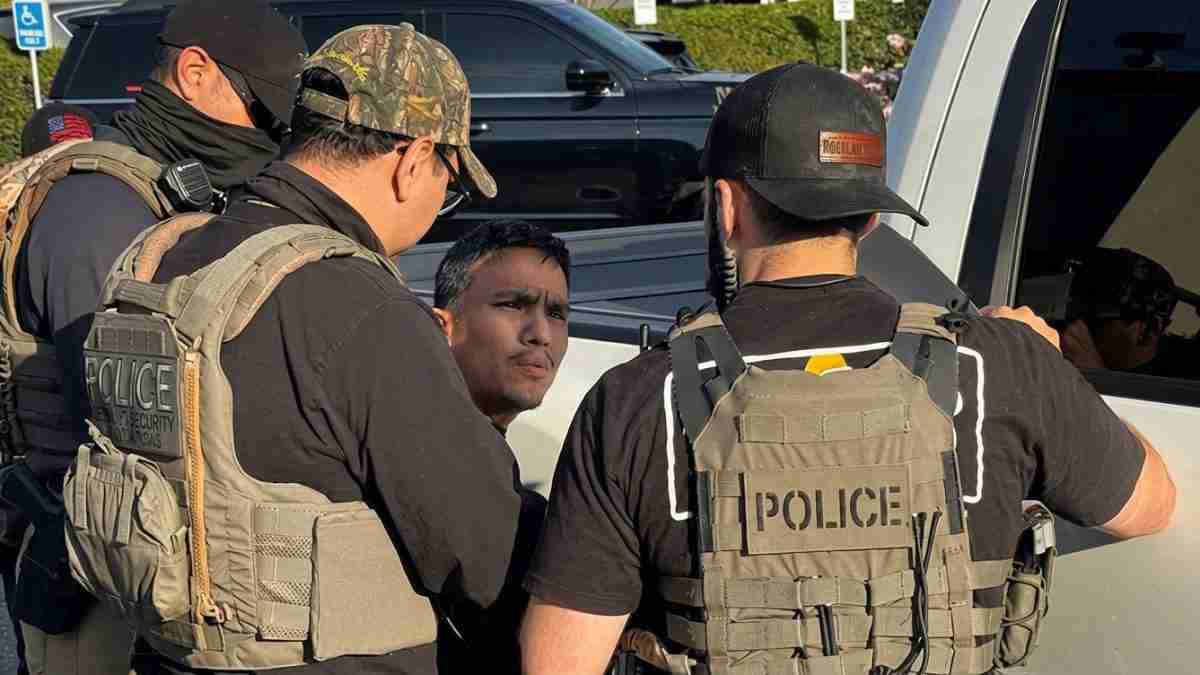
LOS ANGELES, Aug. 28 (Our Los Angeles) — Federal prosecutors in Los Angeles have charged Darwin Jonathan Rivera Flores, a 30-year-old Honduran national and lawful permanent resident, with fraudulent voter registration and falsely claiming to be a U.S. citizen.
Rivera was arrested Aug. 28, 2026, according to the U.S. Attorney’s Office for the Central District of California. The charges were filed in a federal criminal complaint, and Rivera was expected to make an initial appearance in U.S. District Court in downtown Los Angeles.
The allegations have not been proven in court.
What prosecutors allege
An affidavit filed with the complaint says Rivera was born in Honduras, entered the United States in 2002 and is a lawful permanent resident. Lawful permanent residents may live and work in the United States but are not automatically U.S. citizens.
According to the affidavit and prosecutors’ account, an online voter-registration record using the name “Darwin Rivera” was linked to Rivera’s Winnetka address. The application included a box marked to indicate that the applicant was a U.S. citizen.
The affidavit also says Department of Homeland Security records showed no indication that Rivera had applied for or received U.S. citizenship. The U.S. Attorney’s Office said Rivera did not vote in an election.
That distinction is important: The case involves an alleged voter registration and citizenship claim, but prosecutors say the available records do not show that Rivera cast a ballot.
What are the charges?
The federal complaint accuses Rivera of two felony offenses: fraudulent voter registration and making a false claim of U.S. citizenship.
A criminal complaint is a charging document. It sets out the government’s allegations and does not establish guilt. Prosecutors must prove the charges in court, and Rivera is entitled to the presumption of innocence.
The U.S. Attorney’s Office said each felony carries a statutory maximum of five years in federal prison if Rivera is convicted. The maximum is not a sentence and does not indicate what punishment, if any, Rivera would receive.
Who is investigating the case?
Homeland Security Investigations is investigating the matter. Assistant U.S. Attorney Michael G. Wheat, of the Orange County Office, is prosecuting the case for the U.S. Attorney’s Office for the Central District of California.
First Assistant U.S. Attorney Bill Essayli said the arrest was “the first of many to come.” That is a statement about the office’s expected future enforcement activity, not confirmation that additional arrests will occur.
What happens next?
Rivera was expected to appear before a federal judge in downtown Los Angeles on Aug. 28. The available information does not confirm the result of that hearing.
It also does not identify whether Rivera entered a plea, whether a lawyer was appointed or retained, whether he was detained or released, or which judge was assigned to the case.
The Justice Department’s announcement does not establish that the case is the first arrest in a broader national election-fraud initiative. It also does not show any broader effect on Los Angeles County’s election administration or identify other defendants in the county.



