Breaking down the Supreme Court’s key rulings from June
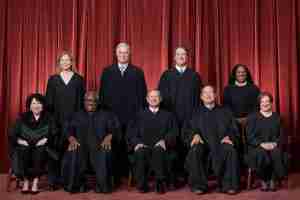 Supreme Court as it was been comprised on June 30, 2022 (Courtesy Wikipedia)
Washington, DC (Times Media Service) – As the Supreme Court wraps up its latest term, the court’s conservative majority issued a series of landmark rulings that reshaped federal power, individual rights, and state authority. From limiting nationwide injunctions to upholding key health-care mandates, these major decisions will reverberate across the nation well into 2026.
Nationwide Injunctions Curtailed
The justices in Trump v. CASA, Inc. ruled on June 27 that lower courts lack authority to issue universal (nationwide) injunctions blocking federal policies, confining relief to the parties before them. Chief Justice Barrett’s 6–3 opinion emphasized that Congress never granted district courts power to enjoin policies for nonparties. This “shadow docket” decision reshapes how immigration and other executive actions will be challenged, steering many cases toward class-action suits or APA challenges.
Preventive Healthcare Coverage Preserved
In Kennedy v. Braidwood Management, Inc. (June 27), the Court upheld the Affordable Care Act’s preventive services mandate, requiring insurers to cover USPSTF “A” and “B” recommendations without cost sharing. Justice Kavanaugh’s majority opinion found the U.S. Preventive Services Task Force validly appointed under the Appointments Clause, preserving free cancer screenings, HIV prevention, and other services for 150 million Americans. Dissenters warned that political influence over health panels could grow, but the ruling secures no-cost preventive care across private and Medicaid expansion plans.
Gender-Affirming Care Ban Upheld
In United States v. Skrmetti, decided June 18, the Court upheld Tennessee’s ban on puberty blockers and hormone therapy for transgender minors, affirming the Sixth Circuit’s use of rational-basis review. Chief Justice Roberts wrote that the law did not classify on the basis of sex and thus fell outside heightened scrutiny, a 6–3 split along ideological lines. This decision cements a conservative stance on trans healthcare and may encourage similar bans in other states.
Federal Workforce Layoffs Approved
On July 8, the justices in Trump v. American Federation of Government Employees lifted a lower-court stay and permitted the Trump administration’s mass federal layoffs to proceed. The unsigned emergency order reversed an injunction blocking the firing of probationary employees across 19 agencies, marking a significant expansion of executive authority over civil-service protections. Union leaders immediately vowed further challenges, but the ruling underscores the Court’s deference to presidential directives on staffing.
State Immigration Laws Checked
In Florida Immigrant Coalition v. Uthmeier (July 9), the Court declined Florida’s request to enforce SB 4-C, a law criminalizing unauthorized entry, thus maintaining a nationwide block on the measure. All nine justices refused to lift U.S. District Judge Williams’ injunction, reinforcing federal primacy over immigration and striking another blow to hard-line state statutes. The decision halted mandatory prison terms and arrests of migrants under Florida’s law, keeping enforcement paused pending full litigation.
Online Age Verification Law Upheld
In Free Speech Coalition v. Paxton (June 27), the Court upheld Texas’ HB 1181 requiring adult websites to verify that users are over 18, applying intermediate scrutiny and ruling the law incidentally burdens free speech. Justice Thomas, joined by five colleagues, held that protecting minors justified modest restrictions on adults’ access, a 6–3 ideological split. This sets a precedent for similar laws in over two dozen states, intensifying debates over privacy and internet regulation.
Medicaid Provider Choice Limited
In Medina v. Planned Parenthood South Atlantic (June 26), the Court ruled 6–3 that Medicaid enrollees lack standing to sue when states exclude providers, clearing the way for states to defund Planned Parenthood from Medicaid. The majority found that Congress did not create private rights of action under Section 1983 for Medicaid provider choice, reversing a Fourth Circuit decision. This empowers conservative states to shrink reproductive and preventive care networks, risking access for low-income patients.
Abortion Parental Consent Appeal Denied
On July 7, the Court declined to hear Montana’s appeal to reinstate a parental consent law for minors’ abortions, leaving a state-court ruling striking down the 2013 law intact. Justices Alito and Thomas noted the procedural posture prevented a merits decision, signaling openness to parental-rights arguments in a future, better-suited case. The refusal maintains Montana’s constitutional privacy protections for minors’ abortion access.
Louisiana Redistricting Deferred
In Louisiana v. Callais, the Court punted its ruling on the state’s second majority-Black congressional district, ordering full reargument in the fall of 2025. This delay preserves the remedial map for the 2026 midterms and highlights the Court’s caution in high-stakes Voting Rights Act challenges. Justice Thomas dissented, urging resolution rather than deferral, underscoring divisions over race and representation in redistricting.
Impact on the Nation
These rulings collectively reinforce the conservative majority’s agenda: limiting nationwide judicial relief, expanding executive discretion, constraining civil-rights and healthcare claims, and upholding state-level restrictions on immigration, gender care, and online content. Their effects will play out through further litigation, legislative responses, and state-level policy battles, with 2026 elections likely influenced by the Court’s legacy.
Robert Newport / Federal Contributor (Times Media Service)
Federal news contributor for Times Media Service, covers Washington’s major offices with insight into how politics drives government.
rnewport@timesmediaservice.com