
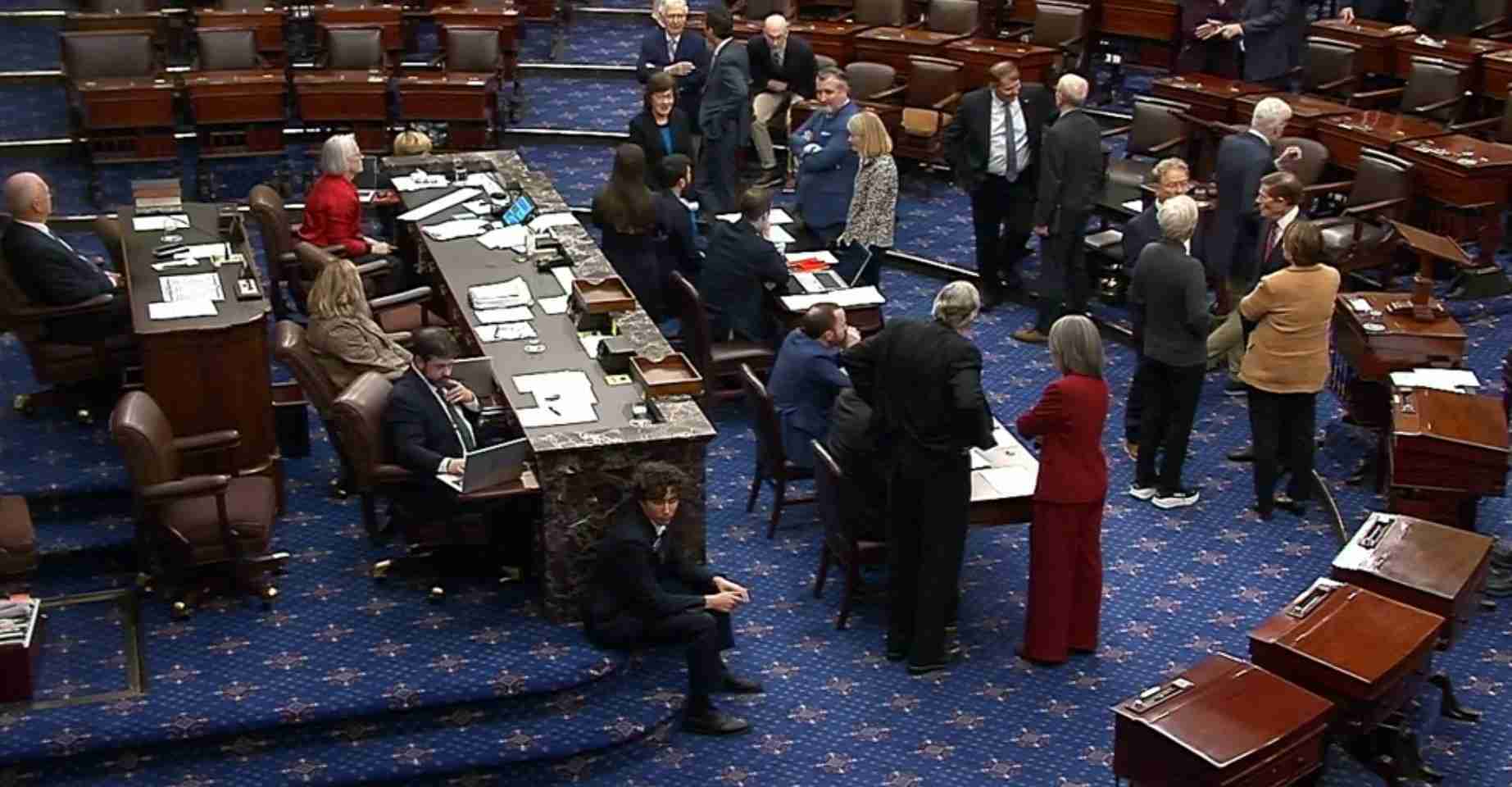
Senate government funding vote clears way to reopen government as eight Democrats cross aisle despite no immediate ACA subsidy deal
The Senate voted 60-40 to break a Democratic filibuster on H.R. 5371, enabling a stopgap funding bill to advance and clearing a path to reopen the government after a 40-day shutdown, while leaving ACA subsidy passage unresolved.
- Cloture passed 60-40 to advance the Motion to Proceed to H.R. 5371, ending extended debate.
- Eight Democrats joined Republicans to move the measure forward, creating the margin needed to break the filibuster.
- Deal trades immediate funding for a December vote on extending Affordable Care Act subsidies, not an up-front guarantee of passage.
What happened and why it mattered
The Senate approved cloture 60-40 on the Motion to Proceed to H.R. 5371, a procedural move that ends extended debate and allows floor consideration of the bill’s text and amendments. That step is critical because it sends a stopgap funding package toward final action and toward the House, where approval and the President’s signature would restore pay and work for federal employees after a 40-day shutdown.
Who crossed and what they said
Eight senators who caucus with or are Democrats joined Republicans to advance the bill: Dick Durbin (Ill.), Jeanne Shaheen (N.H.), Maggie Hassan (N.H.), Tim Kaine (Va.), John Fetterman (Pa.), Catherine Cortez Masto (Nev.), Jacky Rosen (Nev.), and Independent Angus King (Maine) (who caucuses with Democrats). Reporting lists the senators and vote context (see report.az and Jobaaj News).
Many who crossed cited constituent pressure, harm to federal workers and local businesses, and the need to restore services immediately. Others said securing a guaranteed floor vote on ACA subsidies in December was a necessary trade to end the impasse now.
What was traded: funding now, vote later on ACA subsidies
Senators agreed to advance government funding in exchange for a firm commitment to hold a floor vote in December on extending Affordable Care Act premium subsidies. That commitment is a promise of a vote, not an enforceable guarantee of passage or funding up front. Party leaders framed the concession differently: some Democrats called it pragmatic, others a concession that may weaken leverage in the healthcare fight (Politico).
Legislative mechanics — what H.R. 5371 does
H.R. 5371 is a hybrid stopgap funding measure: it fully funds several key departments for the fiscal year while extending temporary funding for other agencies via a continuing resolution through Jan. 30. The approach prioritizes essential national functions while buying time for lawmakers to negotiate remaining budget items and contentious priorities like ACA subsidies (Politico).
Party reactions and internal strain
Senate Democratic Leader Chuck Schumer criticized the floor compromise, saying it left Democrats without a firm guarantee on ACA subsidies and highlighted a party split between immediate relief for workers and long-term bargaining leverage.
The vote exposed internal divisions: some Democrats prioritized ending the shutdown to protect federal workers, while others warned that conceding leverage could weaken priorities like healthcare funding. Progressive groups criticized the deal as insufficient protection for Obamacare subsidies.
Public pressure and practical realities
The shutdown produced mounting pressure from federal employees, unions, contractors, affected businesses, and state and local officials. That pressure—plus the immediate economic harm to communities dependent on federal paychecks—helped push some senators to favor reopening the government now and continuing the healthcare fight on the floor in December (report.az).
What Democrats gained and conceded
Gains:
- A guaranteed floor vote on ACA subsidy extension in December, keeping the issue live on the Senate calendar (Politico).
- Assurances that federal employees will be reinstated and receive back pay once the measure becomes law (report.az).
Concessions:
- No up-front, enforceable extension of ACA subsidies; the deal secured a vote, not an immediate funding guarantee (Jobaaj News).
Next steps
After cloture, the package moves to the House when it reconvenes mid-week. If the House passes the measure and the President signs it, furloughed workers will be paid and many suspended services will resume. The guaranteed December vote on ACA subsidies will be the next major legislative fight (report.az; Politico).
Implications for the United States
Economic: Ending the shutdown restores pay for hundreds of thousands of federal workers and contractors, returning consumer spending to local economies and resuming regulatory actions that matter to markets and key industries.
Political: The outcome is a short-term win for Republicans for securing votes and persuading defections; for Democrats it raises questions about strategy and party unity heading into December.
Social: Reopening relieves immediate hardship for furloughed workers and restarts interrupted services, but ACA subsidy uncertainty leaves many households concerned about healthcare affordability.
Practical applications for residents
- Federal workers and contractors: Monitor House action and the presidential signature to confirm reinstatement and backpay timelines (report.az).
- ACA beneficiaries: Plan for continued uncertainty until the December floor vote and track developments that could affect premium assistance (Politico).
- Businesses and local governments: Expect a phased return to normal operations, with some long-term contracting and regulatory issues still subject to later negotiation.
Reporting and sources
This account draws on contemporaneous reporting and floor coverage. Primary sources referenced in this story include: Politico: Government funding deal on track to advance; report.az: U.S. Senate breaks Democratic filibuster in key vote; Jobaaj News: These 8 Senate Democrats vote to end US government shutdown; and contemporaneous floor coverage at The Gateway Pundit.
The Senate government funding vote marks a pivotal turn: lawmakers must now send the package to the House and prepare for a consequential December vote on ACA subsidies that will shape coverage affordability for millions.



