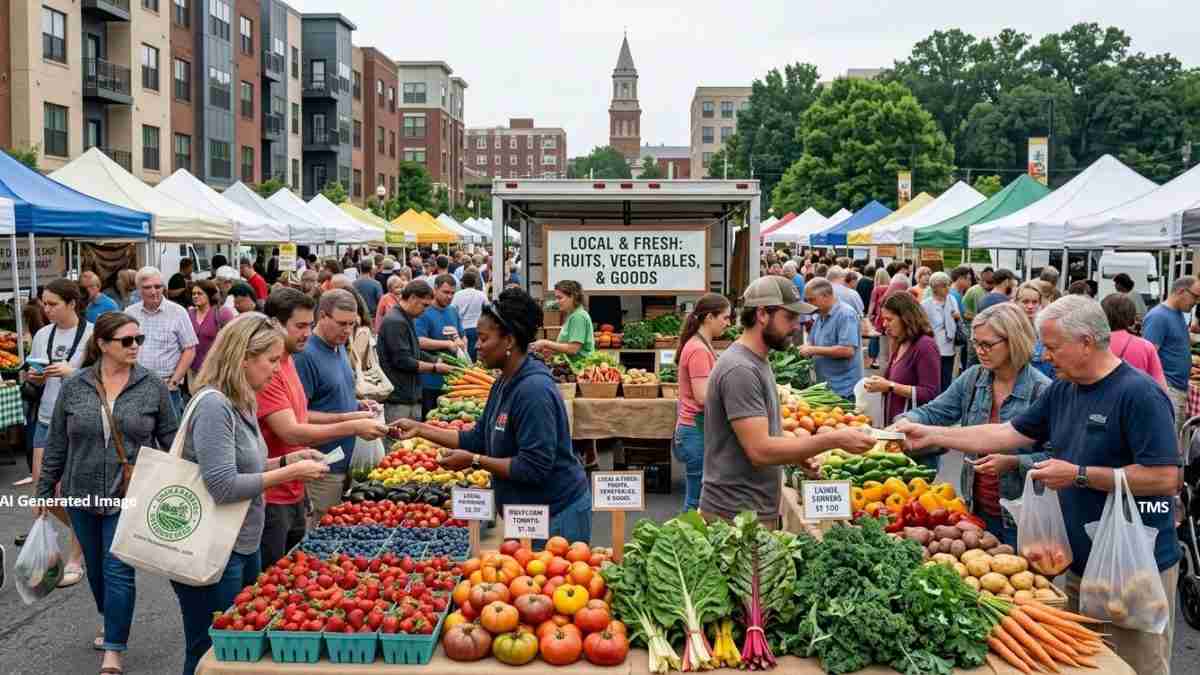
COLUMBUS, Ohio, Aug. 10 (Nationwide Times) — Farmers markets across several U.S. regions are seeing a surge in demand for locally grown lettuce as shoppers grow wary of grocery-store produce during a cyclospora outbreak.
In Ohio, vendors have reported selling out within 30 to 60 minutes of opening, according to Sara Hill, executive director of the Ohio Farmers Market Network. At Michigan’s East Lansing Farmers Market, a vendor identified as Kastner sold 158 heads of romaine over two days and later sold out of about 30 to 40 heads 10 minutes before the market opened.
The increase in farmers-market demand comes as sales of fresh lettuce at U.S. grocery stores decline. NielsenIQ data showed a 9% drop in fresh-lettuce unit sales for the week ending July 18. Darlene Wolnik, program director for the Farmers Market Coalition, said market managers had reported sales increases of 15% to 30%.
The figures do not represent a single nationwide measure of farmers-market sales. Most of the reports come from individual vendors, market managers or regional organizations.
What is driving the shift?
The concerns are tied to a federal and public-health investigation into cyclospora, a parasitic infection associated in the reports with iceberg lettuce supplied by Taylor Farms de Mexico. Taylor Farms voluntarily recalled or removed iceberg lettuce sourced from central Mexico on July 17. The reports said the product had been distributed in at least 27 states.
The investigation has made some shoppers question lettuce and packaged salads sold through large grocery and restaurant supply chains. NielsenIQ data cited in the reports showed that packaged-salad sales also fell in July, although the reported declines varied by product and time period.
Restaurant sales have also been affected in some accounts. Reports cited a 2% decline at some Taco Bell locations and double-digit spending declines at salad-focused chains. Those figures came from company or industry data and are not a measure of all restaurants.
How are local farms responding?
At Oliver’s Produce, a family-owned farm and market in upstate New York, lettuce sales rose from 700 heads in July of the previous year to 1,500 heads in the comparable July, according to owner Sawyer Oliver.
Oliver said the farm sold out ahead of a weekend market. In Tennessee, Ray Tyler of Rose Creek Farms said the farm’s lettuce supply at the Franklin Farmers Market was nearly gone by 10 a.m., about two hours earlier than usual.
The pattern has also appeared in Illinois, Indiana and the Washington, D.C., region, although the available accounts do not show that every farmers market has experienced the same increase. There is no complete national dataset in the reported material covering farmers-market sales.
For shoppers, local farms can seem to offer a shorter path from grower to market. That may mean fewer steps in the supply chain where contamination could occur, but it does not make locally grown produce immune from cyclospora or other foodborne hazards.
Is local lettuce automatically safer?
No. The reported public-health guidance does not say that lettuce from a farmers market is risk-free. Cyclospora can spread through contaminated food or water, and the source of contamination is not always visible to consumers.
The Centers for Disease Control and Prevention advises people to wash their hands and rinse fresh fruits and vegetables under running water before preparing or eating them. Washing produce can remove some germs and dirt, although it cannot guarantee that food is free of every harmful organism.
Consumers should also follow recalls and warnings issued by the Food and Drug Administration, the CDC and state health departments. Those agencies may update information as investigations develop.
Why do the outbreak numbers vary?
The reported case totals differ because the figures were collected on different dates and may use different definitions, such as laboratory-confirmed cases, suspected cases or cases included in a specific outbreak investigation.
One report cited 4,173 laboratory-confirmed cases across 41 states as of July 21, along with more than 7,400 suspected cases. Other reports cited much larger totals or a different number of affected states. Those figures should not be combined into one total without a common reporting date and definition.
What is clear from the market accounts is that food-safety concerns have changed buying habits in some parts of the country. Whether that shift lasts will depend on updated health guidance, the progress of the investigation and whether consumers regain confidence in grocery-store lettuce and packaged salads.