
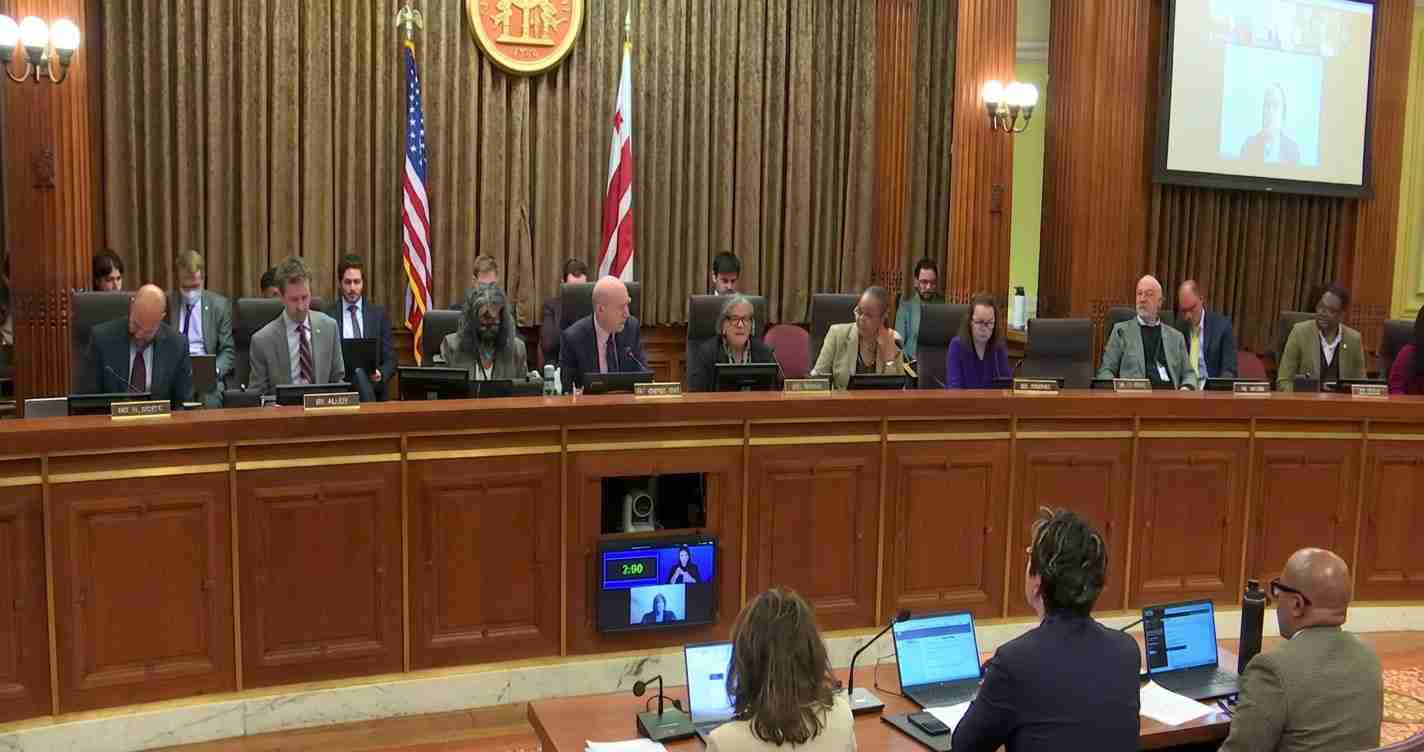
House votes to stop D.C. from decoupling from Trump tax cuts in party-line clash
The House voted Feb. 4, 2026, 215-210 along party lines to block D.C.’s plan to decouple from parts of President Trump’s tax cuts, preventing the District from preserving roughly $600 million in local revenue and upending tax filings.
- Party-line vote: House approved H.J. Res. 142, 215-210, with Republicans unified and Democrats opposed.
- Local impact: D.C. officials estimate about $600 million in lost revenue through 2029 if forced to conform.
- Practical stakes: The dispute could disrupt 2025 tax-year return preparation and local budgeting ahead of filing season.
Key information
The House approved H.J. Res. 142, sponsored by Rep. Brandon Gill (R-Texas), to prevent the D.C. Council’s “Income and Franchise Tax Conformity and Revision Temporary Amendment Act of 2025” (D.C. Act 26-217) from taking effect. The resolution passed 215-210 on Wednesday and was strictly along party lines, with Republicans unified in support and Democrats opposed, according to live coverage from WTOP and a leadership statement.
D.C. lawmakers passed the local measure in December 2025 to keep parts of the city’s tax code separate from the federal changes in the “One Big Beautiful Bill Act,” also called the Working Families Tax Cuts. Local leaders say their decoupling would protect roughly $600 million in District revenue through 2029, per WTOP live coverage and reporting from Fox News Digital.
What the House blocked
If the House resolution becomes law, D.C. would be barred from using its local law to refuse implementation of several Trump tax-cut provisions. Blocked items include elimination of taxes on tipped wages and overtime pay, removal of taxes on some Social Security income, an increased standard deduction, and business-oriented tax cuts. The One Big Beautiful Bill also contains broader changes such as no tax on car loan interest, full business expensing, and new account types affecting savings and business filings; see the Congress.gov bill text and IRS guidance summaries for details.
Republican arguments
House Republicans framed the resolution as protecting tax relief already passed by Congress. Speaker Mike Johnson said it is wrong for D.C. leaders to deny residents benefits like no tax on tips and overtime, per WTOP live coverage. Rep. Brandon Gill told Fox News Digital the measure ensures “more money in the hands of working-class families” rather than in government coffers, and he predicted no Democratic support.
Republicans also cited the 1973 D.C. Home Rule Act, which gives Congress authority to review and overturn District laws, arguing the vote exercised oversight to stop what they called harmful local policy that would strip residents and small businesses of “historic tax relief” (leadership statement).
Democratic and D.C. responses
“Unprecedented sabotage,” said non-voting Del. Eleanor Holmes Norton, warning Congress that forcing full implementation of the Trump tax bill would create a roughly $600 million “DC revenue hole” and disrupt tax season (WTOP).
D.C. officials and House Democrats sharply criticized the House action. Norton said D.C.’s law affects only local taxes and described the House intervention as paternalistic. Rep. Maxwell Frost (D-Fla.) noted that many states — including Virginia, Pennsylvania, Michigan, Maine, Colorado, and Alabama — have taken similar steps to decouple their tax codes from parts of the federal changes (WTOP live updates).
The numbers and tax filing practicalities
D.C. officials say the city already planned for the tax year and prepared paperwork under its local law. If the House resolution is enacted by the Senate and signed by the president, it could upend return preparation and local budgeting. The District estimates the revenue loss at about $600 million through 2029 if forced to conform to full federal changes (WTOP).
The One Big Beautiful Bill’s changes are designed to take effect for tax year 2025 returns filed in 2026. That timing makes the dispute urgent: taxpayers and preparers are entering a filing season that could face shifting rules depending on congressional and executive action; see the bill text and IRS summaries for implementation details.
What happens next in Congress
After the House vote, the measure moves to the Senate. As of the House action, there was no recorded Senate vote or presidential signature on a similar resolution; a Senate vote would determine whether H.J. Res. 142 becomes law. If the Senate does not act, D.C.’s local measure would remain in effect and the District could proceed with its decoupling (Politico live updates).
Broader context across states
Several states have taken steps to decouple from parts of the federal tax package, creating a patchwork of local approaches to the One Big Beautiful Bill. State legislatures and revenue offices have weighed the trade-offs between offering federal-style tax relief and protecting state and local budgets. D.C.’s action follows that broader pattern, though it drew immediate congressional attention because the District is under congressional oversight (WTOP).
Sources and documentation
- House leadership statement (Majority Leader)
- WTOP live coverage
- Fox News Digital reporting
- Politico live updates
- Congress.gov — bill text
- IRS guidance summaries
- Filing guidance context (Intuit/TurboTax)
Implications for the United States
Economic impact: If the House measure becomes law, some D.C. residents would see lower local tax bills and immediate household relief — particularly service workers who rely on tips and overtime pay — while the District warns of a $600 million revenue gap that could force cuts to schools, social programs, and targeted tax credits (WTOP).
Political consequences: The vote highlights federal-local tensions on tax policy. Republicans called it enforcement of uniform federal changes; Democrats and D.C. leaders called it federal overreach and warned of harms to local budget choices. The episode may sharpen debates in the 2026 campaign cycle about federal power, local control, and tax priorities.
Social effects: Residents in tipped industries or those receiving overtime pay could see higher take-home pay if federal provisions apply. Conversely, if local services are cut to cover shortfalls, vulnerable populations may face reduced supports — underscoring the trade-off between short-term relief and long-term funding for public services.
Cultural relevance & practical applications: The fight frames a question of whether tax relief should be delivered via individual paychecks or through government programs. Tax preparers, employers, and residents should watch the Senate closely; states and localities that already decoupled may provide models for protecting revenue while responding to federal law changes (WTOP, Congress.gov).



