
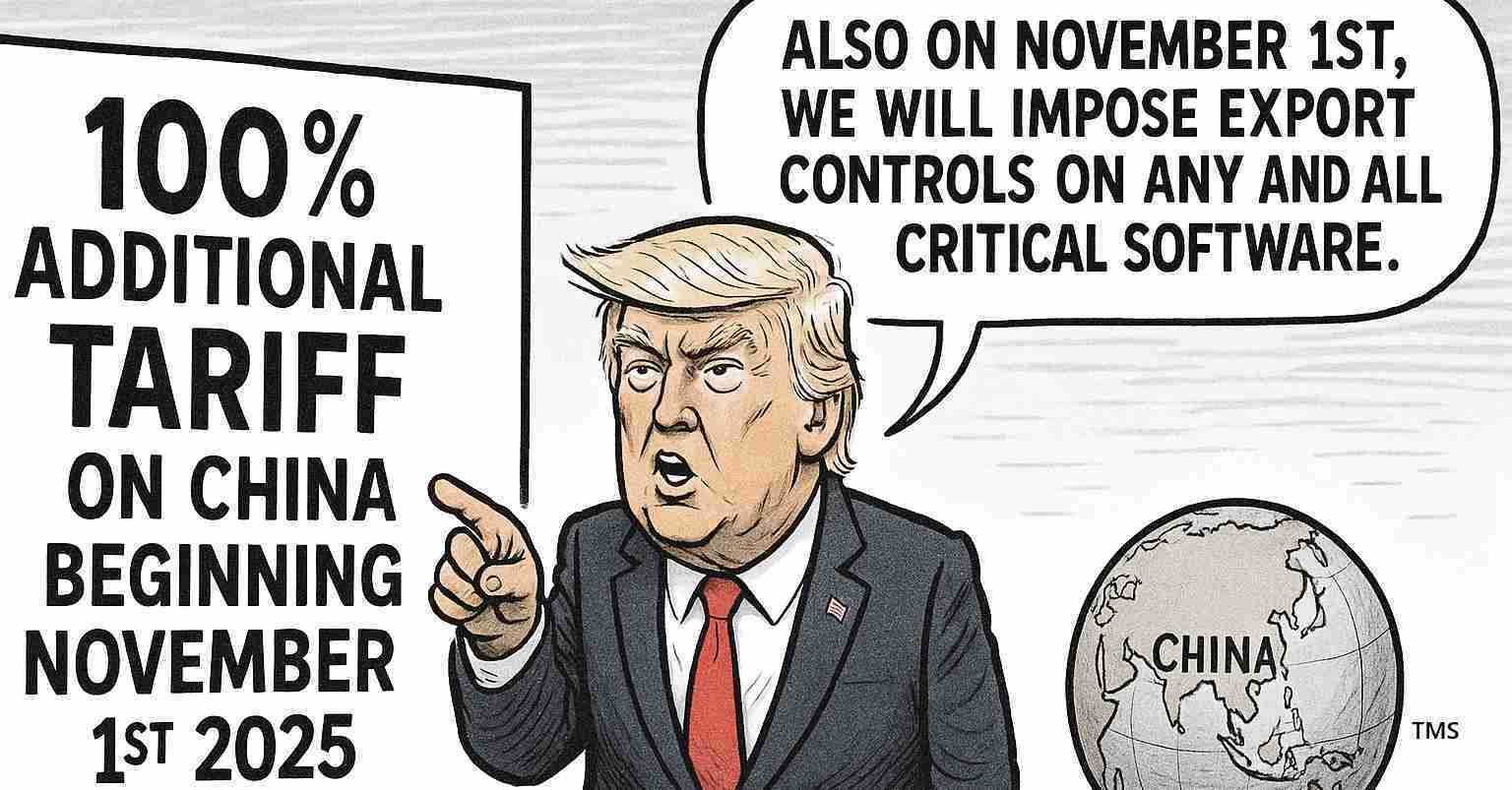
Trump Announces Additional 100% Tariff on China, Cites New Controls on Rare Earth Minerals
Former President Donald Trump announced a new 100% tariff on all imports from China, to take effect by Nov. 1, 2025, in direct retaliation for Beijing’s expanded export controls on rare earth minerals, escalating US-China economic tensions.
- New tariff: An extra 100% tariff on all Chinese imports, to be added on top of existing duties and set to take effect Nov. 1, 2025 (CBS News; Economic Times).
- Retaliation basis: The move targets China’s expanded export controls on rare earth minerals critical to semiconductors, EVs and defense systems (CBS News).
- Broader package: Simultaneous new export controls on “any and all critical software” were announced and a summit with Xi Jinping may be canceled if China does not reverse course (TheJournal.ie; Economic Times).
- Potential impact: The tariff could raise U.S. input costs, spur reshoring of rare earth supply chains, and invite legal or retaliatory responses under WTO and other channels.
Background: China’s rare earth controls
In recent weeks, China expanded its export controls to include additional rare earth elements and related production technologies, requiring special approval for products containing even trace amounts of certain metals regardless of final assembly location (Economic Times; CBS News).
Five elements — holmium, erbium, thulium, europium and ytterbium — were newly added, bringing the total restricted rare earths to 12 of the 17 elements widely used across high-tech and defense supply chains (Economic Times).
China’s Commerce Ministry framed the measures as an effort to “safeguard national security and interests” and to prevent diversion of materials into military applications. The restrictions also extend to export of production technologies and overseas applications, a move Washington and allied capitals view as broad control over global access to critical inputs (Economic Times).
What Trump announced and why
Trump posted the tariff announcement on Truth Social, calling China’s export controls “extraordinarily aggressive” and “a moral disgrace,” and saying the United States would respond forcefully (CBS News).
“These are extraordinarily aggressive export controls — a moral disgrace,” Trump wrote, framing the tariffs as necessary to protect national security, manufacturing and U.S. workers.
Reporting indicates the 100% tariff would be added on top of roughly 30% tariffs already in place on many Chinese goods, meaning some imports could face cumulative duties well above current levels if implemented (CBS News).
He also announced export controls on “any and all critical software,” signaling a broader package aimed at curtailing Chinese access to sensitive materials and technologies (Economic Times).
Domestic and diplomatic signals
The announcement is presented as a show of resolve to deter economic coercion. Trump threatened to cancel a summit with Chinese President Xi Jinping if the export controls and diplomatic posture did not change, underlining how tariffs are being used as a lever in high-level diplomacy (TheJournal.ie).
Advisers and trade experts say the tariff aims to pressure China to rescind or soften export rules and to encourage allies to diversify supply chains. Critics warn the policy risks broad escalation with potential retaliatory measures from Beijing affecting U.S. exporters and global markets.
Economic and industrial stakes
Rare earth minerals are essential to semiconductors, electric vehicles, medical devices and defense systems. China currently dominates mining, processing and refining of many of these elements, giving Beijing leverage over global supply chains (CBS News; Economic Times).
An added 100% tariff would raise costs for U.S. manufacturers that rely on components and finished goods from China. Businesses could face higher input costs and pass those costs to consumers; economists warn tariffs act like taxes on American companies and households, at least in the short term.
Conversely, the tariff could accelerate investment in domestic mining, recycling and processing of rare earths, and incentivize partnerships with allied countries that have deposits or processing capacity. Recent U.S. legislation subsidizing domestic supply chains and semiconductor manufacturing may gain renewed urgency and funding.
Legal and trade implications
A blanket 100% tariff raises questions under WTO rules and U.S. trade law. While national security is often cited to justify trade measures, exporters and trading partners may challenge the tariff in courts or international dispute bodies.
China could respond with retaliatory tariffs or its own trade controls, deepening the trade war and affecting sectors beyond tech and defense. The parallel announcement of export controls on critical software also signals layered compliance challenges for companies navigating licensing, reviews and blacklists (Economic Times).
Reactions and international ripple effects
Business groups and some lawmakers warn a sudden doubling of import duties would hit U.S. firms and consumers. Exporters that sell to China could face retaliation. Allies in Europe and Asia are watching closely; some may support efforts to reduce dependence on China for critical materials, while others may balk at unilateral tariff moves that disrupt trade.
China has defended its export controls as protecting national security and preventing diversion to military uses. Beijing could respond to the tariff package with countermeasures, escalate its diplomatic campaign, or seek relief through international dispute channels (Economic Times).
Implications for the United States
Economic impact: A 100% tariff would likely raise prices for many import-dependent goods, from electronics to household items. U.S. manufacturers that rely on parts from China could see higher input costs; consumers may pay more in the short term.
Jobs and industry: Regions tied to electronics and auto supply chains could face strain, while new domestic processing plants and mines could create jobs. Federal incentives and allied partnerships will shape the speed of any supply-chain shift.
National security: For some audiences, the tariff is framed primarily as a national security measure to limit China’s control over critical inputs and technologies. Policymakers must weigh security benefits against economic costs to industry and households.
Political consequences: The move positions the administration as taking a tough stance vs. China, which may play well politically, but business groups and centrist lawmakers could press for more targeted measures and transition support to avoid sharp shocks.
Practical effects: Households could see higher prices for electronics and EVs; businesses may delay orders or seek non-China suppliers. Over time, successful reshoring and allied partnerships could increase domestic manufacturing and reduce dependence on China.
Sources and reporting
This report draws on official announcements and media coverage including reporting by CBS News, coverage from the Economic Times, and reporting on diplomatic implications by TheJournal.ie.
Video statements and related coverage are available at posted sources: Campaign video 1; Campaign video 2.
(Reporting compiled from Times Media Service sources and media coverage: CBS News; Economic Times; TheJournal.ie; YouTube; YouTube.)



