
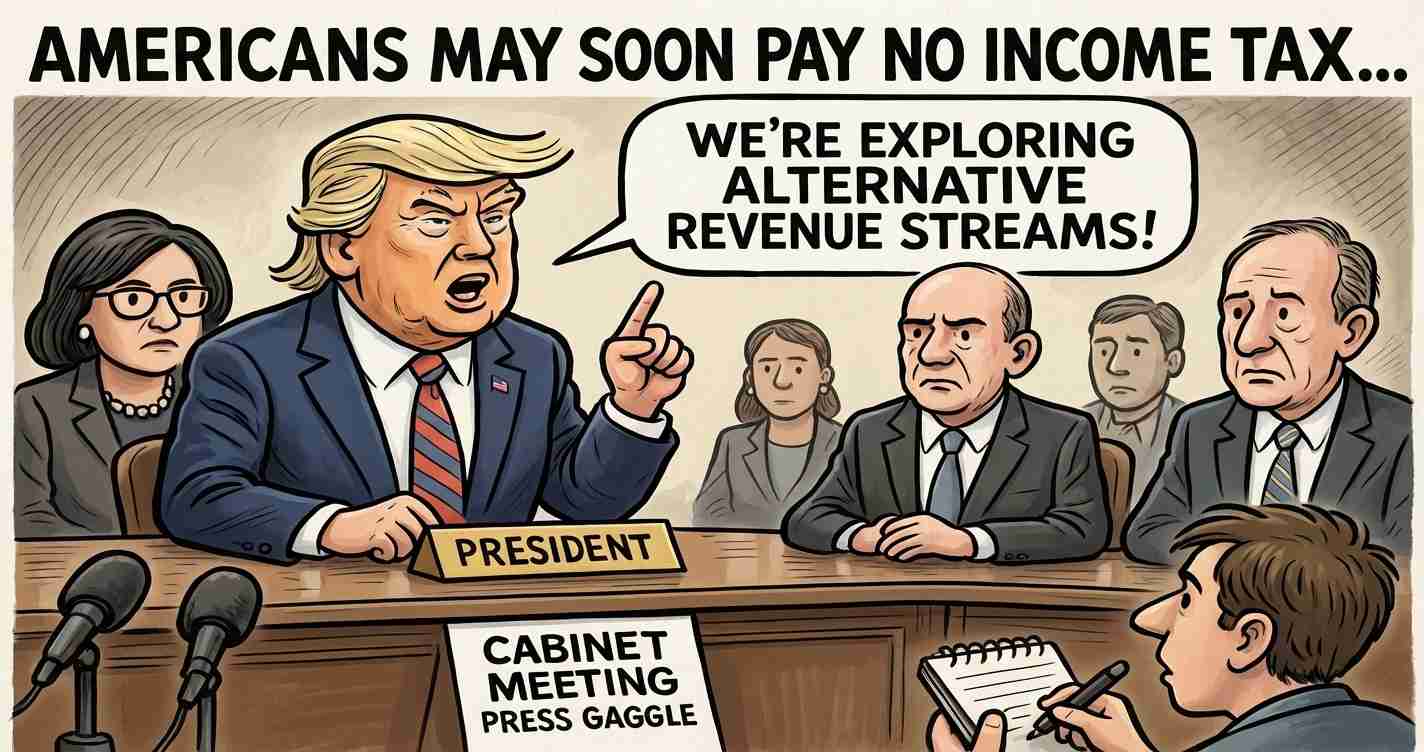
Trump says Americans may soon pay no income tax as White House eyes tariff revenue strategy
President Donald Trump proposed replacing federal income taxes with tariff revenue, saying import duties could fund refunds and debt reduction as part of a 2025 tax overhaul — a plan that raises major economic and legislative questions.
- Tariff-first plan: The White House is exploring using large tariff receipts to replace much income-tax revenue and to fund refunds and debt cuts (CPA Practice Advisor).
- President’s claim: At a Dec. 2, 2025 cabinet meeting Mr. Trump said Americans “won’t even have income tax to pay,” predicting tariffs will bring in “so great… so enormous” revenue (Fox Business; CPA Practice Advisor).
- Legislative backdrop: The FairTax Act of 2025 (H.R. 25) seeks repeal of the income tax in favor of a national sales tax and abolition of the IRS (Congress.gov).
Trump proposes income tax elimination via tariff revenue strategy
At the Dec. 2 cabinet meeting Mr. Trump framed tariff receipts as a transformative revenue source, saying import duties could “pay for government” instead of taxing wages and investment and predicting collections that are “literally trillions of dollars.”
“At some point in the not-too-distant future you won’t even have income tax to pay,” Mr. Trump said, adding that tariff revenue could be “so great… so enormous” that people “won’t be paying income tax.” — Dec. 2, 2025
The president suggested the transition could occur within “the next two, three, four years,” while leaving many specifics undefined. He also floated keeping a nominal income tax “around for fun,” but emphasized that most Americans would no longer pay income tax under his vision (CPA Practice Advisor; Fox Business).
Treasury signals support for targeted tax relief, not full repeal yet
Treasury Secretary Scott Bessent has acknowledged that tariff proceeds could enable targeted tax relief, but he stopped short of endorsing an immediate, full elimination of the income tax. He highlighted options like cutting taxes on tips, Social Security benefits and overtime pay, and restoring interest deductions for American-made autos (CPA Practice Advisor).
The White House has not published public economic models or budget projections showing how tariffs alone would replace income-tax revenue or how the changes might affect inflation, trade, or consumer prices — a gap that has prompted scrutiny from economists and lawmakers (Fox Business).
From campaign rhetoric to House bill — FairTax Act 2025 advances the debate
The administration’s tariff-focused pitch builds on longstanding ideas about shifting taxation toward consumption or trade. In January 2025 the House introduced the FairTax Act of 2025 (H.R. 25), which would repeal the income tax, abolish the Internal Revenue Service, and replace federal income taxes with a national sales tax collected by states (Congress.gov).
Mr. Trump framed tariffs as restoring “the system that made us richer and more powerful,” arguing that taxing imports rather than wages will spur growth — language that echoes prior debates and tax proposals dating to earlier presidential explorations (Fox Business).
Big fiscal and economic challenges remain
Revenue reality: Individual income taxes account for roughly 54% of federal revenue, meaning any full replacement by tariffs would have to match a very large, steady stream of funds. Economists warn tariffs are typically volatile, can raise consumer and business prices, and risk foreign retaliation (CPA Practice Advisor).
Absent published models, analysts say it is difficult to judge the plan’s impact on inflation, growth, trade balances and the federal deficit. Legal and political hurdles are also steep: even with a Republican House, major tax overhauls require Senate approval and the president’s signature, and interest-group opposition could complicate passage (Fox Business).
How this fits into the wider 2025 tax agenda
The tariff strategy sits alongside proposals to make many 2017 Tax Cuts and Jobs Act provisions permanent, pursue corporate rate cuts, and set baseline tariffs on imports. Administration proposals have mentioned corporate rates possibly lowered to 17–20% and baseline tariffs around 10%, with much higher rates (for example, 60%) proposed on goods from certain countries such as China (BrightTax; U.S. Bank).
Implications for United States of America
Economic impact: Replacing income tax with tariffs would change who pays and how much. Tariffs are levied at the border but are often passed through to U.S. consumers, potentially raising prices and disproportionately affecting lower- and middle-income families. Businesses reliant on imports could see higher costs, which may affect hiring and investment (CPA Practice Advisor; Fox Business).
Political consequences: Abolishing the income tax would redraw the fiscal compact between voters and government and likely energize both conservative supporters and Democratic opponents. Passage would require intensive negotiation and risks fracturing coalitions within Congress and among interest groups (Congress.gov).
Social effects: Shifting revenue toward tariffs or sales taxes raises fairness concerns: such taxes can be regressive unless paired with carefully designed rebates or credits. Treasury’s tentative ideas to exempt or target relief (for example, for Social Security) could reduce some harms but add complexity (CPA Practice Advisor).
Cultural and practical effects: The political allure of not filing an annual income tax return is strong, but implementation would shift compliance burdens to businesses and states, alter checkout prices, and require careful design of rebates and collection systems to preserve services and equity (Congress.gov; BrightTax).
Practical next steps
For the tariff-driven vision to move from outline to law, the White House would need to publish detailed revenue models, distributional studies and legislative text. Congress would need committee hearings, a Congressional Budget Office score, and negotiation on offsets — otherwise the proposal remains political rhetoric rather than an operational plan (Fox Business; CPA Practice Advisor).



