
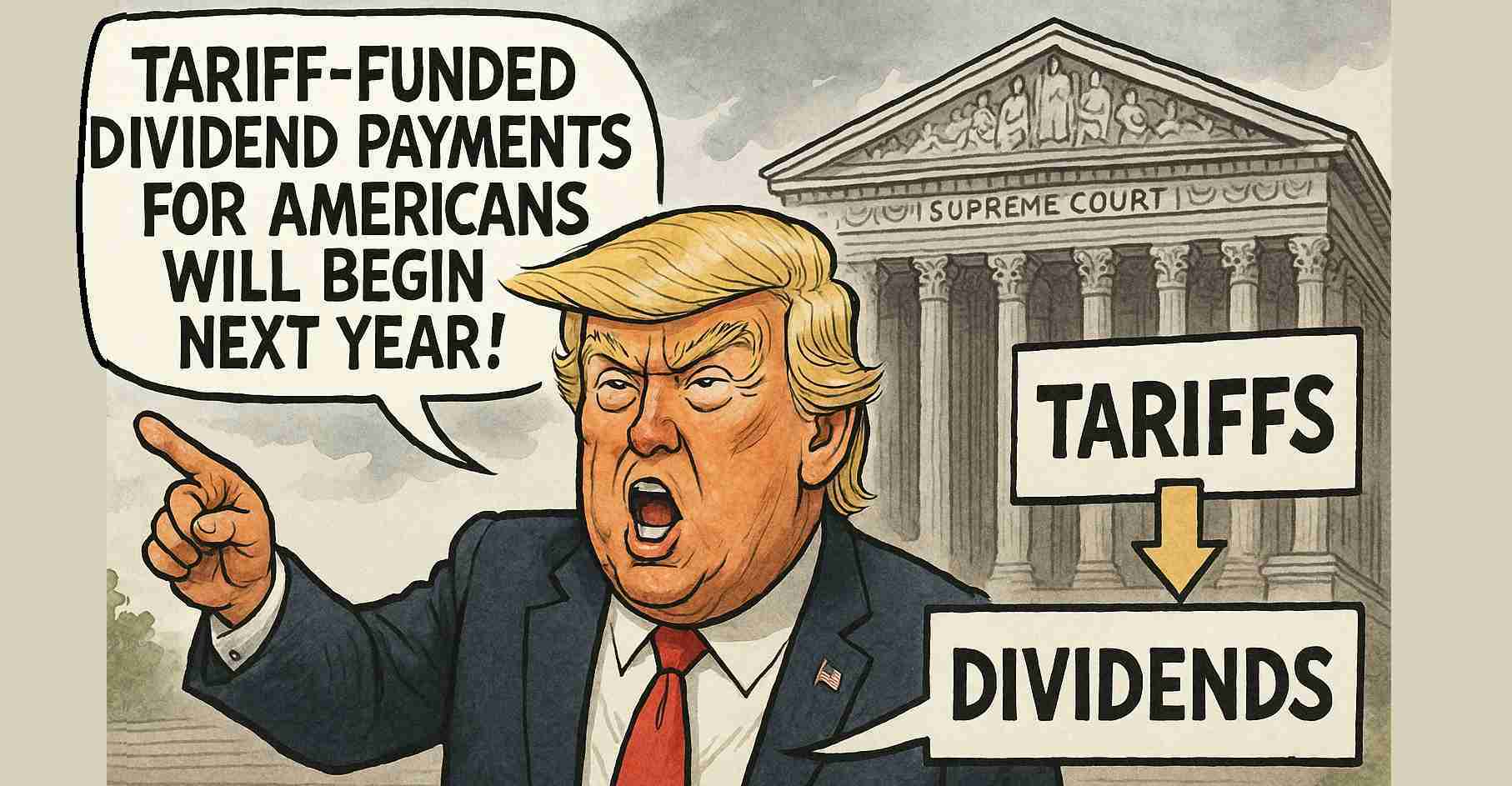
Trump says tariff-funded dividend payments could start in 2026, vows payouts to middle-income Americans
President Donald Trump reiterated plans to distribute tariff-funded dividend payments to moderate and middle-income Americans, saying checks could arrive as early as mid-2026, though legal, congressional and economic hurdles make any timetable provisional and politically sensitive.
- Timing: Administration projects checks “probably in the middle of next year,” making 2026 the earliest realistic window.
- Amount: Described as “thousands of dollars,” with some reports citing $2,000 per person.
- Funding: Payments would be financed from tariff revenues collected by the federal government.
- Hurdles: Economists warn about inflation and sustainability, and both Congress and the Supreme Court pose legal and legislative obstacles.
The promise and the pitch
At an Oval Office event, Trump renewed his pledge that “hundreds of millions of dollars in tariff money” could be distributed as dividends to Americans. He framed the plan as a way to return money collected from trade tariffs to U.S. families, aimed particularly at moderate and middle-income households.
White House press secretary Karoline Leavitt told reporters the administration is “considering all options” for delivering the payments, but she did not provide specifics about eligibility or a formal timetable. The Treasury is reportedly weighing allocations between debt reduction and direct payments.
How the administration says it would work
The plan would use revenue from higher tariffs on imported goods. Officials argue tariffs have generated substantial receipts and that a portion could be returned to households via direct dividends. Treasury advisor Scott Bessent said the dividend “could come in lots of forms,” including direct checks or tax reductions, while also flagging an intent to apply some receipts to debt reduction.
Officials have not released detailed eligibility rules, or whether payments would be one-time or recurring. Any large-scale program of government checks would likely require an act of Congress or a clear legal mechanism tying tariff revenue to payments. For background on fiscal appropriations, see the Congressional Budget Office.
Timing questions and political stakes
Trump suggested the first checks could arrive “somewhere prior to, you know, probably in the middle of next year,” a phrasing reinforced by administration comments that payments would not arrive before the 2025 holidays and are more likely in 2026. The timing carries clear political implications: payments ahead of the 2026 midterm elections could influence voters, though officials say they want to balance payments with deficit reduction.
Administration aides say they are exploring legal and legislative routes to move tariff revenue quickly, but budget experts note that transferring revenue into direct assistance typically needs congressional appropriation. For more from the White House, see White House briefings.
Economic experts raise inflation and sustainability concerns
Budget analysts and economists are skeptical about the plan’s sustainability and inflationary risk. One central worry is that direct checks could increase demand and push prices higher. Research discussed by the Federal Reserve Bank of St. Louis links large stimulus payments during the COVID-19 period to higher inflationary pressures, though methodologies and estimates differ.
Economists also emphasize that tariff receipts are volatile: they rise with imports and rate increases but can fall if trade volumes drop, supply chains shift, or courts curb tariff actions. The Supreme Court’s review of parts of the administration’s trade policy adds legal uncertainty for future revenues.
Legal and congressional hurdles
The Supreme Court is considering challenges tied to the administration’s tariff measures. Until litigation is resolved, the durability of current tariff collections remains uncertain. Legal setbacks could force alternative funding sources or delay dividend payments.
Even with tariff authorities upheld, implementing checks at scale would likely require congressional approval. Lawmakers will debate eligibility, whether payments are temporary or recurring, and interactions with existing tax and benefit programs. For context on appropriations and congressional process, see the House of Representatives.
Administration messaging and fiscal framing
The White House frames the plan as a way to reward American workers while addressing the national debt. By returning tariff receipts directly to households, the administration argues trade policy can produce tangible benefits for citizens rather than solely funding government coffers.
Some moderate conservatives may welcome the approach for its domestic-focused trade framing and stated debt-reduction aims. Fiscal conservatives, however, will press for specifics about long-term impacts and safeguards against creating an open-ended entitlement reliant on volatile tariff receipts.
Implications for the United States
Economic impact: If enacted, dividend payments could boost short-term consumer spending—helping retail and regional economies—but may raise inflation risks if added demand meets tight supply conditions. The long-term fiscal picture is unclear because tariff receipts can fluctuate.
Political consequences: Delivering payments near 2026 would be politically sensitive and could mobilize voters. Because Congress must likely authorize such payments, lawmakers will be central to any final outcome.
Social effects: Direct payouts could relieve families facing high living costs, particularly middle-income households who aren’t targeted by means-tested programs. Critics argue fairness concerns remain if tariffs raise consumer prices that offset some benefits.
Practical applications: For now, no checks are guaranteed. Households should expect debate and potential legislation; businesses and local governments should prepare for modest short-term demand shifts if payments are distributed.
Legal and fiscal safeguards: With the U.S. Supreme Court docket and congressional approval unresolved, any 2026 timetable is provisional. Lawmakers will likely demand clear tracking and rules to prevent budgets from depending on volatile tariff revenue.
Sources and further reading
- White House briefing room
- Treasury Department
- Federal Reserve Bank of St. Louis
- Congressional Budget Office
- U.S. Supreme Court docket
- House of Representatives information on appropriations
- Reuters and AP reporting on tariff policy and legal challenges
This article draws on Times Media Service reporting, White House statements, Treasury commentary, and public economic research from federal agencies and academic centers.



