Trump 50-year mortgage proposal sparks debate — lower monthly mortgage payments but higher lifetime costs, analysts say
Donald Trump has proposed extending standard mortgage terms to 50 years to address America’s housing affordability crisis; while monthly payments may fall, analysts warn the plan could raise lifetime interest costs, slow equity growth, and inflate prices.
- Lower monthly payments, higher lifetime costs: Stretching loans to 50 years reduces monthly bills but can sharply increase total interest paid, per examples from Realtor.com and ABC News.
- Slower equity buildup and higher market risk: Buyers build equity more slowly and lenders may charge higher rates to offset added risk, affecting refinancing and wealth building.
- Potential to push up prices: Easier monthly qualification could raise demand without adding supply, which may inflate home prices and blunt affordability gains.
How a 50-year mortgage would change monthly payments and total cost
Lower monthly mortgage payments are the main selling point of the 50-year idea. Stretching payments over more years reduces the amount due each month, which can help people who can afford a monthly bill but not a higher 30-year payment. Examples cited by Realtor.com and ABC News illustrate the trade-offs.
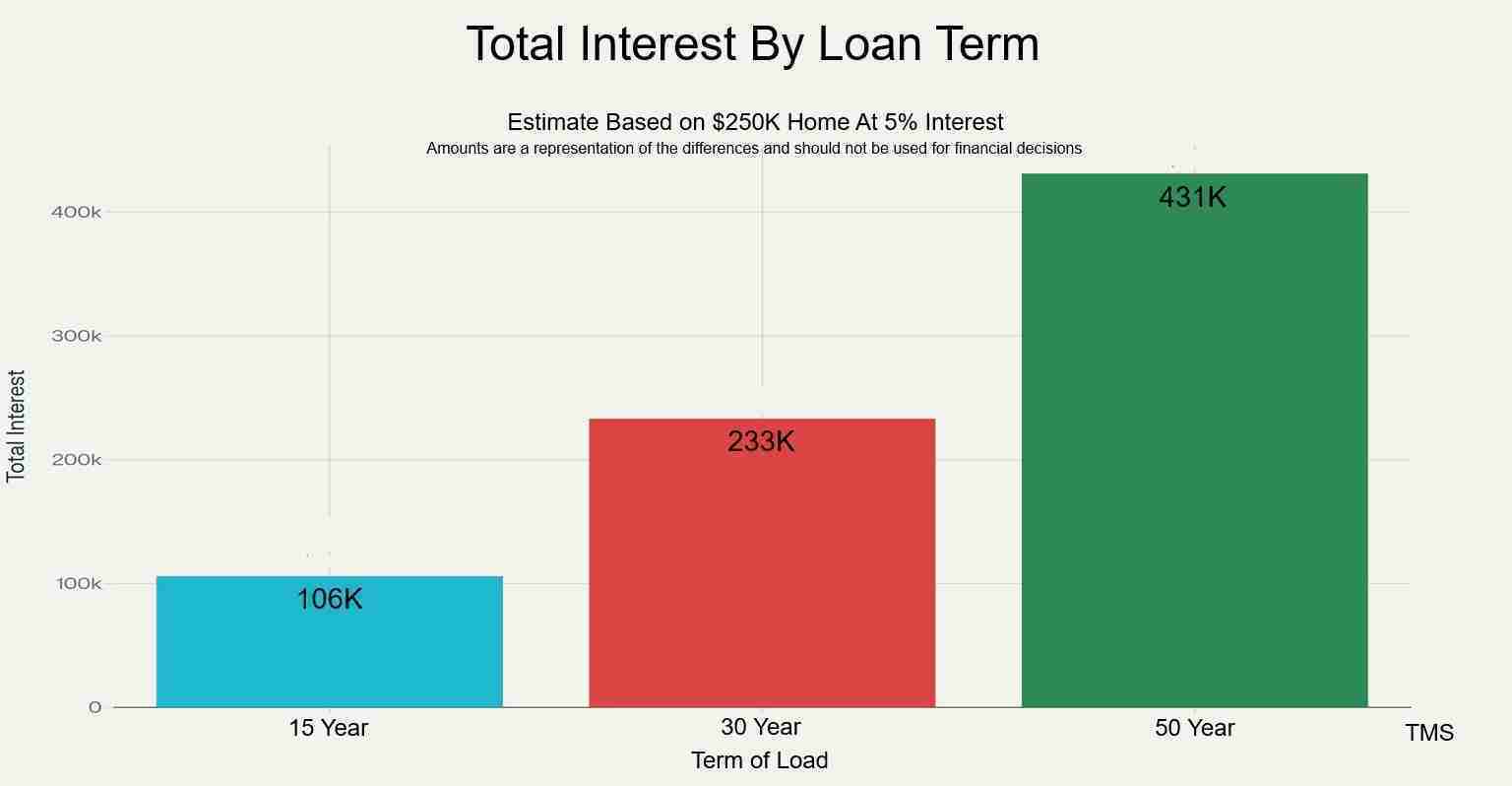
But, stretching the loan also raises the amount paid in interest. For a $400,000 loan at about 6.25%, a 50-year borrower would pay roughly $816,396 in total interest versus about $438,156 over 30 years — roughly an 86% increase in interest paid (figures cited by Realtor.com and Fox Business).
Another example used by ABC News (reflecting Fannie Mae figures) shows a $300,000 loan at 5% produces drastically different monthly bills across 15-, 30- and 50-year terms: the 50-year term yields the smallest monthly payment but the largest long-term cost.
Market and economic effects: will prices rise?
Many economists warn longer loan terms could raise demand for homes without increasing supply. When more buyers qualify because monthly payments fall, competition for existing houses may push prices up — offsetting the intended affordability benefit. Analysts discussed these concerns in pieces from Realtor.com, Fox Business, and Axios.
Lenders, risk and interest rates
Banks and mortgage investors expect higher risk with longer loans. Lenders typically charge more for longer terms to cover inflation risk and the chance a borrower’s finances will change. That could mean a 50-year mortgage carries a higher interest rate than a 30-year loan, reducing the monthly-payment advantage and increasing lifetime cost (Realtor.com, Fox Business, LiveNowFox).
Slower equity buildup also matters for borrowers’ long-term finances. With most early payments going to interest, a homeowner could remain low on home equity for many years — which affects the ability to refinance, borrow against the home, or sell with profit. Critics warn of a “forever debt” risk that could leave people financially exposed (coverage in KIMA TV and Fortune).
Regulatory and political hurdles
Legal barriers exist: current federal rules classify Qualified Mortgages with a 30-year cap. Making 50-year mortgages a standard option would require Congress to change the law — an uncertain outcome given mixed political views and concerns about market effects (Realtor.com).
The idea has divided experts and lawmakers. Supporters, including Federal Housing Finance Agency Director Bill Pulte, say another tool could increase buying options. Critics counter the change mainly helps lenders and could worsen wealth gaps by raising prices and slowing equity buildup; some lawmakers warned about buyers paying mortgages late into old age (see Fox Business and Politico).
Expert views and consumer takeaways
Financial analysts give mixed reviews. Supporters emphasize lower monthly payments can help younger buyers or families with tight budgets enter the market sooner. Opponents argue the policy treats a symptom rather than the root causes — a shortage of homes for sale and rising construction costs (coverage in Realtor.com and Fortune).
Practical advice from analysts for potential buyers:
- Compare lifetime interest costs, not just monthly payments.
- Consider how long you plan to stay in a home before choosing a longer term.
- Think about equity building and future flexibility to refinance or sell.
- Watch for interest-rate differences between a 50-year and 30-year loan (Realtor.com, ABC News, Fox Business).
Implications for United States
Economic impact: A 50-year mortgage option could change demand across the housing market. Lower monthly payments might let more buyers qualify, raising demand; without more homes available, prices could climb and make affordability worse for many (Realtor.com, Fox Business, Axios).
Political consequences: The plan will likely split lawmakers and voters. Some favor market-based choices that expand credit; others worry about long-term financial risk and market stability. Congress would have to change Qualified Mortgage rules, setting up a political battleground (Realtor.com, Politico).
Social effects: Slower equity growth can affect wealth building. Home equity is a core method many U.S. families use to build household wealth; slower accumulation could widen long-term inequality between those affording shorter-term loans and those on extended schedules (Realtor.com, Fortune).
Policy trade-offs and concluding note
The proposal highlights a key policy choice: expand credit to lower monthly payments now, or focus on increasing supply, zoning reform, and construction incentives to address root causes of affordability. Experts generally say boosting supply is more likely to produce lasting relief for prices and affordability (Realtor.com, Fox Business, Fortune).