Repairs Complete After 2026 Potomac River Sewage Spill; Full Flow Restored to Potomac Interceptor
Emergency repairs to the 72-inch Potomac Interceptor are complete and full flow restored after a January 19, 2026 collapse that released an estimated 240–300 million gallons of raw sewage into the Potomac River, DC Water said Saturday.
Key takeaways
- Full flow restored: DC Water says emergency repairs are finished and the bypass and channel used for repairs have been drained (see Wikipedia).
- Massive spill: The collapse released roughly 240–300 million gallons of untreated wastewater, among the largest U.S. sewer failures on record (see Washingtonian).
- Health and environment: E. coli levels spiked near the rupture, prompting closures and advisories; ecological damage and long-term monitoring remain concerns (see KOMO/Komonews).
- Federal response and politics: A federal disaster declaration enabled FEMA and the Army Corps to assist while oversight and liability disputes continue (see Wikipedia).
Main coverage
Emergency repairs and site stabilization
Immediate response: Crews worked continuously after the Jan. 19 collapse of the 72-inch Potomac Interceptor near Clara Barton Parkway to stabilize the site and limit further river pollution. DC Water engineered a bypass using a section of the Chesapeake & Ohio (C&O) Canal near Lock 10, pumping sewage roughly 2,700 feet to an undamaged pipe section.
The temporary bypass was reinforced by adding three additional pumps for steady flow. Workers set a steel bulkhead gate to isolate the damaged section, pumped standing water out, and moved rock to build a stable repair platform. DC Water later reported repairs to the damaged pipe sections were complete and full flow restored before mid-March (see Wikipedia).
Costs and updates: Estimated repair and cleanup costs are roughly $20 million, with about $10 million already spent on immediate pipe fixes and another $5–10 million expected for remediation. DC Water and D.C.’s Department of Energy and Environment provided daily and weekly updates throughout the effort (see Wikipedia).
Environmental and health impacts
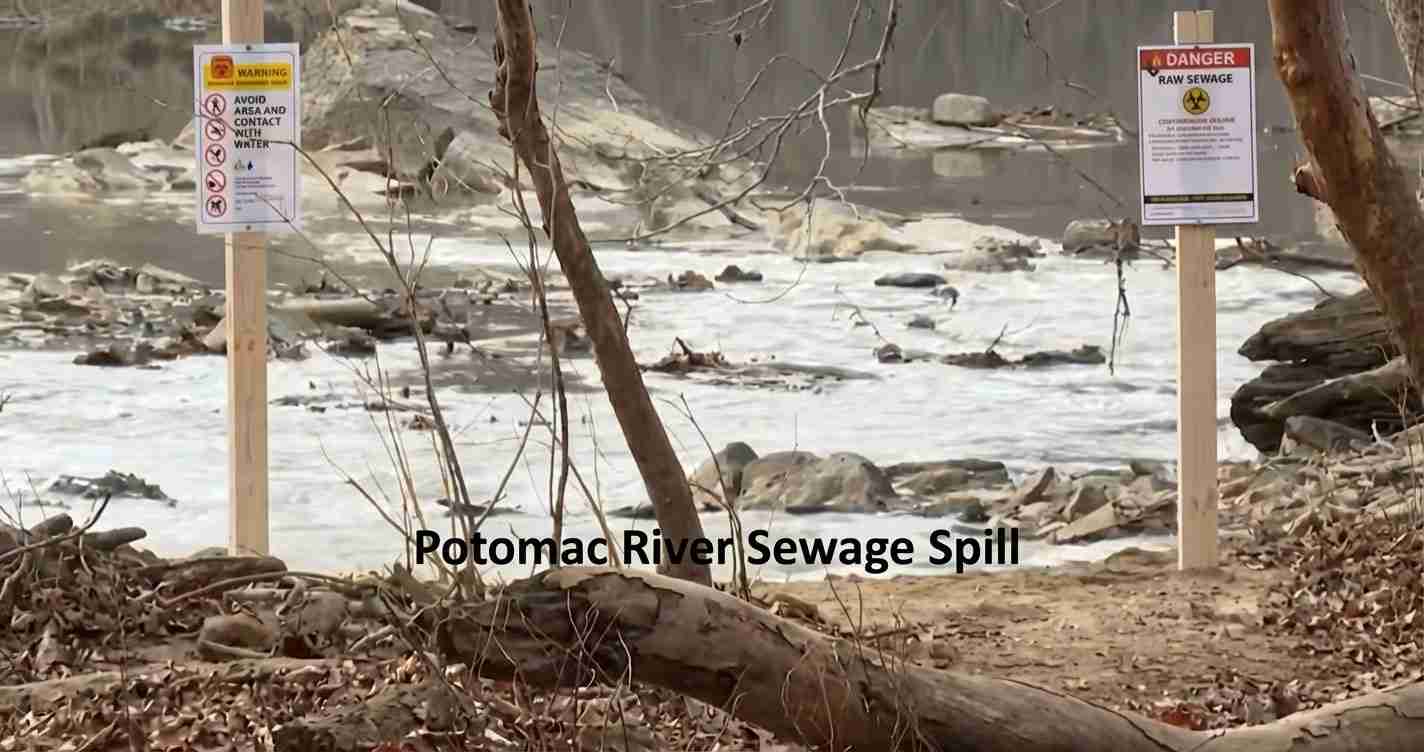
The rupture discharged a massive bacteria load into the Potomac. Independent and government testing recorded E. coli concentrations ranging from hundreds up to 12,000 times the EPA threshold for safe recreational contact in areas nearest the break, including Cabin John and Fletchers Cove. Frozen river conditions and dilution reduced concentrations farther downstream, such as parts of Georgetown.
Maryland’s Department of the Environment closed a downstream shellfish area in Charles County and issued advisories for Montgomery, Prince George’s and Charles counties, warning residents to avoid river recreation until testing cleared the water. Officials stressed that drinking-water intakes for Washington and parts of Montgomery County were upstream of the spill and were not affected, but environmental groups warned ecological damage, impacts on wildlife and shellfish beds, and public concern could persist beyond repairs (see Washingtonian and KOMO/Komonews).
The Potomac Riverkeeper Network conducted independent testing and urged broader cleanup and ongoing monitoring to ensure ecological recovery and public safety (see KOMO/Komonews).
Political dispute and federal role
The response quickly became politicized. D.C. Mayor Muriel Bowser declared a disaster emergency on Feb. 18 and sought federal reimbursement for response costs. President Donald Trump approved a federal disaster declaration that enabled FEMA support; the EPA led the environmental response and the U.S. Army Corps of Engineers joined operations on Feb. 21 (see Wikipedia).
President Trump said local officials were at fault and warned the river might “still stink” for summer events, a remark that drew pushback.
Maryland Gov. Wes Moore countered that the Potomac Interceptor sits on federal land and is managed by DC Water, an independent D.C. utility, noting that Maryland does not regulate the line. He described Maryland’s role as neighborly assistance while reiterating that federal oversight applies on federal land (see Wikipedia).
Responsibility, legal fallout and broader context
Jurisdictional complexity is central: the Potomac Interceptor traverses multiple jurisdictions. DC Water manages most of the system; the Washington Suburban Sanitary Commission oversees some Maryland suburban sections. That split complicates oversight and raises questions about who pays for upgrades and enforces maintenance on aging infrastructure (see Wikipedia).
Legal action has followed: recreational boater Nicholas Lailas filed a lawsuit seeking compensation for those whose property interests and river use were impaired by the spill. That case may test how courts apportion liability among utilities, federal land managers and other parties involved in oversight and repairs (see Wikipedia).
National context: Experts say the collapse highlights a nationwide problem of aging water infrastructure. Tens of thousands of smaller sewer overflows occur annually across the U.S., fouling waterways and posing health risks. Comparable incidents — including a recent 15-million-gallon overflow in Baltimore — indicate this is not isolated. Watchdogs and officials argue decades of deferred maintenance have left critical systems vulnerable (see WSB-TV and Washingtonian).
Implications for United States
Economic and fiscal impact: Immediate repair and cleanup costs are in the tens of millions. If similar large-diameter conduits nationwide need emergency intervention, federal, state and local budgets could face steep bills. The disaster declaration that brought FEMA help shows federal funding can be used for such infrastructure emergencies, but it raises questions about long-term preventative funding (see Wikipedia).
Public health and recreation: High E. coli levels forced closures and advisories that affected recreation, tourism and river-dependent businesses. Even after repairs, public confidence in water quality can lag, potentially reducing outdoor spending and local revenue unless monitoring and communication are strong (see Washingtonian).
Political accountability and oversight: The episode underscores gaps in jurisdiction that complicate response and liability. Voters and officials may press for clearer oversight and enforceable maintenance standards for utilities that cross jurisdictions or operate on federal land (see Wikipedia).
Infrastructure policy: For pragmatic conservatives and other policymakers, the spill bolsters arguments for targeted investments in resilience, public-private partnerships, and strict utility accountability — while also illustrating the practical need for federal support when systems cross state lines or federal land (see WSB-TV).
Legal and regulatory precedents: Lawsuits like the one filed by Nicholas Lailas could set precedents for apportioning damages from environmental contamination and clarifying liability when multiple agencies and utilities intersect. That may influence future contracts, insurance, and oversight agreements for critical infrastructure (see Wikipedia).
Reporting and sources
This report draws on official statements and public reporting, including summaries and agency updates compiled on Wikipedia; local reporting by Washingtonian; environmental and cleanup coverage from KOMO/Komonews; and broader infrastructure context reporting from WSB-TV.