
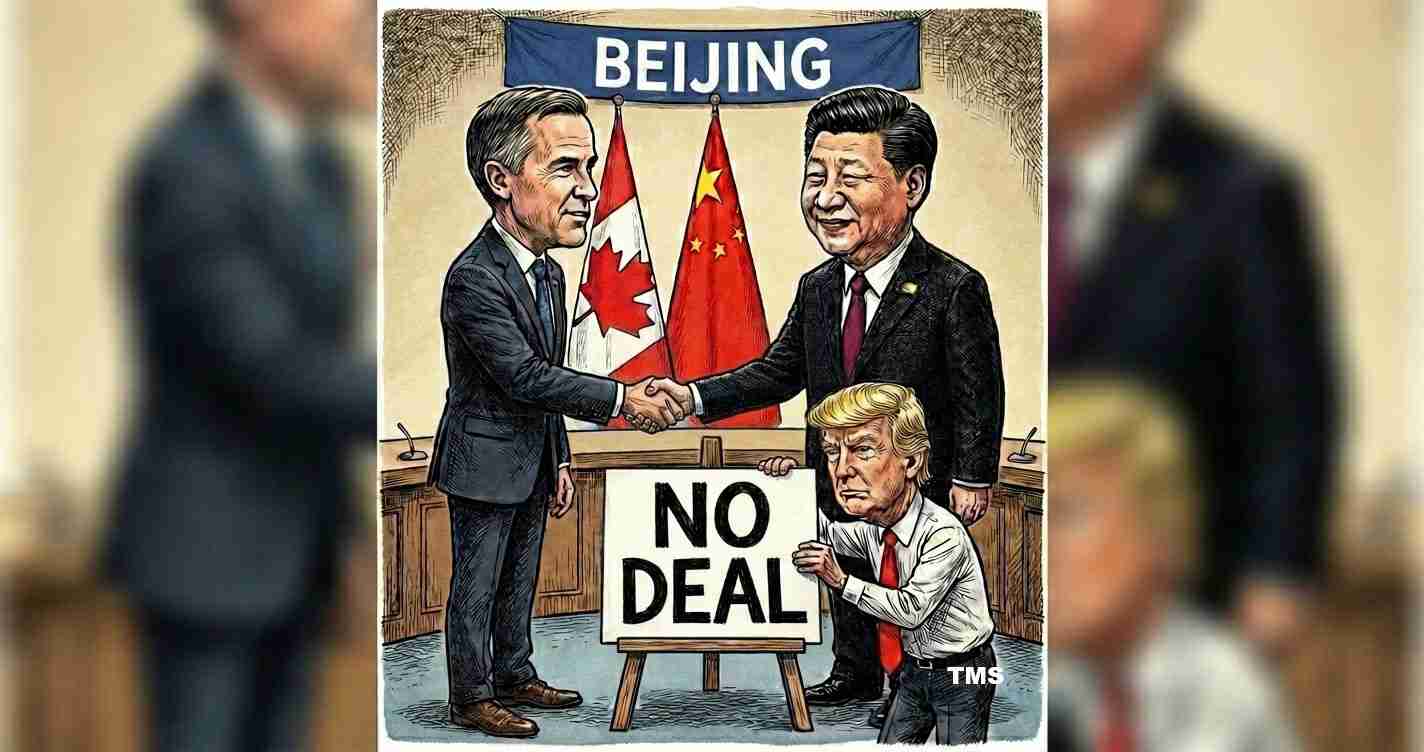
Trump threatens 100% tariffs on Canadian goods over possible Canada-China deal, calls Carney a ‘governor’
President Donald Trump warned Saturday he would impose 100% tariffs on all Canadian goods entering the United States if Ottawa finalizes a trade deal with China, sharply escalating tensions after a narrow Canada–China electric vehicle tariff agreement.
Key takeaways
- Trump posted threats of a 100% tariff on “all Canadian goods” if Canada makes a deal with China, per ABC News.
- He accused Canadian leader Mark Carney of enabling China to “eat Canada alive,” and referred to him as “Governor Carney,” covered by NBC Montana.
- Canada-China talks reportedly cut Canada’s 100% tariff on some Chinese electric vehicles in exchange for lower Chinese tariffs on certain Canadian farm goods — a narrow, targeted deal, not a free trade pact (ABC News).
Trump’s post and exact wording
On Saturday, Mr. Trump published a series of posts on Truth Social asserting that any deal between Canada and China that lets Chinese goods move through Canadian ports into the U.S. would be met with immediate tariffs. He wrote that Canada would be “hit with a 100% tariff against all Canadian goods and products coming into the U.S.A.” (ABC News).
“China will eat Canada alive, completely devour it, including the destruction of their businesses, social fabric, and general way of life.”
In another post he warned the world does not need a “China take over Canada,” insisting “It’s NOT going to happen, or even come close to happening!” (NBC Montana).
Rhetorical pattern and past remarks
The posts echo a recurring pattern. Mr. Trump has previously misnamed Canadian leaders as “governor” instead of prime minister and floated the idea of annexing Canada while campaigning. Video clips and coverage of his remarks are documented on YouTube and YouTube.
What is the Canada–China deal?
The immediate trigger appears to be a limited trade agreement: Canada reduced its 100% tariff on some Chinese electric vehicles while China agreed to lower tariffs on certain Canadian agricultural exports. Reporting emphasizes the deal is narrow and not a comprehensive free trade pact (ABC News).
Canadian reactions and diplomatic friction
Canadian officials pushed back. Prime Minister Mark Carney said Canada and the U.S. have built a strong partnership and that Canada “thrives because we are Canadian,” rejecting any suggestion Ottawa seeks to be subordinate to Washington (ABC News).
Minister for Canada–U.S. trade Dominic LeBlanc explicitly denied that Ottawa is pursuing a China free trade agreement and stressed the U.S.–Canada partnership remains “remarkable” (ABC News).
Tensions include revoked invitations and policy disagreements, such as criticism over missile defense, which commentators link to the tariff threat (NBC Montana).
Legal and practical hurdles to a 100% tariff
A unilateral presidential move to impose 100% tariffs on all Canadian imports would face major legal and practical obstacles. U.S. trade law grants the president certain national security or emergency authorities, but sweeping action against a close ally would invite legal challenges and likely retaliation.
Economists warn such tariffs would raise costs for American consumers and businesses that rely on Canadian inputs. Canada is the U.S.’s second-largest trading partner; roughly three-quarters of Canadian exports flow to the U.S., underscoring deep integration and potential disruption (video coverage).
Questions for Washington and Ottawa
- What specifically in the Canada–China arrangement prompted the president’s threat, and does the deal permit re-export of Chinese goods through Canadian ports into the United States?
- Would the White House pursue tariffs under national security authorities, and how would that align with past U.S. practice toward allies?
- How would Canada respond — economically, legally, and diplomatically — if such a tariff were imposed?
Implications for the United States
Economic impact
A 100% tariff would quickly push up prices for fuel, food, cars and parts, timber, and other daily imports. U.S. manufacturers using Canadian inputs would face higher production costs, and consumers could see increases at the pump and in grocery aisles.
Supply chain and retaliation risks
Integrated North American supply chains — particularly autos and energy — depend on predictable cross-border trade. Sudden tariffs would create bottlenecks, delays, and shortages. Canada could retaliate with counter-tariffs hitting U.S. farmers and manufacturers that sell into Canadian markets.
Political consequences
Imposing steep tariffs on Canada would mark a severe break with a close ally, potentially weakening cooperation on defense and intelligence. Domestically, lawmakers in trade-dependent districts could push back if tariffs raise prices or cost jobs.
Social and regional effects
Industries with cross-border operations could face layoffs and reduced investment. Rural border communities may be particularly exposed. Low- and middle-income households would likely feel price increases most sharply.
Cultural and security considerations
Sustained trade conflict could erode public goodwill and impede joint defense projects and border security coordination that depend on trust and shared planning.
Practical applications for policymakers
- Clear review: A formal review would likely be required to show how a Canada–China deal threatens U.S. markets or national security.
- Congressional role: Lawmakers could challenge or constrain a large tariff move through hearings and oversight.
- Contingency planning: Federal agencies and firms would need rapid plans to maintain supply lines and protect key industries if tariffs were enacted.
Reporting and sources
This report draws on contemporaneous coverage and public statements from: ABC News (detailed reporting on the Truth Social posts and the Canada–China EV tariff deal); NBC Montana (coverage of the “drop off port” claim and diplomatic friction); and related video summaries on YouTube and YouTube.
Preserved all original facts, information, and URLs as provided.



