
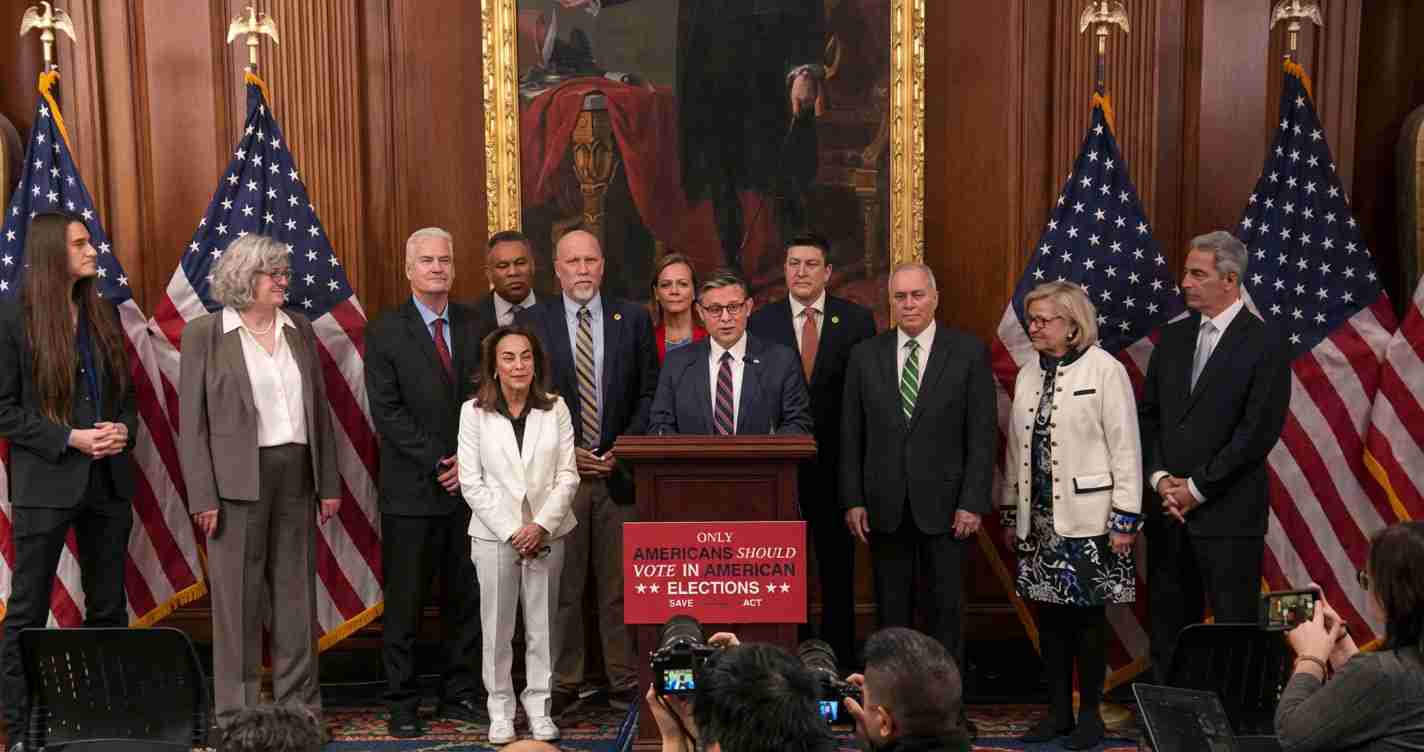
House Passes SAVE America Act, Clearing Way for Photo ID for Voting in Federal Elections
WASHINGTON, D.C. – On Wednesday, February 11, 2026, the House of Representatives passed the SAVE America Act (H.R. 7296), mandating photo identification and U.S. citizenship verification for federal voting; the bill passed largely along party lines and faces an uncertain Senate future.
Key takeaways
- House vote: Approved 218–213 on Feb. 11, 2026; all House Republicans and one Democrat, Rep. Henry Cuellar (D‑TX), voted in favor — see Politico live updates and the Fox News report.
- Core rules: Establishes a national photo ID requirement and in-person proof of U.S. citizenship for federal registration, plus federal database checks and state-to-federal data sharing — see Rep. Roy’s press release and the original H.R. 22 text.
- Implementation concerns: Independent analysts warn about costs, immediate effective dates, tight EAC guidance deadlines and no federal funding — see the Bipartisan Policy Center analysis.
- Senate outlook: The bill faces procedural and political hurdles in the Senate and potential legal challenges if enacted.
Overview
The SAVE America Act (H.R. 7296), sponsored by Rep. Chip Roy, was advanced by House Republicans as an election-integrity measure intended to prevent non-citizens from appearing on voter lists or casting ballots in federal elections. The legislation’s most visible change is a nationwide photo ID requirement for voting in House, Senate and presidential contests.
What the SAVE America Act would do
Key provisions include:
- Photo identification: Voters must present an accepted form of photo ID at the polls for federal elections.
- Proof of citizenship at registration: In-person proof of U.S. citizenship would be required for federal election registration; acceptable documents can include those that meet REAL ID standards.
- Federal database checks: States would be directed to use federal data to identify and remove potential non-citizen registrations.
- Information sharing: State election officials could share flagged records with federal agencies, including the Department of Homeland Security, which the bill allows to pursue immigration-related cases if non-citizens are found on rolls.
“Supporters say the measure standardizes rules and closes perceived loopholes; critics say it blurs the line between election administration and immigration enforcement.”
Background and legislative history
This version updates an earlier SAVE Act (H.R. 22) that passed the House in April 2025 but stalled in the Senate. The current bill adds the nationwide photo ID requirement that was not in the earlier measure — details and prior text are available on Congress.gov (H.R. 22).
How lawmakers framed the bill
Republicans presented the SAVE America Act as a common-sense reform to protect the integrity of federal elections, citing concerns about illegal immigration and public demand for secure voting rules. Rep. Chip Roy and GOP leaders emphasized polling that shows broad support for voter ID.
Democrats called the bill voter suppression, arguing it creates new barriers for seniors, low-income people and minority communities who may lack photo ID or ready access to required citizenship documents. Nearly all House Democrats — 213 members — opposed the measure.
Only one Democrat crossed the aisle
Rep. Henry Cuellar of Texas was the lone Democrat to vote in favor, highlighting regional and ideological splits within the Democratic caucus, particularly among members from competitive or conservative-leaning districts.
Implementation, costs and timing
Independent reviewers warn the bill could be difficult to implement quickly:
- The measure would take effect immediately upon enactment.
- The Election Assistance Commission (EAC) would be required to issue guidance within 10 days, a timeline critics describe as unrealistic for many states.
- The bill provides no federal funding to help states comply, potentially shifting substantial costs to state and local budgets.
- Analysts also flagged concerns about federal database accuracy and the risk of legal challenges over removals from voter rolls — see the Bipartisan Policy Center analysis.
Legal and political hurdles in the Senate
Republicans currently lack the votes to overcome a Democratic filibuster in the Senate, and several Senate Republicans have expressed reservations. Senate leaders have resisted rule changes to fast-track the measure; some GOP senators called parts of the bill federal overreach that could erode public trust. Given those barriers, the bill faces a difficult path in the upper chamber unless leaders secure additional support or change filibuster rules.
Political context and strategy
The House vote occurred amid public pressure from conservative leaders, including President Trump and other influencers who urged passage. Some Republicans considered attaching SAVE language to must-pass spending legislation but ultimately did not pursue that route after leadership guidance. GOP strategists view the bill as a way to mobilize voters on election-integrity and border issues ahead of the 2026 midterms.
Facts on non-citizen voting and public opinion
Experts and voting-rights groups note that confirmed instances of non-citizen voting are extremely rare and already illegal. Supporters argue that even isolated cases undermine trust and justify stronger safeguards. Polling consistently shows broad public support for voter ID requirements, a point cited by proponents.
Implications for the United States
Economic impact
If enacted, states and local election offices would likely face new expenses to update registration systems, train personnel, redesign materials, and create processes for verifying citizenship and photo ID — with costs borne by state and local governments because the bill provides no federal funding.
Political consequences
The House passage sharpens election integrity as a GOP message for the 2026 midterms and deepens partisan contrast on voting rights. The partisan split may catalyze legal and political fights in states over implementation and could influence competitive races depending on how quickly new rules roll out.
Social effects
Requiring photo ID and proof of citizenship could disproportionately affect elderly voters, low-income individuals and some minority communities less likely to possess required documents. Without accessible options to obtain IDs or prove citizenship, eligible voters could face new hurdles, raising civil-rights concerns and possible litigation.
Cultural relevance
The debate reflects broader tensions about trust in institutions and national identity. For supporters, the bill is about confidence in elections; for critics, it is an example of federal intrusion into state-run election systems. Those cultural dynamics will shape public discussion through the election cycle.
Practical applications for voters and election officials
- Voters may need to obtain and bring acceptable photo ID to federal polls and retain documents proving U.S. citizenship for registration in federal contests.
- Election officials must prepare guidance, assist voters in obtaining IDs, and implement verification and challenge procedures.
- States with existing photo ID laws may see fewer operational changes than states without such requirements.
Legal challenges and next steps
The bill’s path depends on the Senate and on litigation if enacted. With split views in the Senate and concerns from some Republicans about federal overreach, the measure faces an uphill climb. If it stalls in Washington, debates over voter ID and registration will increasingly play out in state legislatures and courts.



