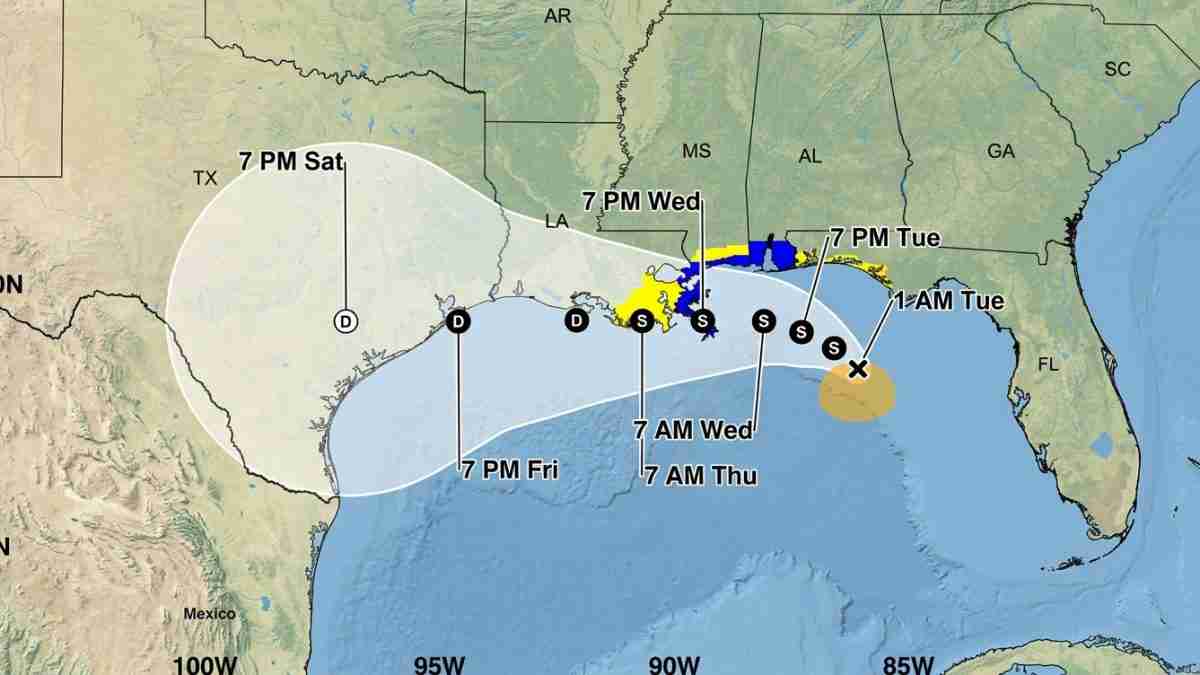
NEW ORLEANS, July 21 (DC Times Online) — Tropical Storm Bertha has formed in the northeastern Gulf, and the main question for Texas is not whether the system will matter, but how much it will strengthen or shift west before late week.
For people along the Texas coast, the practical step right now is to keep checking official forecasts over the next 24 to 48 hours. Forecasts still leave room for a track that stays farther east, reaches the Upper Texas Coast as a weaker system late in the week, or falls apart over Louisiana before getting that far.
What Bertha is expected to do
CNN reported that Bertha was the second named storm of the Atlantic hurricane season and had top winds of 40 mph. CNN also reported that the storm was already sending bands of heavy rain into the Florida Panhandle Monday afternoon.
The latest forecast CNN cited called for Bertha to move toward southeast Louisiana and southern Mississippi by Wednesday, then possibly reach the Upper Texas Coast late in the week as a tropical depression. CNN also reported that the system could instead dissipate over Louisiana.
AccuWeather said Tropical Depression Two strengthened into Tropical Storm Bertha Monday evening. AccuWeather’s forecast called for the storm to track across the Gulf and bring flooding rain, gusty winds, dangerous surf and rough seas from Florida to Louisiana and possibly Texas.
Why Texas should pay attention
Texas is not the area with the clearest current watch or warning, but it is inside the range of possible impacts if the storm takes a farther-west track.
AccuWeather said a path that stays closer to the coast would keep winds weaker overall, but would still raise the risk of heavy to flooding rain along the central Gulf Coast as the storm loses wind strength inland. The same forecast said a farther-south track could push heavy rain, gusty winds and potentially damaging surf farther west into Texas, including central Texas.
CNN reported that the system could bring heavy rainfall, gusty winds and some coastal flooding along the northern Gulf Coast from Monday night through at least midweek. The report said rainfall totals of 2 to 4 inches were possible across a broad area, with up to 8 inches in stronger thunderstorms.
What the watches mean
A tropical storm watch means tropical storm conditions are possible in the watch area within 24 to 48 hours.
CNN reported that a tropical storm watch had been issued for the Florida Panhandle coast from the Ochlockonee River west to the Jefferson-Plaquemines Parish border in Louisiana. CNN also reported a storm surge watch from the mouth of the Mississippi River in southeast Louisiana to the Alabama-Florida border, where water levels could rise 2 to 4 feet above normal.
Those watches do not currently cover Texas in the reports provided, but they show where the strongest official concern was centered Monday.
What Texas residents should do now
The main issue for Texas is uncertainty. If Bertha stays east, Texas may see little more than rough surf and scattered rain. If the storm shifts west, the state could face heavier rain, stronger wind gusts and coastal flooding later in the week.
People along the Texas coast should keep an eye on updated official forecasts, especially if new watches are issued farther west. The key timing window is the next 24 to 48 hours, when forecast tracks can still change enough to move the risk area closer to Texas.