
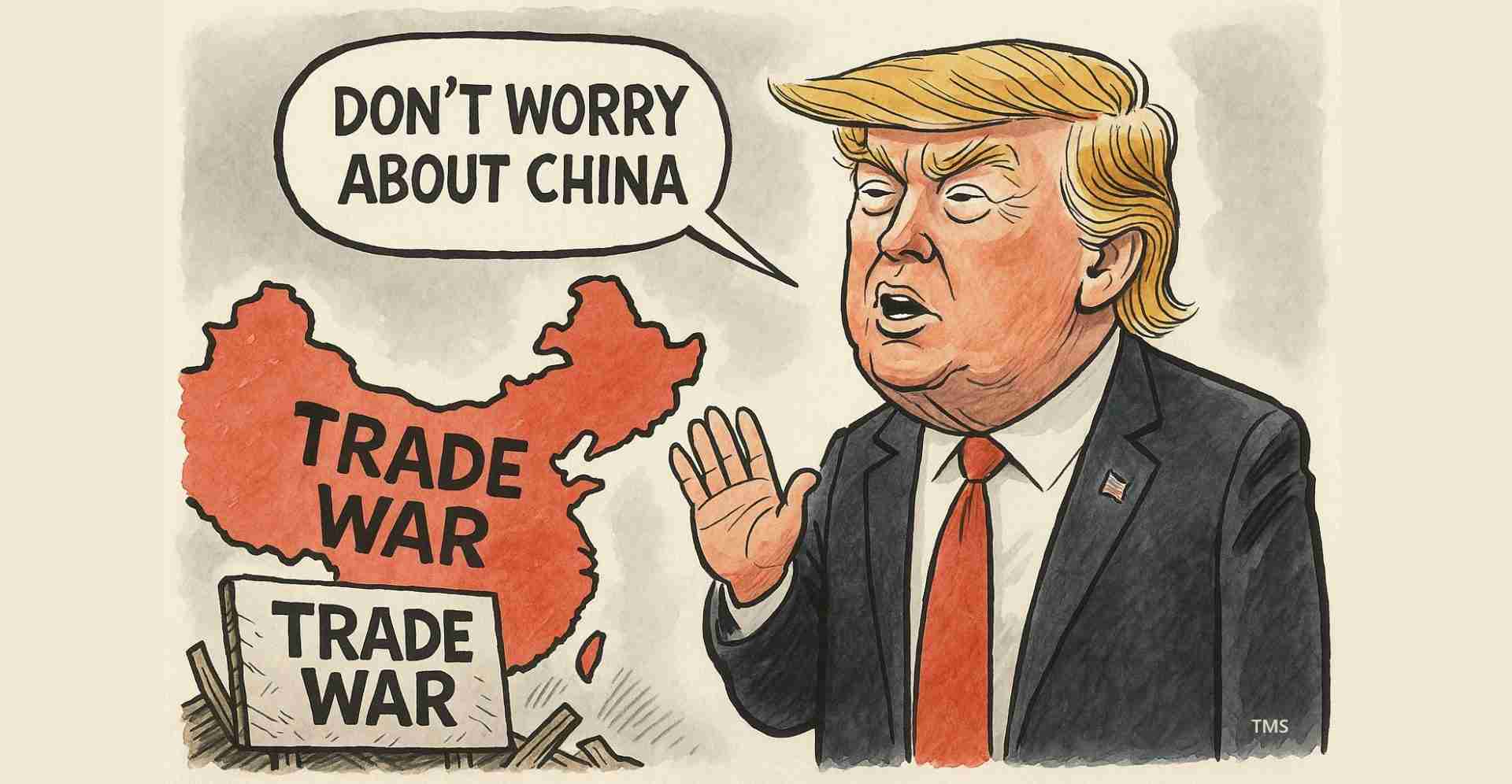
Trump moves to calm trade war fears after Beijing responds to 100% tariff threat as China tightens rare earth mineral controls
Donald Trump sought to ease fears of a US-China trade war after Beijing reacted to his threat of a 100% tariff, while China tightened controls on rare earth minerals—raising stakes over strategic resources and testing fragile trade truces.
Key takeaways
- Trump reassured the public on Truth Social:
“Don’t worry about China, it will all be fine,”
framing action as defensive rather than aggressive.
- Beijing warned of retaliation and urged dialogue — Fox Business.
- A proposed 100% tariff would raise levies well above the current ~55% average on Chinese goods — Fox Business.
- China tightened rare earth export controls; Beijing dominates ~70% of mining and ~90% of processing capacity — Fox Business.
- Vice President J.D. Vance called China’s supply-chain dominance a “national emergency” and urged leverage — Fox Business.
Trump’s effort to calm markets and voters
President Trump moved quickly to tamp down concerns after Beijing signaled it would retaliate to talk of a steep tariff increase. On Truth Social he wrote, “Don’t worry about China, it will all be fine,” and argued the United States wants to help China, not hurt it.
He framed the potential tariff as a defensive step to prevent a single country from controlling critical materials, rather than an intent to launch a prolonged economic conflict. The message targeted multiple audiences: businesses worried about supply chains, consumers facing higher import costs, and investors watching signs of a widening trade war.
For politically moderate conservatives, the rhetoric emphasizes national security while attempting to avoid panicked economic fallout and reassure markets.
Beijing’s stern response and the language of retaliation
China’s Commerce Ministry issued a formal warning that it would “resolutely take corresponding measures” if the U.S. moves forward with the tariff hike and urged both sides to resolve differences “through dialogue.” Fox Business
The ministry also said Beijing would continue to issue export licenses for rare earths used in legitimate civilian applications while leaving open the option to act in defense of national interests. This reflects a common playbook: public calls for negotiation combined with coded threats of retaliation to maintain leverage without immediately disrupting essential civilian supplies.
Rare earth mineral controls — the strategic center of the dispute
Rare earth elements are crucial for electric vehicles, wind turbines, smartphones, and many defense systems. China’s move to tighten export controls raised alarms because Beijing already controls roughly 70% of global mining and about 90% of processing capacity. Fox Business
That concentration gives Beijing leverage in a geopolitical standoff and poses real questions for U.S. defense and manufacturing supply chains. U.S. officials, including Vice President J.D. Vance, have framed the dependency as a “national emergency” and argued for asserting leverage to secure supply chains if tensions worsen. Fox Business
Tariff math and market implications
A proposed 100% tariff would represent a major escalation, jumping well above the current average U.S. tariff on Chinese goods (~55% following earlier rounds). Fox Business
Such a move would likely raise consumer prices and increase costs for American manufacturers that rely on Chinese parts. Sudden tariff changes create planning problems for businesses with locked-in contracts or supply chains built around existing tariff levels, potentially squeezing margins or forcing cost pass-throughs to consumers.
Investors may react to fears of retaliation — including limits on strategic exports like rare earths — prompting market volatility and re-pricing of risk for affected sectors.
Potential diplomatic fallout and the bump in talks with Xi
The exchange clouds a possible in-person meeting between Trump and Xi Jinping later this year. Both sides prefer dialogue to reduce strategic risk and secure access to critical materials, but public threats and counter-threats complicate private diplomacy.
Analysts note such exchanges can lead either to behind-the-scenes negotiations or further friction if either side doubles down. The episode highlights the fragility of any trade truce when strategic materials and national security claims are at stake. Fox Business
Domestic political framing and messaging
Trump’s messaging seeks to thread a needle: reassure voters worried about a trade war while maintaining the tough posture his base expects on China. Calling Beijing’s action a “bad moment” softens rhetoric and signals room for diplomacy while keeping the threat of tariffs as leverage.
For moderate conservatives, the posture balances protecting U.S. industry and national security with avoiding policies that severely harm the economy. The specifics of any tariffs — targeting, exemptions, or phased approaches — will be closely watched by business groups and lawmakers. Fox Business
Implications for the United States
Economic impact: A 100% tariff would raise costs for many U.S. businesses and consumers, pushing up retail prices and squeezing manufacturers that use China-based parts. Targeted tariffs tied to rare earth dependency could speed supplier diversification, domestic production, or shifts to allied sources.
Political consequences: The standoff will shape congressional debates on trade and national security, potentially prompting funding for domestic rare earth mining, processing, or strategic stockpiles. A hardline tariff could split opinion across political lines.
Social effects and cultural relevance: Consumers may face higher prices for electronics and vehicles. The dispute taps into conversations about economic independence and technological leadership, resonating with concerns about sovereignty and rebuilding industrial capacity.
Practical advice: Households could see higher costs for some goods; businesses should review procurement plans and diversify suppliers; state and local officials may seek federal support to pivot industries and retrain workers.
Source and further reading
All reporting in this article is based on reporting from Fox Business.



