
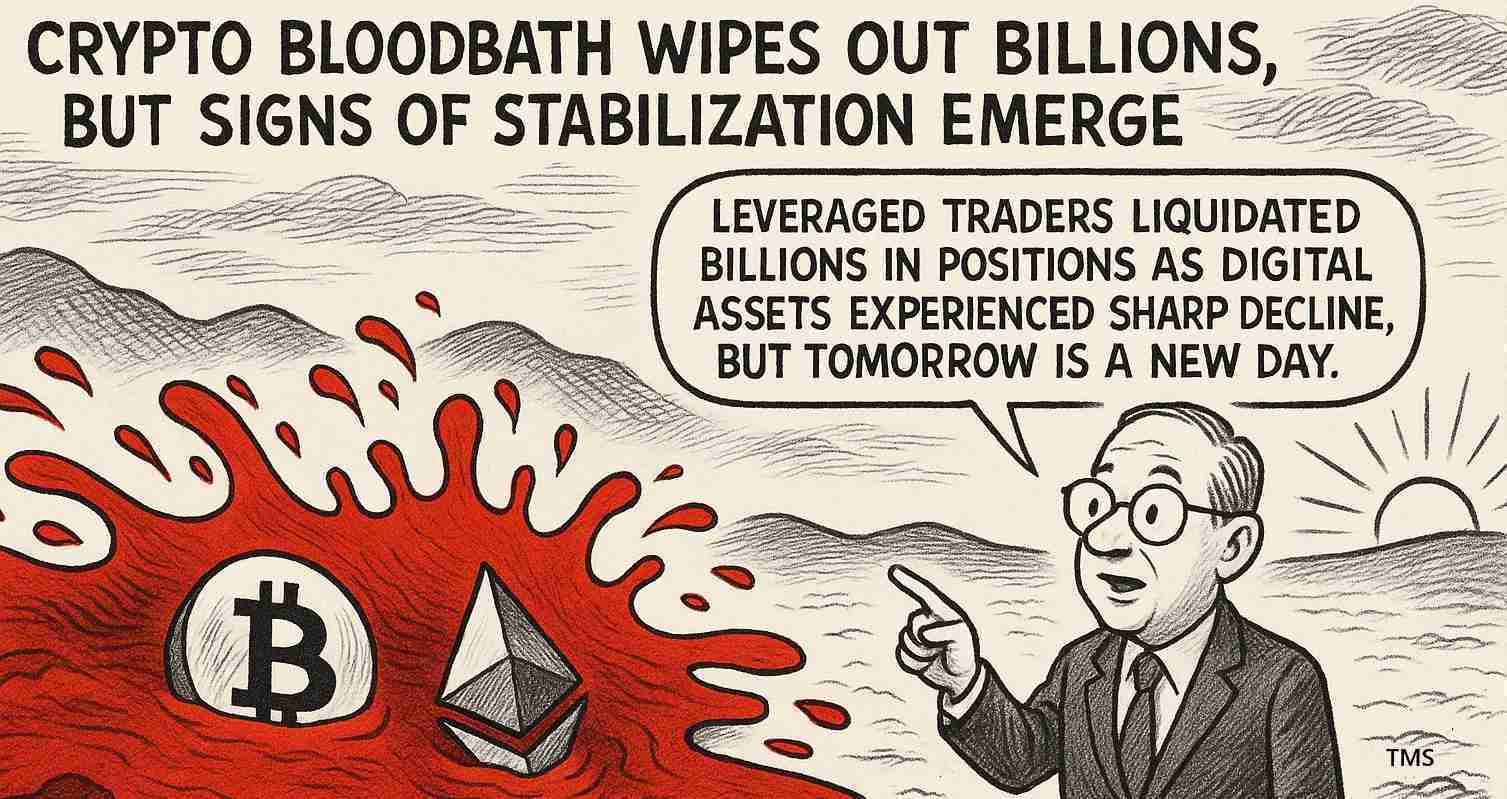
Crypto bloodbath wipes out $560 billion as Trump China tariffs trigger massive liquidations — signs of stabilization emerge
A sudden market crash erased about $560 billion from crypto valuations after President Donald Trump’s announcement of steep China tariffs, triggering roughly $18 to $19 billion in leveraged liquidations and affecting more than 1.6 million traders amid signs of stabilization.
Key takeaways
- Market loss: ~$560 billion wiped from crypto market cap, led by altcoins (CoinDesk, Times of India).
- Liquidations: Roughly $18–19 billion forced closed in 24 hours, impacting >1.6 million traders (DL News).
- Trigger: President Trump’s tariff announcement sparked a leverage-driven cascade that hit altcoins hardest (CoinDesk).
- Outlook: Analysts note historical October rebounds and technical supports may limit further damage; stabilization signs present (TradingView, Times of India).
What happened
On and around Oct. 10, global crypto markets plunged after a surprise policy post from President Donald Trump announcing a new 100% tariff on Chinese imports. The announcement, published on his Truth Social account, ricocheted through financial markets and triggered fast selling in cryptocurrencies.
Altcoins experienced the most severe moves: according to market analysts cited by CoinDesk, many altcoins cratered in a roughly 25‑minute window, losing roughly a third of their value before a partial rebound.
“The sell-off was a leverage-driven cascade that hit smaller tokens hardest,” — CoinDesk analysis.
Scale and the liquidation cascade
Liquidations hit staggering levels. Data compiled by trading platforms and market trackers show about $18–19 billion in leveraged positions were liquidated within 24 hours, with roughly $7 billion lost in a single hour. Reporting from Times of India and DL News places the number of traders affected at more than 1.6 million.
Some industry estimates warn overall liquidations could exceed $30 billion if aftershocks continue, raising concerns about counterparty exposure on major exchanges and potential systemic stress.
Which tokens were hit
Bitcoin demonstrated relative resilience. Trading data from TradingView and reporting in Times of India show Bitcoin fell from above $125,000 to below $102,000 before recovering near $113,000 in early trading.
Ethereum dipped below $3,800 (a roughly 5.8% drop at parts of the move). Major altcoins such as Binance Coin and XRP suffered deeper losses — XRP lost more than 22% at the low point. Stablecoins, including Tether, showed only minimal deviation, signaling a flight to perceived safety.
Why leverage magnified the move
Experts told CoinDesk and other outlets that large shares of leveraged retail positions turned a policy shock into a cascading market meltdown. Forced liquidations force selling, which pushes prices down and triggers more liquidations — a feedback loop especially potent in low‑liquidity altcoins.
Wiston Capital analysts monitored technical indicators such as Bitcoin’s 365‑day exponential moving average and volatility indexes to assess when stability could return.
Signs of stabilization and what analysts see next
Despite the severity, several analysts cited historical patterns and technical supports as reasons to expect some stabilization. Edul Patel of Mudrex and other commentators noted that October corrections in prior years have sometimes preceded relief rallies of up to ~21% in certain cycles (Times of India).
Some traders on platforms like TradingView warned the market resembled a “pump‑then‑dump” set‑up that could precede a fourth‑quarter recovery, suggesting distressed selling may create buying opportunities if sentiment calms.
Allegations, exchange risk and systemic concerns
The speed of the move spawned allegations of insider activity and coordinated squeezes on specific exchanges in some media reports; these claims remain unproven and are under scrutiny (The Telegraph).
Separately, observers warn that large liquidations could strain exchange risk models and counterparty credit lines, increasing the chance of contagion if more forced selling unfolds (Mitrade).
Regulatory and policy context
The episode highlights how global policy moves — here, the Trump China tariffs announcement — can ripple through lightly regulated markets. Analysts say sensitivity to macro headlines, combined with high retail leverage and platform interconnectedness, may renew calls for clearer rules, stronger custody standards, and leverage limits (CoinDesk).
Implications for United States
Economic and investor impact
- Household exposure: Retail investors with leveraged positions or concentrated altcoin bets faced the biggest losses; retirement and speculative accounts may be affected (Times of India).
- Market confidence: High‑visibility crashes can dampen faith in crypto as a store of value and slow inflows to spot ETFs and institutional channels.
Political and policy consequences
- Regulatory pressure: Regulators may leverage the event to press for tighter disclosure, custody rules, and retail leverage limits (CoinDesk).
- Trade debate: The crash illustrates how trade policy can produce rapid financial reactions, feeding broader debate over tariff strategy and economic impacts.
Social and community effects
- Advisory demand: Financial advisers and community groups can expect increased inquiries as investors seek guidance and counseling (Times of India).
- Trust in exchanges: Persistent reports of exchange stress or insider activity could erode public trust and push funds toward regulated institutions (The Telegraph).
Practical takeaways for Americans
- Check leverage: Review margin and leverage exposure and avoid positions you cannot sustain during abrupt moves (CoinDesk).
- Diversify and vet custody: Consider regulated custodial arrangements for larger holdings and diversify away from single high‑risk tokens (Times of India).
- Watch policy headlines: Major federal and international policy moves can move prices quickly; factor macro risk into position sizing (DL News).
Ongoing monitoring and next steps
Market‑watch firms are continuing to track liquidations, exchange health, Bitcoin dominance, and moving averages. While signs of stabilization exist, many analysts warn volatility may persist until leverage and counterparty exposures decline. Policymakers and investors will watch trading data and exchange disclosures closely in the days ahead.
Sources
- CoinDesk: Altcoins cratered in Oct. 10 crypto flash crash as Bitcoin held up, Wiston Capital says
- Times of India: Donald Trump’s China tariff announcement wipes billions from crypto market
- DL News: Leverage and China tariffs drive $19bn crypto crash
- TradingView / NewsBTC: Crypto crash prediction comes true
- The Telegraph: Crypto anger — speculators accuse insiders over Trump crash
- Mitrade: Live news and exchange reports



