
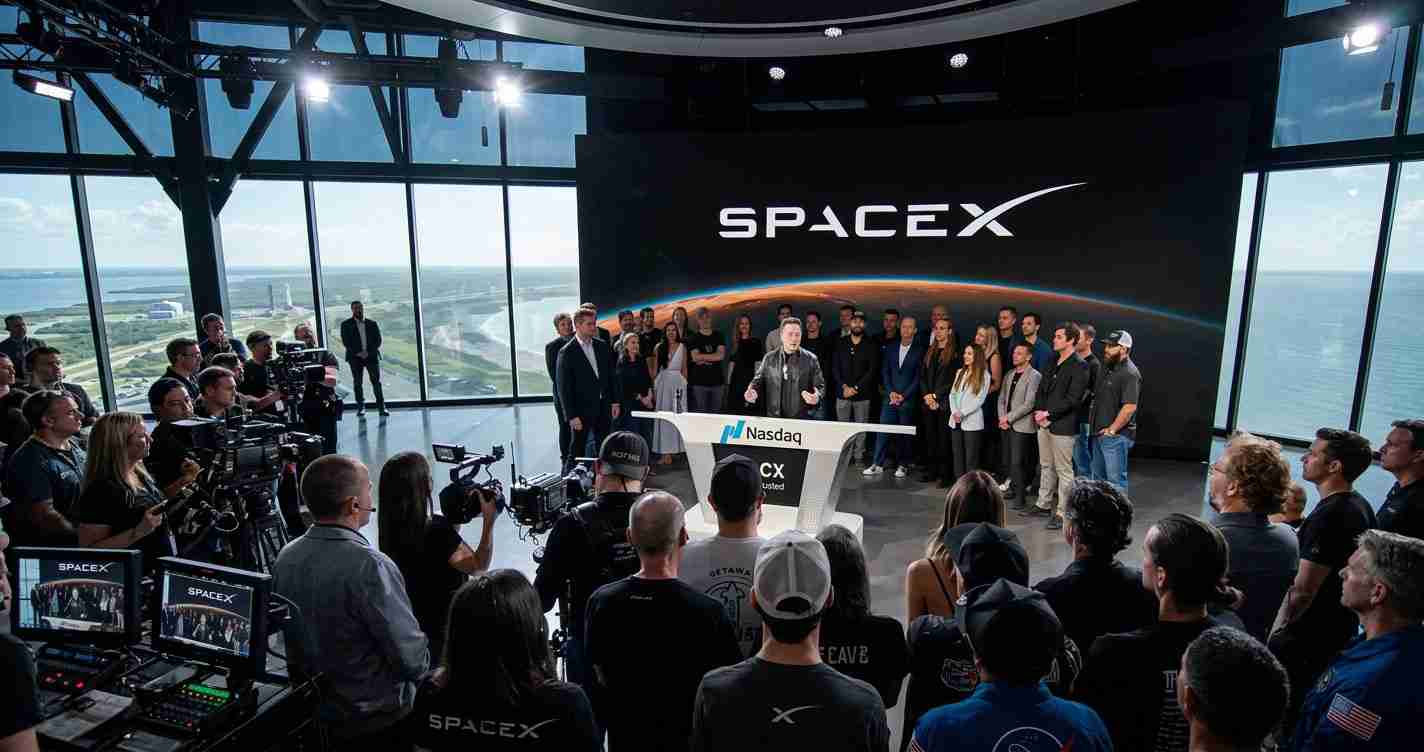
NEW YORK, June 13 (Our New York News) — SpaceX’s first day of public trading on Nasdaq produced two measurable financial outcomes: the rocket and satellite company raised $75 billion in its initial public offering, and the market value of Elon Musk’s SpaceX holdings helped push wealth-index estimates of his net worth above $1 trillion.
The finding rests on three sets of records and named sources: SpaceX’s announced IPO terms, Nasdaq trading data for the company’s new shares and wealth calculations by Forbes and Bloomberg. Those sources show a sharp first-day rise in SpaceX’s stock, trading under ticker SPCX, and a major increase in the paper value of Musk’s stake.
SpaceX priced the IPO at $135 per share, according to the company’s offering announcement as described in the source material. The offering raised $75 billion. Trading began on June 12, 2026, on Nasdaq, where the stock opened around $150, above the IPO price, according to Nasdaq market data. During the session, shares reached about $176.50 and closed at roughly $161.
That closing price was about 19% above the IPO price. Market capitalization figures derived from the trading price put SpaceX above $2 trillion after its first session. That compared with an IPO valuation reported around $1.77 trillion to $1.8 trillion, based on the offering price.
For public investors, the first day established a wide gap between the price SpaceX set for the IPO and the price buyers paid once trading began. Investors who bought near the open paid roughly $150 a share, while investors who bought near the intraday high paid about $176.50. The closing price of roughly $161 still left the stock well above the $135 offering price.
For Musk, the effect was larger because of the size of his SpaceX holdings. Forbes and Bloomberg wealth calculations placed his total net worth at roughly $1.05 trillion to $1.11 trillion after the debut, making him the first person tracked by those indexes to cross the trillion-dollar mark. Those estimates are not cash holdings. They are largely paper wealth tied to publicly traded stock, private or newly public company interests and options.
The value of Musk’s SpaceX stake alone depends on the price and method used. Forbes-based calculations put the stake at roughly $688 billion at the IPO price. Other market-based estimates put it near $690 billion, and higher estimates reached roughly $766 billion to $800 billion when using higher trading prices or including options. The range reflects timing and methodology, not a single fixed cash value.
The exact size of Musk’s ownership and voting control could not be stated with the same certainty from the available source material. Several accounts described a dual-class or special share structure that left Musk with outsized control, but the reported percentages conflicted. Some accounts cited ownership near 38%, others near 42% or about half, and voting-control figures also differed. The underlying prospectus or official share-count filing was not included in the source material reviewed for this article, so the precise control figures are not asserted here as fact.
The records are clearer on the market result than on governance details. Nasdaq trading data shows the opening, intraday and closing prices. SpaceX’s IPO terms show the $135 offering price and $75 billion raise. Forbes and Bloomberg supply the wealth estimates that placed Musk above $1 trillion.
SpaceX was established in 2002. Musk has said the company went public to fund plans for satellites and data centers in space and, ultimately, a human settlement on Mars, according to AP reporting based on his statement. That stated use of capital ties the IPO to SpaceX customers and future customers who rely on its rocket and satellite business, though the available records do not show how the proceeds will be allocated across specific projects.
The debut also exposed a valuation dispute. Morningstar analysts, described in AP and PBS material as independent of investment-banking fees, estimated SpaceX’s value at about $780 billion and called the IPO “significantly overvalued.” That estimate was far below both the IPO valuation and the first-day public-market valuation above $2 trillion.
The documented record therefore shows a company that raised $75 billion, a stock that closed well above its IPO price and a founder whose SpaceX holdings pushed major wealth indexes past an unprecedented threshold. It also shows unresolved questions about exact ownership, voting control and valuation assumptions that cannot be answered without the full offering documents and official share-count records.



