
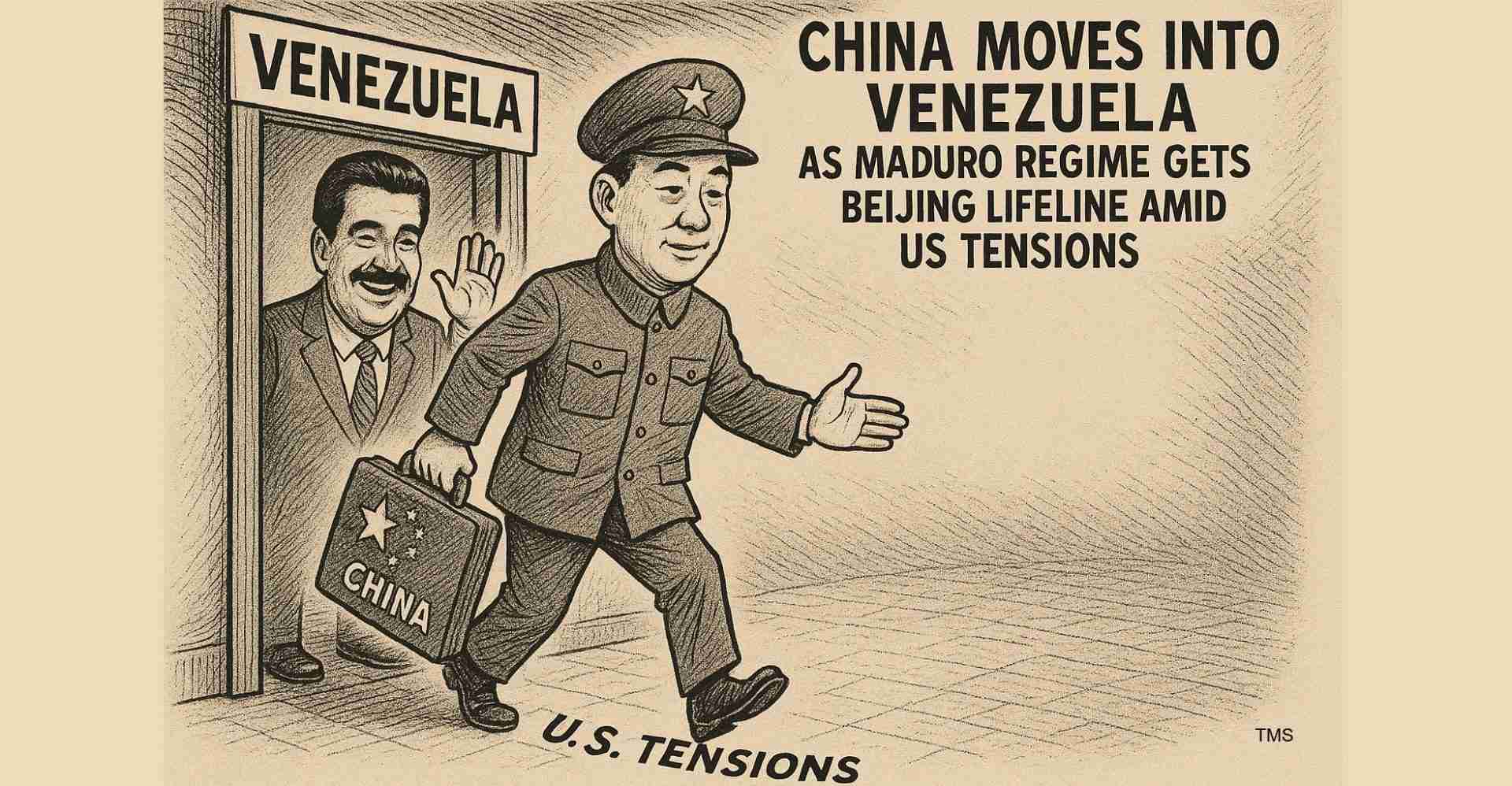
China moves into Venezuela as Maduro regime gets Beijing lifeline, raising alarms about growing influence
China has markedly deepened economic and political ties with Venezuela, offering the Maduro regime direct investment, trade deals and technological cooperation that go beyond debt-driven aid. The shift provides a Beijing lifeline while raising regional and geopolitical concerns.
- Beijing has upgraded ties and shifted from oil‑backed loans to contract‑based investment, SEZs and legal protections under a new BIT.
- Chinese exports to Venezuela have surged (about $3.45 billion in 2023), while Venezuelan exports to China remain modest.
- Political alignment and governance cooperation accompany economic deals, prompting U.S. concern about diminished influence.
- Analysts caution China is likely pursuing protected, productive projects rather than repeating open‑ended lending.
Key information and institutional steps
China and Venezuela upgraded ties to an “all‑weather strategic partnership” in 2023 and have expanded cooperation across trade, investment, technology and governance (see China CIDCA statement (May 10, 2025); Chinese Ministry of Foreign Affairs (May 13, 2025)).
Beijing is shifting away from large, oil‑backed loans toward “productive deals,” Chinese‑led special economic zones (SEZs) and guaranteed investment protections (reporting by El País; legal analysis by FIETTALAW).
A new Bilateral Investment Treaty (BIT) between China and Venezuela entered into force on April 1, 2025, offering legal protections for Chinese investors (FIETTALAW).
Chinese exports to Venezuela totaled roughly $3.45 billion in 2023, a figure that has grown rapidly even as Venezuelan exports to China remain small by dollar value (OEC).
Beijing’s oil involvement is more cautious: state firms focus on services and smaller projects, while some interest shifts to Guyana (El País; Global Policy Journal).
U.S. analysts warn Beijing’s moves could sideline Washington’s leverage; commentators like Gordon Chang suggest China may gain outsized economic control (Fox News).
China’s new approach: productive deals and SEZs
Beijing’s current strategy favors productive deals over raw lending. Rather than large loans repaid with oil shipments, agreements emphasize technology transfer, factory construction and joint ventures. Officials and reporting highlight plans for more than 600 projects in 2025 across agriculture, manufacturing and infrastructure (El País).
Special economic zones (SEZs) are central: Chinese‑led SEZs offer simplified rules, tax breaks and easier access to labor. For China, SEZs reduce direct cash exposure and protect investments; for Venezuela, they promise jobs and factory output. Critics warn SEZs could favor Chinese companies and limit host‑country oversight.
“SEZs can create jobs quickly, but they may also concentrate benefits and limit regulatory control,” analysts caution.
Trade and investment: what the numbers show
Trade between China and Venezuela has climbed steadily. Chinese exports to Venezuela reached about $3.45 billion in 2023, led by motorcycles, tires and electronics, growing nearly 25% annually since 2018 (OEC).
Institutional steps like the April 2025 BIT aim to reduce investor risk and normalize long‑term Chinese economic presence (FIETTALAW).
Energy and oil: cautious engagement, shifting focus
Venezuela owns the world’s largest proven oil reserves and historically Chinese lending—estimated around $62.3 billion—was tied to oil shipments (Global Policy Journal). Recent Chinese moves are more cautious: state firms have pulled back from major upstream commitments after payment and management troubles, favoring services and smaller contracts. Reporting also notes activity in less formal oil channels.
Some Chinese energy focus has shifted toward Guyana, where new discoveries and clearer contract terms offer perceived safer returns (El País).
Political and ideological ties
Political alignment accompanies economic deals: Caracas has engaged in party training and governance exchanges with Chinese institutions. Beijing pledged to “firmly support Venezuela in safeguarding state sovereignty, national dignity and social stability,” language signaling diplomatic cover for Maduro amid Western pressure (China CIDCA statement; Chinese MFA).
Joint statements frame the partnership as part of a broader effort to rebalance global power—visible at multilateral venues like the China‑CELAC summit in May 2025 (El País; Council on Foreign Relations).
Geopolitical overtones and U.S. reactions
U.S. policymakers view Beijing’s moves through a security lens: deeper China–Venezuela ties can weaken U.S. influence and complicate sanctions and diplomatic pressure. Reports note preferential trade measures announced at the Shanghai Expo 2025 that could help Caracas sidestep some sanctions effects (Fox News).
“This really looks like China is going to completely take over the Venezuelan economy,” said commentator Gordon Chang, reflecting alarmed views in some U.S. circles (Fox News).
Limitations and diverging views
Not all experts foresee a full takeover. Economists note China’s caution after costly past lending; the current trajectory favors contract‑backed, risk‑managed investments protected by the BIT and implemented via SEZs and targeted projects (El País).
Implications for the United States
Economic impact
– Trade and markets: Growing China‑Venezuela trade and SEZ investment could undercut U.S. business access in Venezuela and neighboring markets, squeezing opportunities for American exporters and regional partners.
– Energy: If China stabilizes Venezuelan oil shipments through private channels or services, it could limit U.S. leverage over Venezuela’s energy sector and affect global oil market dynamics (El País; Global Policy Journal).
Political consequences
– Hemispheric influence: Beijing’s footprint challenges U.S. influence and enables a politically aligned Venezuela to act as a diplomatic counterweight in regional forums.
– Sanctions strategy: Trade deals and investment protections could blunt targeted U.S. sanctions, forcing Washington to reassess financial and diplomatic tools (CFR).
Social effects
– Migration and stability: Projects may create jobs, but controlled SEZ growth could deepen inequality or limit broad recovery, potentially sustaining migration pressures.
– Human rights and governance: Closer ties with Beijing may embolden Venezuela’s ruling party to resist Western pressure on human rights and democratic norms (China CIDCA statement).
Cultural and strategic relevance
– Soft power: Educational exchanges, media and development projects can shape narratives and influence regional elites (CFR).
– Military and strategic risks: While no large public Chinese military footprint is reported, economic ties may create ports, logistics and infrastructure with potential long‑term strategic value.
Practical applications for U.S. policy
– Tighten investment screening and export controls to prevent sensitive technology transfer tied to SEZs.
– Coordinate with regional partners to offer alternative investment and trade options that bolster governance and reduce dependence on Beijing.
– Target sanctions and diplomatic measures to limit illicit oil channels while minimizing harm to ordinary Venezuelans.
– Invest in regional development, energy partnerships and migration management to blunt Beijing’s political gains through economic deals (FIETTALAW; CFR).
Sources
- China CIDCA statement (May 10, 2025)
- Chinese Ministry of Foreign Affairs (May 13, 2025)
- El País reporting on partnership (July 6, 2025)
- FIETTALAW on China‑Venezuela BIT (April 2025)
- OEC trade data profile
- Global Policy Journal on past loans and oil ties
- Council on Foreign Relations backgrounder on China in Latin America
- Fox News coverage including Gordon Chang quote and Shanghai Expo reference



