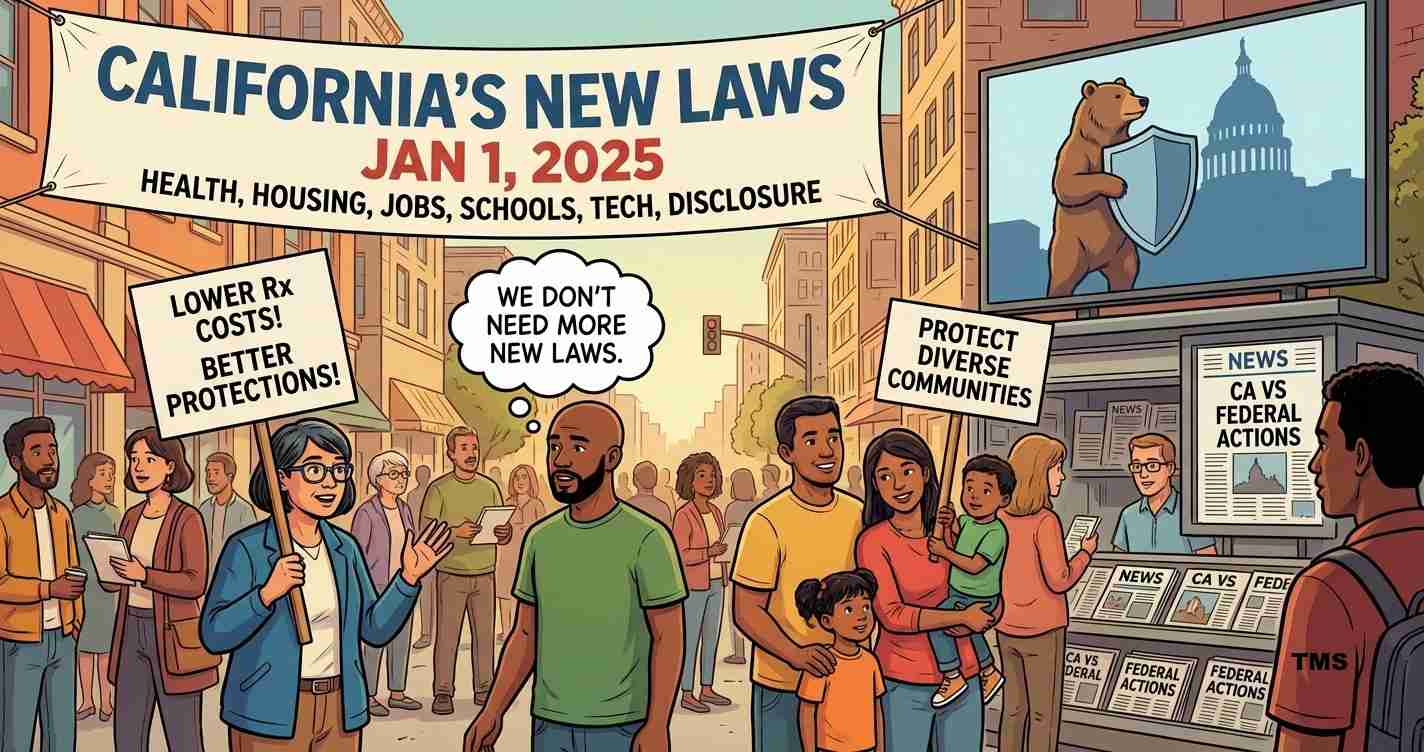
New California Laws 2026 Take Effect — What Residents and Businesses Must Know
California enacted a broad set of laws taking effect Jan. 1, 2026, revising employment, healthcare, housing, consumer and animal-welfare rules; residents, employers and landlords must update policies, understand new obligations and prepare for immediate compliance statewide.
- Broad package: Employment, health, housing, consumer protection and animal-welfare changes effective Jan. 1, 2026 — see the state announcement.
- Pay and work rules: Minimum wages and exempt salary thresholds rose; employers should review pay and classification — see the MTO summary.
- Worker protections and gig rules: New pay-equity enforcement, expanded leave and clearer gig-worker pay breakdowns — see KTVU.
- Health, housing and consumer updates: Insulin copay caps, rental appliance standards and plastic bag limits — see ABC7.
Employment and workplace rights
Key changes affect pay, benefits and classification. The state increased wage and salary thresholds: the minimum wage rose to $16.90 per hour (from $16.50), the annual salary minimum to qualify as exempt rose to $70,304, and the hourly threshold for exempt computer software employees is now $58.85 per hour (about $122,573.13 annually). (See the MTO summary.)
Contract and bonus rules: AB 692 bans “stay or pay” clauses that require employees to repay signing or relocation bonuses or other debts after separation, with limited exceptions. Employers should audit agreements and benefit plans to remove prohibited clauses. (See the MTO summary.)
Expanded protections and leave: Notable measures include AB 250 (temporarily lifting statute of limitations for adult survivors to bring civil claims tied to workplace sexual assault cover-ups through Dec. 21, 2027), AB 406 (broadening leave for crime victims attending court), SB 294 (employer posting and written information requirements about misclassification, heat-illness prevention, workers’ comp, paid sick days and immigration-related protections; notification to emergency contacts if an employee is arrested or detained at work), and SB 809 (requiring reimbursement for employee-owned trucks or commercial vehicles used for work). (See the state announcement and KTVU.)
Pay equity and reporting: SB 642 expands equal-pay enforcement by broadening definitions, extends the statute of limitations to three years (with recovery possible for up to six years), while SB 464 tightens private employer pay reporting, raises penalties and requires demographic pay data to be stored separately from personnel files. (See the state announcement and KTVU.)
Gig economy and tips: AB 578 bars delivery platforms from using tips to offset driver base pay and requires clear, itemized pay breakdowns for gig workers, strengthening transparency and pay protections. (See KTVU.)
Healthcare changes
Insulin copay cap: SB 40 requires larger state-related health plans to cap insulin copays at $35 for a 20-day supply, aiming to reduce out-of-pocket costs for people with diabetes. (See the state announcement.)
Midwifery and birth services: AB 55 eases licensing for alternative birth centers to help midwives operate more easily; AB 836 creates funding for statewide midwifery education through the Department of Health Care Access and Information; and SB 669 directs a 10-year pilot to place standby perinatal services in up to five critical-access hospitals by July 1, 2026. (See the state announcement.)
Pregnancy supports: SB 646 expands access to prenatal multivitamins to support healthy pregnancies and infant development. (See the state announcement.)
Housing and tenant protections
Appliance standards for rentals: AB 628 requires landlords to provide working refrigerators and other basic appliances in rental units — reinforcing habitability standards and tenant expectations. (See the state announcement and KTVU.)
Protections for delayed federal benefits: Tenants cannot be evicted solely because Social Security payments were delayed or terminated by the federal government through no fault of the tenant. (See ABC7.)
Transit-oriented housing changes: SB 79 requires cities and counties to adopt general plans supporting higher-density housing near frequent transit and allows residential buildings up to nine stories within half a mile of high-frequency transit lines in designated counties (Alameda, Los Angeles, Orange, Sacramento, San Francisco, San Mateo, San Diego and Santa Clara). This rule takes effect in July 2026. (See ABC7.)
Consumer and environmental protections
Plastic bag purchases: Beginning Jan. 1, consumers will be required to purchase recycled paper bags or bring reusable bags; options for single-use plastic bags are limited under the new rules. (See ABC7.)
Animal welfare and pet sales
Declawing ban: AB 867 bans non-therapeutic cat declawing statewide; only medically necessary procedures are allowed. (See the state announcement.)
Transparency in pet sales and import rules: AB 506 requires pet sellers to disclose a pet’s origin and health information; AB 519 bars third-party pet brokers from selling cats, puppies and rabbits bred by others for profit in California; and SB 312 requires dog importers to file health certificates electronically with the California Department of Food & Agriculture within 10 days of shipment. (See the state announcement.)
Immigration, education and privacy protections
School postings and privacy: AB 419 mandates that schools post information about students’ rights related to immigration enforcement and reinforces that all children have the right to a free public education. AB 495 strengthens protections to keep family and immigration-related information private in emergencies and at child facilities. (See the state announcement.)
Food assistance and social supports
Emergency food bank expansion: AB 798 expands the state emergency food bank program to allow distribution of diapers and wipes for families with young children. (See the state announcement.)
Traffic safety and criminal justice measures
Ignition interlock extension: The program requiring some people convicted of driving under the influence to install ignition interlock devices was extended through January 2033; those who install devices may apply for restricted driver’s licenses. (See the California courts newsroom.)
Mental health care access
CARE Act expansion: SB 27 expands the CARE Act to include people with bipolar I disorder with psychotic features, widening access to community-based mental health services and supports. (See the California courts newsroom.)
What this means — and where to look
“The measures reflect state focus on public safety, affordability, transparency and accountability,” as summarized by Gov. Gavin Newsom in the state’s overview of new measures.
Practical implications: Employers, landlords, health plans, transit agencies and service providers must update policies and practices quickly. Workers should check pay stubs and contracts for compliance with updated pay thresholds and tip rules. Renters should note clearer habitability standards and protections tied to federal benefit issues. Health plan members should review coverage details for insulin caps and perinatal services. Employers and landlords are advised to consult legal counsel to align policies with the new rules. (See the state announcement and related local coverage.)
Implications for the United States of America
Economic impact: Raising minimum wage and exempt thresholds in California often sets a national reference point. Multi-state businesses may face higher labor costs or adjust hiring and pay structures; tech, logistics and gig sectors may experience higher overhead from salary tests and tip protections. (Sources: MTO summary, KTVU.)
Political consequences: The mix of worker protections and housing mandates will re-ignite debates over state regulation vs. local control. Transit-oriented building requirements and tenant protections may be models for other states or prompt legal and policy pushback. (See ABC7 and the state announcement.)
Social effects: Expanded health protections such as capped insulin copays and broader perinatal supports aim to reduce out-of-pocket costs and improve access. Stricter pay reporting, leave rules and rental appliance requirements may alter housing markets and landlord behavior. (See the state announcement and KTVU.)
Cultural and legal relevance: Laws on animal welfare, immigration privacy at schools, and transparency in pet sales reflect public values prioritizing welfare and consumer knowledge. These measures may inspire similar actions in other states or provoke debate about regulatory scope. (See the state announcement.)
Reporting and resources
For the full list and official summaries, see the state announcement of laws taking effect in 2026. For breakdowns of employment changes, see the MTO overview. Local news summaries and context are available at KTVU, ABC7, and the California courts newsroom.
Note: Employers, landlords, health plans, transit agencies and service providers should consult counsel and the cited resources to confirm compliance steps and timelines.