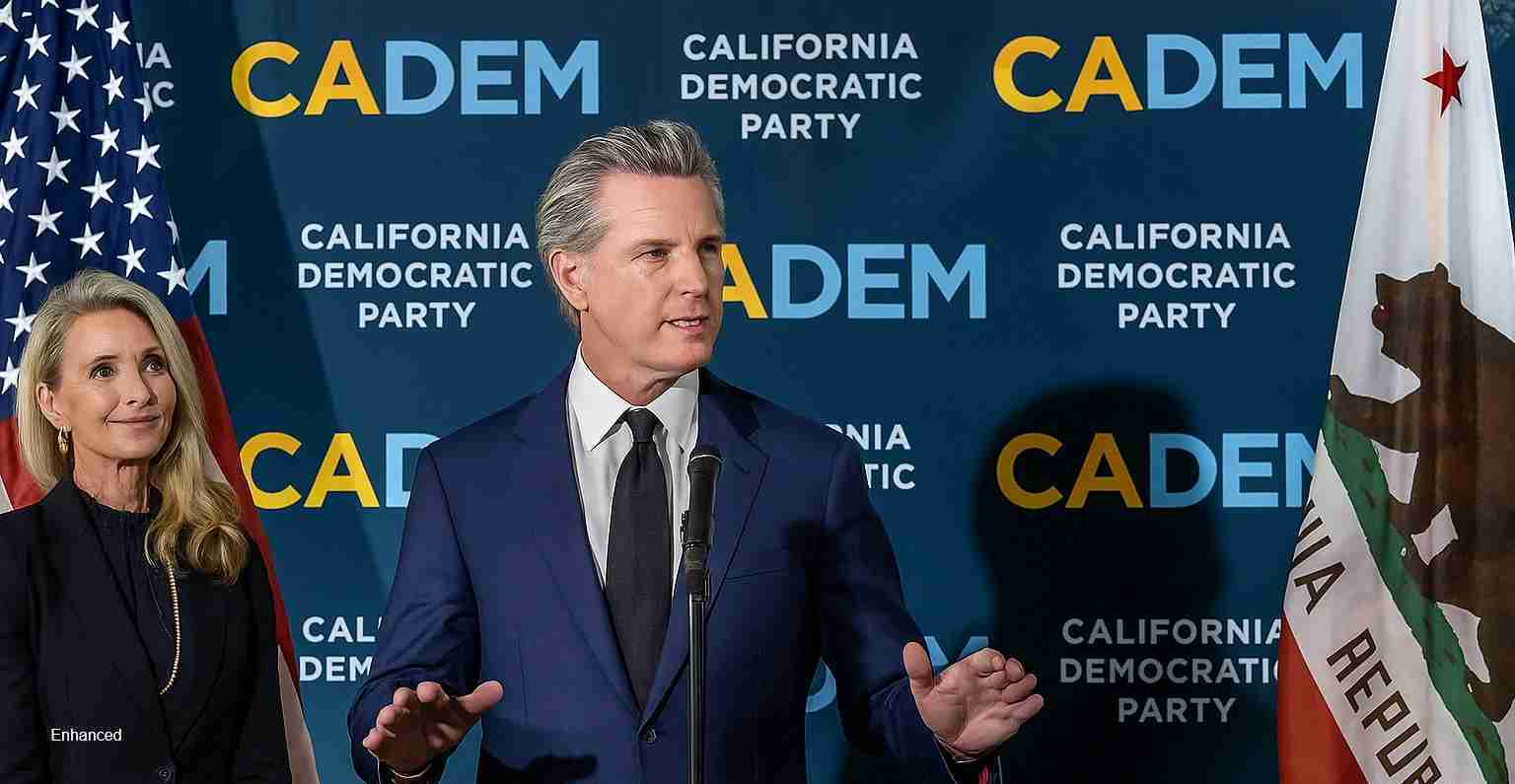
Newsom: Prop. 50 a Win for Democracy; Blasts Trump Over Voter Intimidation
On Nov. 4, 2025, Gov. Gavin Newsom hailed Proposition 50’s passage in Sacramento as a defense of democratic principles, criticized President Donald Trump for alleged voter intimidation, and urged other states to adopt similar measures to protect free elections.
Key takeaways
- Proposition 50 passed: It moves congressional redistricting control from the independent commission to the state Legislature.
- Newsom frames it as a defense: He says the change strengthens democratic defenses and could yield up to five Democratic House pickups in 2026.
- Sharp criticism of Trump: Newsom accused the president of voter intimidation and anti-democratic tactics.
- Calls for national action: Newsom urged leaders in other states to “meet the moment” and confront what he described as undemocratic strategies.
What Newsom said
Gov. Newsom opened by framing the Proposition 50 result as a broad public victory. “It was a good evening for everybody, not just the Democratic Party, but what a night for the Democratic Party—a party that is in its ascendancy…no longer on its heels from coast to coast, sea to shining sea,” he said on stage, thanking voters and characterizing the outcome as a defense of American founding principles. See the video of his remarks (YouTube).
“There are no crowns, no thrones, no kings” — Newsom used this line to underscore his argument against unchecked power.
He also said the country is “sicker and poorer” than promised and labeled the president as “the most historically unpopular president in modern history,” arguing that, across key measures, the president is “underwater.” For context, watch the YouTube video of the speech.
Proposition 50 and California redistricting
What Prop. 50 does: It replaces the Citizens Redistricting Commission with congressional maps drawn by the Democratically controlled state Legislature. Supporters, including Gov. Newsom, defended the change as a tool to protect the state from aggressive Republican redistricting nationally; opponents say it hands too much power to one party and risks partisan gerrymandering.
Newsom argued legislative control could help Democrats pick up as many as five congressional seats in the 2026 midterms, a shift he said could reshape national politics and affect House leadership. (See the video of Newsom’s remarks.)
Newsom criticizes Trump — a nationwide call to action
Beyond map mechanics, Newsom cast the Prop. 50 vote as a national rebuke of what he labeled anti-democratic forces and directly accused President Trump and his allies of actions amounting to voter intimidation. He urged Californians and leaders in states such as Virginia, Maryland, New York, Illinois, and Colorado to follow California’s lead and “meet the moment” to protect democratic institutions. Watch related footage in the additional YouTube clip.
Reactions and political stakes
Supporters present Prop. 50 as a safeguard of democratic norms and a model for other states. Critics call it a partisan power grab that could undermine public trust in fair mapmaking. Newsom’s projection about flipping seats is a political estimate based on how maps might be drawn under legislative control.
He suggested those gains could have immediate consequences for federal governance, including committee leadership and oversight, saying such shifts could even “de facto end Donald Trump’s presidency as we know it” if House control changes after the 2026 midterms. View the governor’s statements in the YouTube video of the remarks.
Implications for the United States
Economic impact: Immediate local economic effects are likely modest, but Newsom warned of potential political instability that could affect markets if control of the House shifts and policy directions change.
Political consequences: If state legislatures nationwide reclaim mapmaking, partisan map drawing could accelerate, raising the stakes of state elections and increasing pressure on turnout and statehouse control.
Social effects & cultural relevance: Perceptions of fairness in elections can erode when mapmaking appears partisan. Newsom used civic language — quoting Walt Whitman and urging citizens to “contribute a verse” — to appeal to civic pride and national identity.
Practical applications: Voters in competitive districts could see their influence diluted under new maps, making who draws maps a higher priority for activists and voters ahead of 2026.
Source notes and documentation
This report draws on publicly posted video recordings of Gov. Newsom’s Nov. 4, 2025 remarks. See the video of Newsom’s remarks (YouTube), an additional YouTube clip, and a third YouTube clip. The governor’s statements about voter intimidation, his critique of President Trump, the Whitman reference, and his projections about potential House gains are quoted from these videos.
Fair-balanced context
Gov. Newsom framed Prop. 50 as both a defensive move and a national example. Supporters argue the change is needed to guard democratic institutions from aggressive partisan tactics; opponents say it replaces an independent system with one susceptible to political maneuvering, raising concerns about fairness and accountability.
Newsom’s public criticism of President Trump — calling him “historically unpopular” and accusing him of undermining democracy — is part of a broader national debate. His remarks aim to mobilize allied states and voters while sharpening the partisan framing of redistricting, a technical process with major consequences for representation.